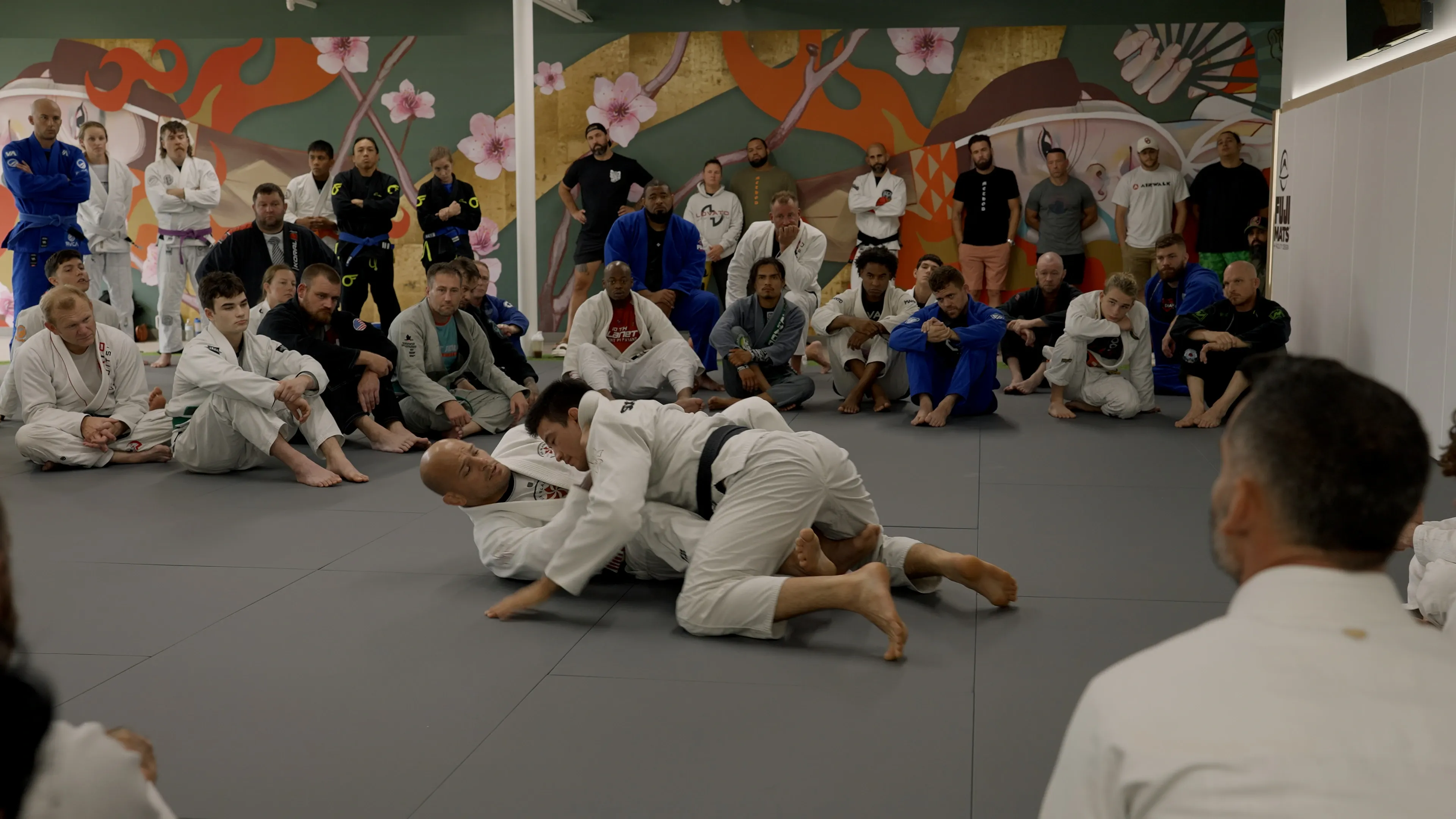
BJJ uses a mix of Portuguese, Japanese, and English terminology. Key terms include "oss" (a greeting and acknowledgement), "roll" (live sparring), "tap" (the surrender signal that stops a submission), "guard" (a bottom fighting position using your legs to control an opponent), and "mount" (the most dominant top position). This glossary covers 50+ essential terms organized by category.
Walking into your first BJJ class can feel like entering a foreign country. Instructors call out position names in Portuguese, partners talk about "rolling," and someone tells you to "shrimp." Within a few weeks the vocabulary clicks — but this glossary gives you a head start. Bookmark this page and refer back to it as you progress through the ranks.
GENERAL TERMS
These are the foundational words you will hear in every class, from warm-up to the final round of sparring. Learn these first.
GENERAL TERMS
13 termsPOSITIONS
BJJ is fundamentally a positional game. Before submissions, there is positioning — controlling where your body is relative to your opponent. These are the primary positions you will learn and encounter in training.
POSITIONS
15 termsSUBMISSIONS
Submissions are techniques that force a tap by applying controlled pain or threatening unconsciousness. They fall into two categories: joint locks (attacking a joint past its range of motion) and chokes (restricting blood flow or air to the brain or lungs).
SUBMISSIONS
14 termsMOVEMENTS
BJJ has its own movement vocabulary — specialized techniques for escaping, transitioning, and creating offense from unusual positions. These are the building blocks of the "flow" you see in experienced grapplers.
MOVEMENTS
9 termsCOMPETITION TERMS
If you plan to compete — or just want to understand how tournaments work — these terms cover the rules, point system, and major organizations you will encounter.
COMPETITION TERMS
10 termsBELT & RANK TERMS
The BJJ belt system is one of the most respected in martial arts — promotions are earned over years of training and cannot be purchased. Understanding the rank vocabulary helps you follow conversations about lineage and progression.
BELT & RANK TERMS
6 termsDON'T MEMORIZE — JUST TRAIN
You do not need to memorize any of these terms before your first class. At Method Jiu-Jitsu in Tulsa, our instructors explain every technique and position in plain English before using the formal terminology. Within a few weeks on the mat, this vocabulary becomes second nature — you will hear the same words repeated in context until they simply click.
The best way to learn BJJ's language is the same as learning any language: immersion. Show up, listen, and train. The glossary will follow.
Try a Free ClassFREQUENTLY ASKED QUESTIONS
No. While BJJ has roots in Japanese Judo and developed in Brazil, most modern gyms in the United States use a mix of English and Portuguese terms interchangeably. You will pick up the vocabulary naturally within your first few months of training — no pre-study required.
Oss (also spelled "osu") is a general-purpose acknowledgement used in BJJ and other martial arts. It can mean "yes," "I understand," "thank you," "good job," or serve as a greeting depending on context. Its exact origin is debated — it likely comes from Japanese martial arts — but it is used widely across all BJJ schools.
Rolling is the BJJ term for live sparring — practicing techniques against a resisting partner in a controlled environment. Unlike a street fight or competition, rolling has safety rules: submissions must be applied with control and your partner can tap to signal they are in danger. Rolling is the core of BJJ training and is how you develop timing, sensitivity, and the ability to apply techniques under pressure.
A sweep is performed by the bottom player (the person in guard) to reverse position and come on top. A pass is performed by the top player to get around or through the guard player's legs to reach a dominant top position like side control or mount. They are opposite actions: sweeping comes from below, passing goes above.
Tapping — physically tapping your hand on your partner's body or the mat — is the universal signal that you are caught in a submission and want the technique stopped. It is the equivalent of saying "I give up" in a safe, controlled way. Tapping is not a sign of weakness; it is what allows practitioners to train submissions at full intensity without injury. You can also tap verbally by saying "tap" out loud.