Half guard is a position where you're on your back with one of your opponent's legs trapped between yours. Once considered a defensive last resort, modern BJJ has turned half guard into a powerful offensive position with complete sweep and back-take systems that work at every level of competition.
HALF GUARD BASICS
In half guard, you are on your back with one of your opponent's legs trapped between both of yours. This is different from closed guard, which traps the torso — in half guard you trap a single leg, creating a fundamentally different control dynamic.
The trapped leg is your anchor point. From here, you fight for position in the upper body — specifically for an underhook. The person on top wants to flatten you out (pin your back to the mat) and achieve a crossface (their arm across your jaw, pushing your head away). The person on the bottom wants to get to their side, achieve an underhook, and create space to work.
This battle — underhook vs. crossface — is the defining conflict of half guard. Whoever wins this upper body fight typically wins the position.
KNEE SHIELD AND Z-GUARD
The knee shield (also called Z-guard) is the most fundamental defensive structure from half guard. You insert your bottom knee between yourself and your opponent as a frame that prevents them from flattening you out and achieving the crossface.
The knee shield creates space in which you can fight for the underhook. Without it, heavier opponents can simply use weight and pressure to make half guard miserable. With a proper knee shield, even a much larger opponent cannot fully settle their weight on your chest.
Z-guard refers specifically to the shape formed by your legs — one leg trapped, one knee up as a frame — which looks like a Z from the side. It is the starting point for many modern half guard attacks.
DEEP HALF GUARD
Deep half guard is a more committed version where you dive completely under your opponent, positioning your head near their knee rather than their hip. Your entire upper body scoops under them, and you control their lead leg tightly with both arms.
Deep half was popularized at the highest levels of competition by Bernardo Faria (five-time world champion) and has become one of the most studied positions in modern BJJ. From deep half, back takes and sweeps become extremely powerful because you are controlling the opponent's base from directly underneath them.
THE UNDERHOOK BATTLE
The underhook is the single most important concept in half guard. When you slide your inside arm under your opponent's arm so your shoulder is past theirs, you have the underhook. This position allows you to:
- Come up to your knees and take their back
- Execute the Old School sweep (elevating their far leg)
- Enter into deep half guard
- Stand up and break their posture
When you do not have the underhook and your opponent has the crossface, you are in a purely defensive half guard. The goal is always to recover the underhook or transition to a different guard position.
SWEEPS FROM HALF GUARD
Old School Sweep
With the underhook secured, scoop the far leg and elevate while driving forward. One of the highest-percentage sweeps in BJJ — it reverses position cleanly when executed with proper timing and connection.
Dogfight (Up-Kick) Sweep
From the underhook, come up to your knee (the "dogfight" position), then hook behind their near leg and sit out to take them down. The dogfight is a scramble-heavy position with many options for both players.
Back Take from Half Guard
When you have the underhook and your opponent defends the sweep by posting, use the momentum to slide behind them and insert your hooks. The back take from half guard is one of the most reliable back-taking sequences at every belt level.
PASSING HALF GUARD
From the top, passing half guard requires managing the underhook and flattening the bottom player. The two fundamental passing families are:
- Over-under pass — one arm over the hips, one arm under, driving through while blocking with the hip to free the trapped leg
- Knee slice — driving the knee across the body to create a diagonal angle and freeing the trapped leg toward side control
Both require winning the crossface first. Without controlling the head, the bottom player will always re-establish their underhook or transition to a different guard.
THE EVOLUTION OF HALF GUARD IN MODERN BJJ
In the early days of BJJ competition, ending up in half guard on the bottom was considered nearly equivalent to being passed. The evolution began when practitioners like Roberto "Gordo" Correa started systematically developing attacks from the position. Today, at every level from local tournaments to the World Championship, half guard is played intentionally — not as a defensive fallback but as a planned strategic choice.
Half guard is particularly valuable for practitioners dealing with larger, stronger opponents. The position allows a smaller person to control and attack someone much heavier by working from underneath and using technique rather than strength or athleticism.
HALF GUARD AS A WEAPON
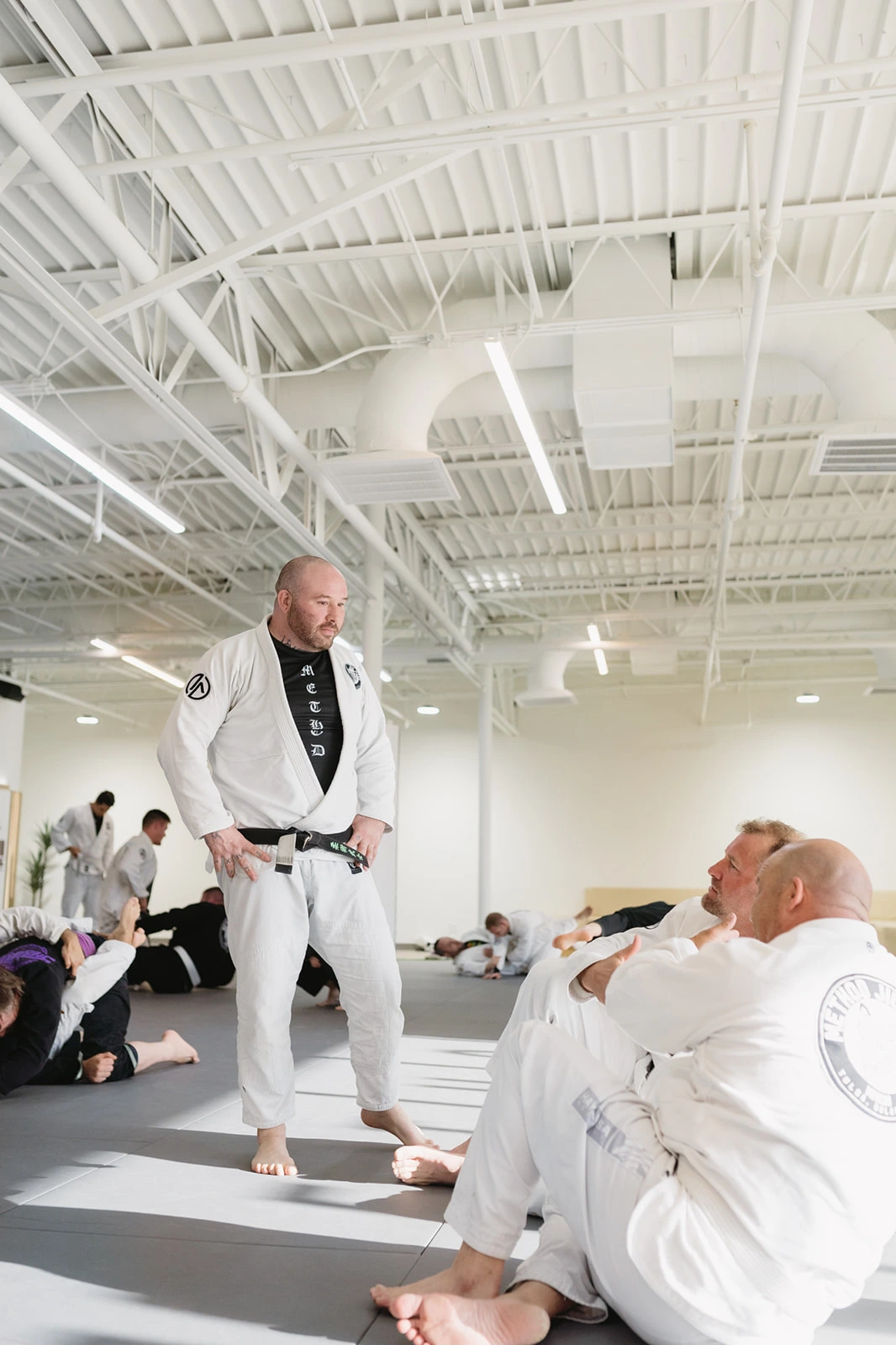
At Method Jiu-Jitsu, we teach half guard as an offensive position rather than a defensive fallback. Students learn the knee shield structure first, then the underhook battle, then their first sweeps — all before learning to pass it from the top. This gives students a complete understanding of the position from both sides. Half guard is particularly valuable for our students dealing with larger training partners, because proper technique and positioning neutralize the size advantage effectively.
Try a Free ClassFREQUENTLY ASKED QUESTIONS
Half guard is a ground position where you are on your back with one of your opponent's legs trapped between both of yours. Unlike closed guard which controls the torso, half guard controls a single leg, creating a different set of attacks and defensive concepts centered around the underhook battle.
Modern BJJ treats half guard as primarily offensive. While it began as a defensive position to prevent guard passes, practitioners like Bernardo Faria and Tom DeBlass developed complete offensive systems from half guard with sweeps, back takes, and submission entries that work at the highest competition levels.
The underhook is achieved when you slide your inside arm under your opponent's arm from half guard so your shoulder passes theirs. The underhook is the key to offensive half guard — it allows you to come up to your knees, take the back, or execute powerful sweeps. Losing the underhook and being crossfaced is what makes half guard purely defensive.
In regular half guard your opponent's leg is trapped between your knees while your head is roughly at their hip level. In deep half guard you scoop completely under their body so your head is near their knee and your entire upper body controls their lead leg. Deep half opens a highly effective set of sweeps and back takes by controlling from directly underneath your opponent.