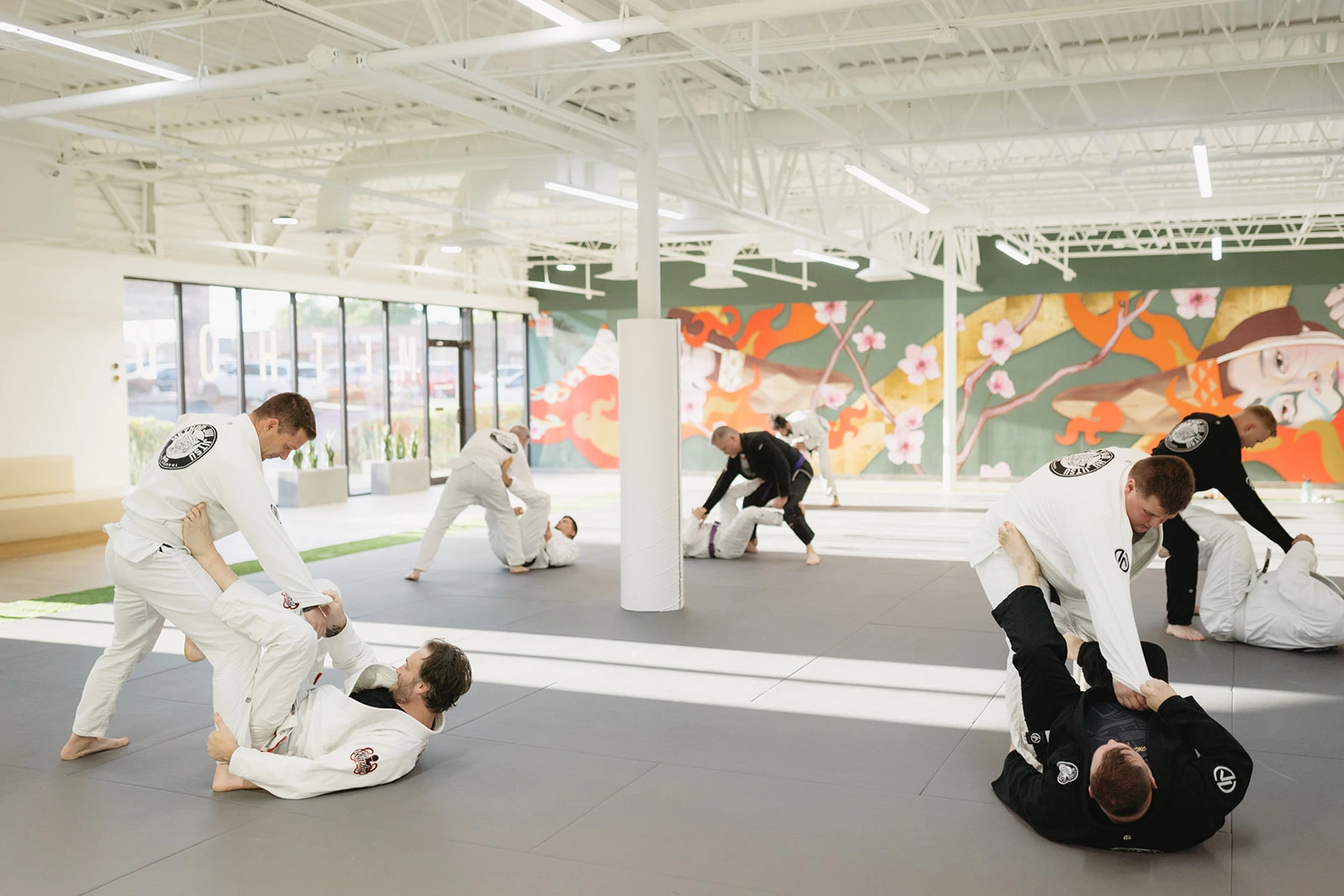
Guard is a ground position in BJJ where you are on your back but controlling your opponent with your legs. Despite being on the bottom, the guard is an offensive position — you can sweep, submit, or stand up. This concept is what separates BJJ from nearly every other martial art.
WHY GUARD IS UNIQUE TO BJJ
In most combat sports and traditional martial arts, being on your back is considered a losing position. You are told to get up as quickly as possible. Brazilian Jiu-Jitsu turns this idea completely on its head. Guard is not just a place to survive — it is a platform to attack, control, and finish fights.
This insight comes from BJJ's roots in Judo and the innovations of the Gracie family, who recognized that a smaller, weaker person could control and submit a larger opponent by using their legs — the strongest muscles in the body — to manage distance and apply leverage.
When you are in guard, your legs are actively working: pulling your opponent close, creating frames to push them away, breaking their posture, and setting up submissions or sweeps that reverse the position entirely.
THE MAIN TYPES OF GUARD
Guard has evolved significantly over the decades. What started as a single concept has branched into dozens of specialized variations. Here are the foundational types every BJJ practitioner should understand:
Closed Guard
The starting point for every beginner. Your ankles are locked behind your opponent's lower back, securing them in your hips. From here you control posture and attack with armbars, triangles, kimuras, and sweeps. See our full guide: What Is Closed Guard?
Half Guard
You trap one of your opponent's legs between your own. Once seen as a desperate defensive measure, half guard is now one of the most dangerous offensive positions in modern BJJ, with a full system of sweeps and submission entries. More detail: What Is Half Guard?
Open Guard
When your ankles are not locked, your guard is "open." This is a broad category that includes many sub-styles where you use your feet, knees, and grips to manage distance and off-balance your opponent.
Butterfly Guard
You sit up with your feet hooked inside your opponent's thighs. Butterfly guard is known for its powerful sweeping game and transitions to other positions. It works exceptionally well in both Gi and NoGi.
Spider Guard (Gi Only)
Using the sleeves of your opponent's Gi, you post your feet on their biceps and control their arms at a distance. Spider guard creates tremendous leverage for sweeps and triangle setups.
De La Riva Guard
A hooking outside-leg guard where you wrap one leg around the back of your opponent's lead leg. De La Riva is foundational to modern open guard and connects to many advanced systems including berimbolo and back takes.
BASIC GUARD ATTACKS
Guard is most dangerous when your opponent is close and their posture is broken. The core attacks include:
- Armbar — isolating and hyperextending the elbow joint
- Triangle choke — a figure-four leg choke attacking the neck and one arm
- Kimura — a shoulder lock targeting the rotator cuff
- Guillotine choke — a front headlock choke that works Gi and NoGi
- Hip bump sweep — sitting up into your opponent to reverse position
- Scissor sweep — using your legs like scissors to take your opponent to the mat
HOW TO DEVELOP YOUR GUARD GAME
Guard development is a long-term investment. No single technique works against all opponents. The goal is to build a system — a set of connected moves where each attack creates a reaction that opens another attack.
Beginners should focus on closed guard first. It is the safest environment to practice attacks because your opponent cannot simply walk away. Once you can reliably break posture, control grips, and threaten with at least two submissions, you can begin exploring open guard variations.
The most important training tool for guard is live rolling. Drilling builds muscle memory, but rolling teaches you timing, sensitivity, and how to chain movements together under resistance. Expect to get your guard passed frequently when you are learning. This is not failure — it is information.
GUARD FROM DAY ONE
At Method Jiu-Jitsu in Tulsa, guard is introduced in the very first weeks of our fundamentals curriculum. New students learn closed guard posture control and two foundational sweeps before moving on. We believe that building confidence from the bottom early gives students a complete game — not just a top game — and makes them significantly harder to submit in sparring.
Our instructors hold black belt credentials and have competed at the highest levels, bringing a nuanced, modern understanding of guard that reflects how the position is actually used in competition and self-defense today.
Try a Free ClassFREQUENTLY ASKED QUESTIONS
Guard is a ground position in BJJ where you are on your back but controlling your opponent with your legs. It is unique because it allows the bottom player to remain offensive with sweeps and submissions — one of the defining concepts that sets BJJ apart from other martial arts.
The main types of guard are closed guard, open guard, half guard, butterfly guard, spider guard (Gi only), and De La Riva guard. Each serves different purposes depending on your body type, opponent, and game plan. Beginners start with closed guard, which is the most controlled environment to practice attacks.
Neither is inherently better — both are essential skills. A complete BJJ player learns to both play guard effectively and pass the opponent's guard. In competition, guard play scores the same points as top position, and many elite grapplers prefer to pull guard and attack from the bottom.
Most practitioners develop a reliable closed guard within the first year of consistent training. Building a complete guard game — including open guard, sweeps, and seamless submission chains — is a multi-year process. Consistent drilling and live sparring are the two most important factors. At Method, we structure our curriculum to give you real guard tools within the first few months.