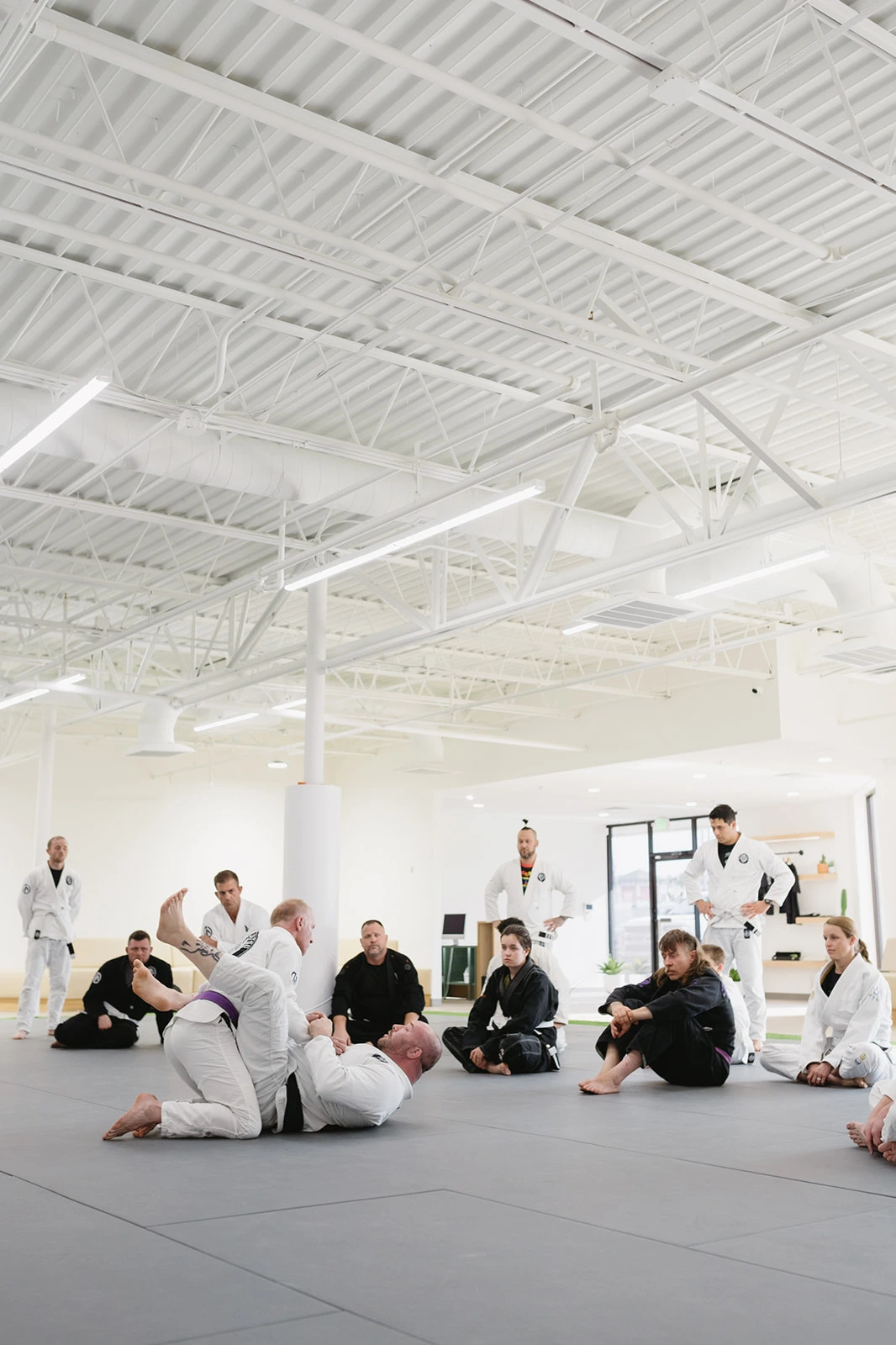
Mount is a dominant ground position in BJJ where you sit on top of your opponent's torso with your knees on the mat. It is one of the most powerful positions in the sport, giving the top player excellent control and access to submissions targeting the neck and both arms.
WHAT MAKES MOUNT DOMINANT
In Brazilian Jiu-Jitsu, position before submission is the guiding principle — and mount is near the top of the positional hierarchy. When you achieve mount, your opponent is flat on their back beneath you, limited in their ability to generate force, and exposed to a wide range of finishing techniques. You control the pace, the pressure, and the attack.
From the bottom player's perspective, being mounted is one of the most uncomfortable and dangerous positions on the ground. Your hips are pinned, your arms are vulnerable, and your neck is exposed. Even experienced practitioners struggle to escape mount against a skilled opponent who knows how to maintain it. This is precisely what makes mount such a central goal in any BJJ game plan.
Mount is worth 4 points in IBJJF competition — tied with back control as the highest-value position in the sport. These points reflect what practitioners and rule makers have long understood: control from mount is exceptional, and the submission options it creates are among the highest-percentage finishes in grappling.
MOUNT VARIATIONS
Full Mount
The foundational version. You sit squarely on your opponent's torso with both knees on the mat beside their body. Your weight is centered, and you typically grip their collar or shoulders to maintain control. From full mount you have access to cross collar chokes, arm attacks, and the setup for more advanced variations.
The primary challenge of full mount for beginners is keeping the position. Opponents will immediately begin to buck, bridge, and shrimp in an attempt to escape. Learning to follow their movement with your hips — rather than stiffening up and getting bucked off — is the foundational skill of mount maintenance.
High Mount
As you advance in mount, you will move your knees up toward your opponent's armpits. This high mount position improves your control dramatically. Your weight shifts forward onto their upper chest, making the upa (bridge escape) much harder to execute. From high mount, the cross collar choke, armbar, and ezekiel choke all become significantly more accessible.
Transitioning from full to high mount is itself a skill — walking your knees up without creating space that allows your opponent to recover a guard position requires patience and precise weight distribution.
S-Mount
An advanced configuration where one knee is posted behind your opponent's head and the other shin crosses their torso, creating a figure-four-like frame. S-mount is one of the most direct armbar setups in all of BJJ. From this position the armbar requires minimal movement to execute — the geometry of the position does most of the work for you.
S-mount requires good balance and precise positioning, making it a position to develop after establishing a reliable full and high mount game.
ATTACKS FROM MOUNT
Mount is often described as a "finishing position" — you reach it not just to hold but to submit. The attack options are extensive:
Armbar
The mount armbar is one of the most common match-ending submissions in competitive BJJ. From high mount or S-mount, you trap one of your opponent's arms, swing one leg over their face, and extend their elbow against your hips. The lever created by your hips against their elbow joint is one of the most powerful in grappling. The transition requires both timing and technique — rushing causes you to lose the position; going too slowly gives your opponent time to counter.
Cross Collar Choke (Gi)
Using the lapels of your opponent's gi jacket, you feed one hand deep into their collar, then the other hand into the opposite collar, and squeeze. The cross collar choke from mount is tight, difficult to defend, and requires almost no movement to apply once the grips are established. Achieving these grips is the challenge — experienced opponents will fight to protect their collar.
Americana (Keylock)
When your opponent extends one arm in an attempt to push you away or frame against your weight, you have an opportunity for the americana — a shoulder lock that isolates the wrist and elbow in a figure-four grip and externally rotates the shoulder. The americana is particularly effective from full mount and is one of the first submissions taught to beginners because the mechanical principle is straightforward and it requires minimal athleticism to apply correctly.
Ezekiel Choke
A choke applied using the sleeve of your own gi as a weapon. Sliding one sleeve under your opponent's neck and gripping your own forearm creates a collar-like loop that, when squeezed, compresses the carotid arteries. The ezekiel is a surprise weapon from mount because many opponents do not immediately recognize the threat, giving you time to establish the grip before they react.
ESCAPING MOUNT
Understanding how to escape mount is equally important to knowing how to maintain it. Every practitioner at Method Jiu-Jitsu learns both sides of every position — the attacks and the defenses — from the beginning of their training.
Upa (Bridge and Roll)
The upa is the fundamental mount escape taught to every beginner. You trap one of your opponent's arms (typically by grabbing their wrist and posting your elbow) and simultaneously trap the foot on the same side. Then you execute a strong hip bridge, driving your hips into the air and rolling your opponent over the trapped arm. The key is coordinating the arm trap, foot trap, and bridge simultaneously — any single component alone will not succeed against a resisting opponent.
Experienced practitioners sitting in mount will anticipate the upa and defend by posting their foot or arm. This is why the upa is most effective when combined with misdirection — threatening a second attack before executing the bridge, or baiting your opponent to shift their weight in the wrong direction.
Elbow-Knee Escape (Shrimping)
Also called the elbow-escape or the shrimp, this technique involves creating space by shrimping your hips to one side, inserting your inside knee as a frame against your opponent's hip, and recovering to half guard or full guard. The elbow-knee escape requires good hip mobility and timing. It works best when your opponent is not applying heavy chest pressure — for example, when they sit up to prepare an attack.
Most practitioners use a combination of both escapes: threatening the upa to make their opponent post defensively, then using the space created to execute the elbow-knee escape. Developing both techniques and understanding how they connect is the foundation of bottom-game survival.
COMMON MISTAKES IN MOUNT
New students in mount often make several predictable errors:
- Sitting too high or too low — sitting too high gives your opponent space to insert knees; sitting too low reduces your submission access
- Not controlling the hips — allowing your opponent to bridge without responding causes loss of position
- Attacking too early — rushing for submissions before stabilizing the position gives your opponent escape opportunities
- Flat feet — keeping your feet flat on the mat makes you vulnerable to foot traps for the upa; hook your feet under your opponent's legs or cross your ankles
- Not transitioning — staying static in one variation of mount gives your opponent time to organize their defense
MOUNT FROM WEEK ONE
At Method Jiu-Jitsu in Tulsa, mount fundamentals are introduced in the early weeks of our curriculum. Students learn full mount maintenance, the upa escape, and the armbar setup before moving on — ensuring they understand both sides of the position from the very beginning. We believe that training the escape alongside the attack builds more complete, more resilient practitioners than simply drilling offense in isolation.
Our instructors bring black belt credentials and competitive experience to every class, teaching mount as a connected system rather than a collection of isolated techniques. Come experience the difference a structured curriculum makes.
Try a Free ClassFREQUENTLY ASKED QUESTIONS
Mount is a dominant ground position in BJJ where you sit on top of your opponent's torso with your knees on the mat beside their body. It is one of the highest-scoring and most submission-rich positions in the sport, giving the top player excellent control and access to the neck and both arms.
Mount is worth 4 points in IBJJF competition — tied with back control as the highest-value position in the sport. Points are awarded once the position is held for three seconds. The high point value reflects how difficult mount is to escape and how dangerous the submission opportunities from mount are.
Full mount has your knees beside your opponent's hips with your weight centered on their torso — the standard starting position. High mount moves your knees toward their armpits, improving arm control and making the bridge escape harder. S-mount is an advanced configuration with one knee behind the head and one shin crossing the torso, creating a direct armbar position with minimal setup required.
The two fundamental mount escapes are the upa (bridge and roll) and the elbow-knee escape (shrimping). The upa involves trapping an arm and a leg on the same side, then bridging explosively to roll your opponent. The elbow-knee escape involves shrimping your hips to create space, inserting a knee as a frame, and recovering to half or full guard. Advanced practitioners use both in combination, threatening one to open the other.