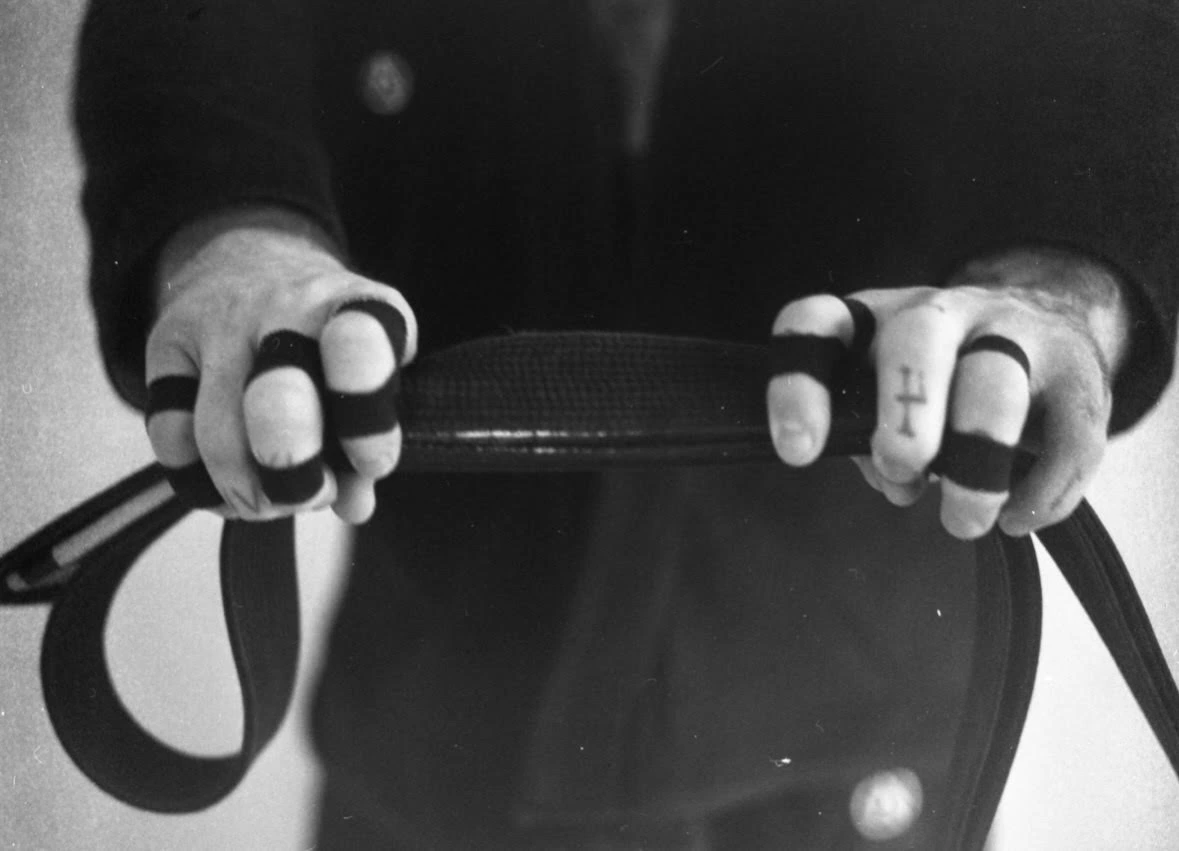
BJJ has five adult belts — white, blue, purple, brown, and black — plus coral and red belts for grandmasters. Progression is based on skill, knowledge, and time on the mat, not memorized forms or testing fees. The average black belt takes about ten years of consistent training to earn.
WHY THE BJJ BELT SYSTEM IS DIFFERENT
Most martial arts award belts through formal testing — a set curriculum you memorize and perform in front of a panel. BJJ works differently. Promotions are granted by your instructor based on observed performance during live training, drilling, and sparring over time. There is no single test day. Your entire mat career is the test.
This approach makes BJJ belts genuinely difficult to earn and deeply meaningful when received. You cannot study for a belt like a school exam. A blue belt in BJJ is earned by surviving — and then beginning to thrive — against trained, resisting opponents for months and years. That is a standard that has no shortcut.
The International Brazilian Jiu-Jitsu Federation (IBJJF) sets minimum time requirements at each rank, but most reputable academies hold standards that exceed those minimums. Belt promotions in BJJ are a reflection of who you are on the mat — your technique, your composure, your consistency, and your character.
THE FIVE ADULT BELTS
The adult belt system applies to practitioners aged 16 and older. Here is a look at each rank, what it represents, and approximate timelines:
BEYOND BLACK BELT — CORAL AND RED BELTS
After black belt, there are additional distinctions for long-term practitioners. Seventh and eighth degree black belts wear a red-and-black "coral" belt. Ninth degree practitioners wear a red-and-white coral belt. Tenth degree — reserved for the original founders of Brazilian Jiu-Jitsu — is a solid red belt. These ranks are extremely rare and typically reflect a lifetime of dedication to the art.
WHAT ARE STRIPES?
Within each belt, instructors award stripes — small pieces of white tape applied to the belt's tail. There are typically four stripes per belt. Stripes mark incremental progress between major promotions and acknowledge that your instructor sees growth in your technique, attitude, and mat time.
Stripes are not universally standardized. Some academies award them regularly; others are more sparing. What they represent is consistent across the sport: your instructor has noticed you improving. Some practitioners receive stripes at every belt level; others receive their next belt without every stripe being formally marked. The belt itself is what matters.
THE KIDS BELT SYSTEM
Children and teens (typically under 16) train under a separate belt system designed to acknowledge progress at a pace appropriate for younger practitioners. The kids system uses a wider palette of colors to provide more frequent milestones, which supports motivation during the years when children most need positive reinforcement.
The IBJJF kids belt system progresses through: white, grey, yellow, orange, and green belts — each with three variations (solid, white-half, and solid-color). This creates 15 distinct rank levels before a child reaches the adult system. When a junior practitioner turns 16, they typically re-enter as a white belt on the adult system, though instructors may award blue belt directly based on demonstrated skill.
WHAT PROMOTIONS LOOK LIKE
Belt promotions in BJJ carry real emotional weight. The most common format is a ceremony at the end of a regular class. The instructor calls out the promoted student, presents the new belt, and the class acknowledges the achievement. Many academies do the "belt whipping" tradition — each student in attendance taps the new belt-holder across the back with their own belt. It hurts a little and you will never forget it.
Major promotions, especially blue belt and black belt, are often the culmination of years of dedication and sacrifice. Black belt ceremonies can feel like receiving an advanced degree — because in a very real sense, that is what they are. Some academies hold annual promotion ceremonies; others promote as students are ready, regardless of the calendar.
MERIT-BASED. NO TESTING FEES.
At Method Jiu-Jitsu in Tulsa, promotions are based entirely on mat time, technical development, and character. We do not charge testing fees. We do not run formal testing days. Your performance in class every week is what earns your next belt.
We take the belt system seriously because our students take it seriously. When you receive a belt at Method, every person in the room knows you earned it the right way — through years of consistent effort and genuine skill. That is the only standard we recognize.
Start Your JourneyFREQUENTLY ASKED QUESTIONS
Most practitioners reach blue belt within 1 to 2 years of consistent training — typically 2 to 4 sessions per week. The IBJJF does not set a minimum time requirement for white to blue, but instructors generally look for reliable positional control, functional escapes, and a basic submission game before awarding blue belt.
The average BJJ black belt takes around 10 years of consistent training. The IBJJF requires a minimum of 31 years of age and at least 1 year as a brown belt. Many practitioners receive their black belt between 8 and 15 years depending on training frequency and intensity. It is genuinely one of the most difficult belts to earn in any martial art.
Yes. The kids belt system is separate from the adult system and includes white, grey, yellow, orange, and green belts with multiple sub-ranks within each color. Kids transition to the adult system at age 16, typically starting at white belt regardless of their prior rank, though instructors may award blue belt directly based on demonstrated skill.
Stripes are incremental promotions within each belt rank, marked by small pieces of white tape on the belt's tail. There are four stripes per belt. Stripes acknowledge consistent progress and are awarded by the instructor based on mat time, technical improvement, and behavior on and off the mat. They are not universally standardized across academies.
Skipping belts is extremely rare and generally only considered when an advanced practitioner from another grappling art (wrestling, judo, sambo) demonstrates genuinely high-level skills. Even then, most instructors award blue belt rather than jumping multiple ranks. BJJ culture values earned progression over fast-tracking, and trying to rush your belt journey tends to leave skill gaps that cost you later.