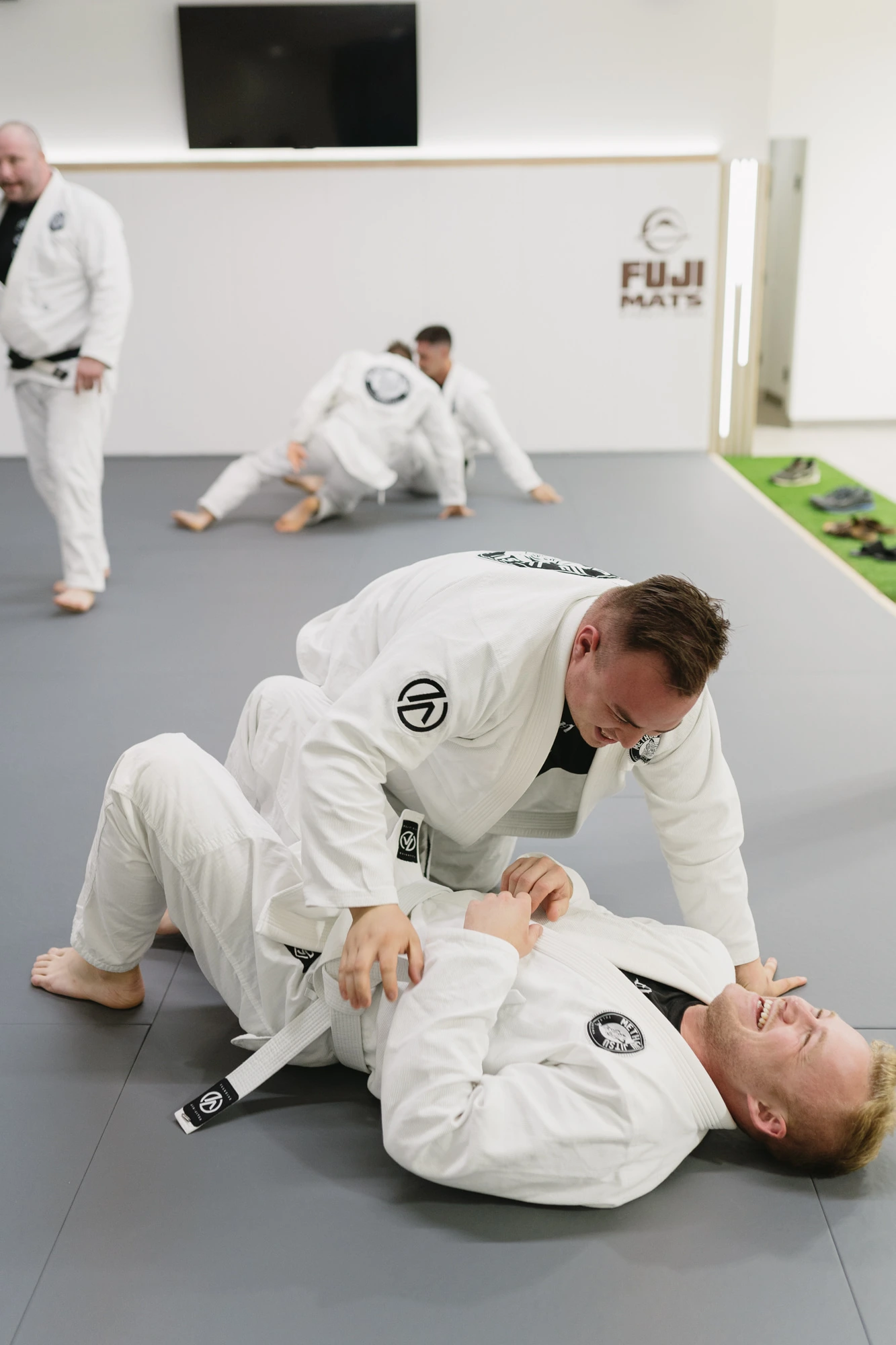
BJJ etiquette includes bowing on and off the mat, keeping your gi clean, trimming your nails, respecting tap outs immediately, and arriving on time. Good etiquette creates a safe and respectful training environment for everyone — and it is one of the first things an instructor notices about a new student.
WHY ETIQUETTE MATTERS IN BJJ
Brazilian Jiu-Jitsu is a contact sport where training partners put their bodies and safety in each other's hands every single session. Etiquette is not about rigid formality — it is about creating the conditions where people trust each other enough to train hard and learn effectively. When everyone on the mat respects the same norms, training becomes more productive for the whole room.
New students are not expected to know every unwritten rule on day one. But demonstrating care — being clean, being attentive, being safe — signals that you take the training environment seriously. That signal opens doors with training partners and with your instructor faster than any technique you can learn in your first month.
BEFORE CLASS — THE ESSENTIALS
Hygiene Is Non-Negotiable
BJJ is a close-contact sport. You will be in someone's face, under their arm, wrapped around their neck. Hygiene is not optional. Shower before training. Wash your gi after every single session — no exceptions. Brush your teeth before evening classes. Arrive clean and expect your training partners to do the same.
A dirty gi can transmit ringworm and staph infections — real health risks that shut down training rooms and sideline athletes for weeks. If your gi smells or looks dirty, do not wear it. This is one area where there is no gray zone in any reputable academy.
Trim Your Nails
Long fingernails or toenails cut skin. It happens quickly and sometimes the victim does not say anything — they just quietly avoid training with you afterward. Trimming them is a two-minute act of consideration for your training partners. Check both hands and feet before every session. If you notice a sharp edge mid-class, step off the mat, fix it, and return. Your partners notice and appreciate this level of care.
Remove Jewelry and Arrive on Time
Rings, necklaces, earrings, and facial piercings can lacerate your training partners or get caught in fabric during rolls. Remove all jewelry before stepping on the mat. If a piece cannot be removed, cover it with athletic tape.
Late arrivals disrupt warm-ups, distract training partners, and signal that you do not value the class structure. If you genuinely cannot avoid being late, enter quietly, bow, and wait for your instructor to acknowledge you before joining the group. Do not cut through pairs already in the middle of a roll.
ON THE MAT
DURING ROLLING
Control Your Intensity
Not every roll is a competition. Match the intensity of your partner and the context of the class. A high-intensity roll with an experienced teammate is appropriate at certain times. Muscling a beginner or a lighter partner at full force is not a demonstration of skill — it is a demonstration of ego. Good training partners are aware of who they are rolling with and calibrate accordingly.
As a beginner, your default setting should be moderate and technically focused. You are learning movement patterns, not winning medals. Trying to overpower everyone in the room your first week is the fastest way to build a reputation that makes experienced students avoid pairing with you.
Ask to Roll — Do Not Just Grab
To invite someone to roll, make eye contact and extend your hand or bump fists. Grabbing someone's collar without an invitation is considered rude in most gym cultures. If you want to roll with someone specific, ask. They may need a water break, have a minor injury, or already have a partner lined up. A polite ask is always the right approach.
Respect the Tap — Always
The tap is sacred. When someone taps, the roll pauses. You release immediately, reset, and continue if both parties want to. Continuing after a tap — even "just a little more" — is one of the most serious violations of BJJ etiquette. It breaks trust and can cause injury. This rule applies even when you think your partner tapped accidentally or could have escaped.
Watch Out for Other Rolls
The mat is shared space. Always maintain awareness of where other pairs are rolling. If you are moving toward another active roll, pause and create distance. Do not roll through other people's space. If you collide with another pair, everyone stops, adjusts positions, and restarts calmly.
Control Your Ego
Getting submitted is normal. Getting submitted repeatedly — even by someone less experienced — is also normal at some point in every practitioner's journey. Do not react to taps with frustration, excuses, or sudden spikes in intensity. Take a breath, acknowledge it, and keep training. The athletes who improve fastest are genuinely comfortable being uncomfortable on the mat.
AFTER CLASS
Thank your training partners after each roll and again at the end of class. A fist bump, a handshake, and a brief acknowledgment costs nothing and builds the relationships that make BJJ worth showing up to every week for years.
If mats need cleaning after class, participate without being asked. Helping take care of the training space is a sign of investment in the community, and it does not go unnoticed by instructors and senior students. It is one of the quietest ways to demonstrate that you belong.
If you notice something about another student's gi or hygiene that could be a health issue, tell your instructor privately rather than confronting the student directly. Let the instructor handle it with care. This protects the training community without causing unnecessary embarrassment to anyone.
COMMON BEGINNER MISTAKES TO AVOID
- Wearing shoes on the mat even briefly
- Talking or checking your phone during instructor demonstrations
- Offering unsolicited technique advice to higher belts
- Going full intensity against all partners regardless of size or experience
- Not washing the gi between every session
- Defending a tap by arguing "I was almost out of it"
- Walking off the mat during class without letting the instructor know
- Making excuses when submitted rather than asking what happened
DAY ONE ORIENTATION
At Method Jiu-Jitsu in Tulsa, every new student gets a walkthrough of our gym culture and expectations on their very first day. We go over hygiene standards, mat etiquette, how to tap, what to expect during live rolling, and how to be a great training partner. You are never left to guess — we tell you upfront.
We take culture seriously because good culture makes everyone's training better. Our students take care of each other on the mat, and that commitment to mutual respect is one of the things long-term members consistently cite as their favorite thing about training at Method.
Try a Free ClassFREQUENTLY ASKED QUESTIONS
Most gyms are forgiving with beginners who are genuinely trying. If you make a mistake — forget to bow, wear shoes on the mat, or miss a tap — your instructor or a senior student will usually correct you quietly. The key is to be receptive and fix the issue. Violations only become a real problem when they are repeated or ignored after being pointed out.
Bowing is a tradition carried over from Judo and Japanese martial arts culture. Most BJJ academies bow when entering and exiting the mat as a sign of respect for the training space and the lineage of the art. Some gyms also bow before and after each roll. It is a simple gesture that signals you are entering a focused, respectful environment. When in doubt, bow.
You always have the right to stop a roll if you feel unsafe. Tap to pause the action, or say "stop" or "relax" verbally. If a partner is consistently too rough after being asked to ease up, bring it to your instructor. A good gym addresses aggressive training partners directly — it is a safety issue, not just a preference.
Yes. You always have the right to decline a roll. You might be tired, nursing an injury, or simply not comfortable with a particular partner's intensity. A polite "I'm going to sit this one out" is completely acceptable. Nobody is entitled to roll with you, and good gyms respect personal limits without making it awkward.
BJJ respects rank. Higher belts generally set the tone for a roll — if a black belt wants to go light and technical, match their energy. Lower belts typically invite higher belts to roll rather than expecting to be approached first. When lining up, students arrange by rank with higher belts closer to the front. These are norms, not rigid laws, and they vary by gym culture.