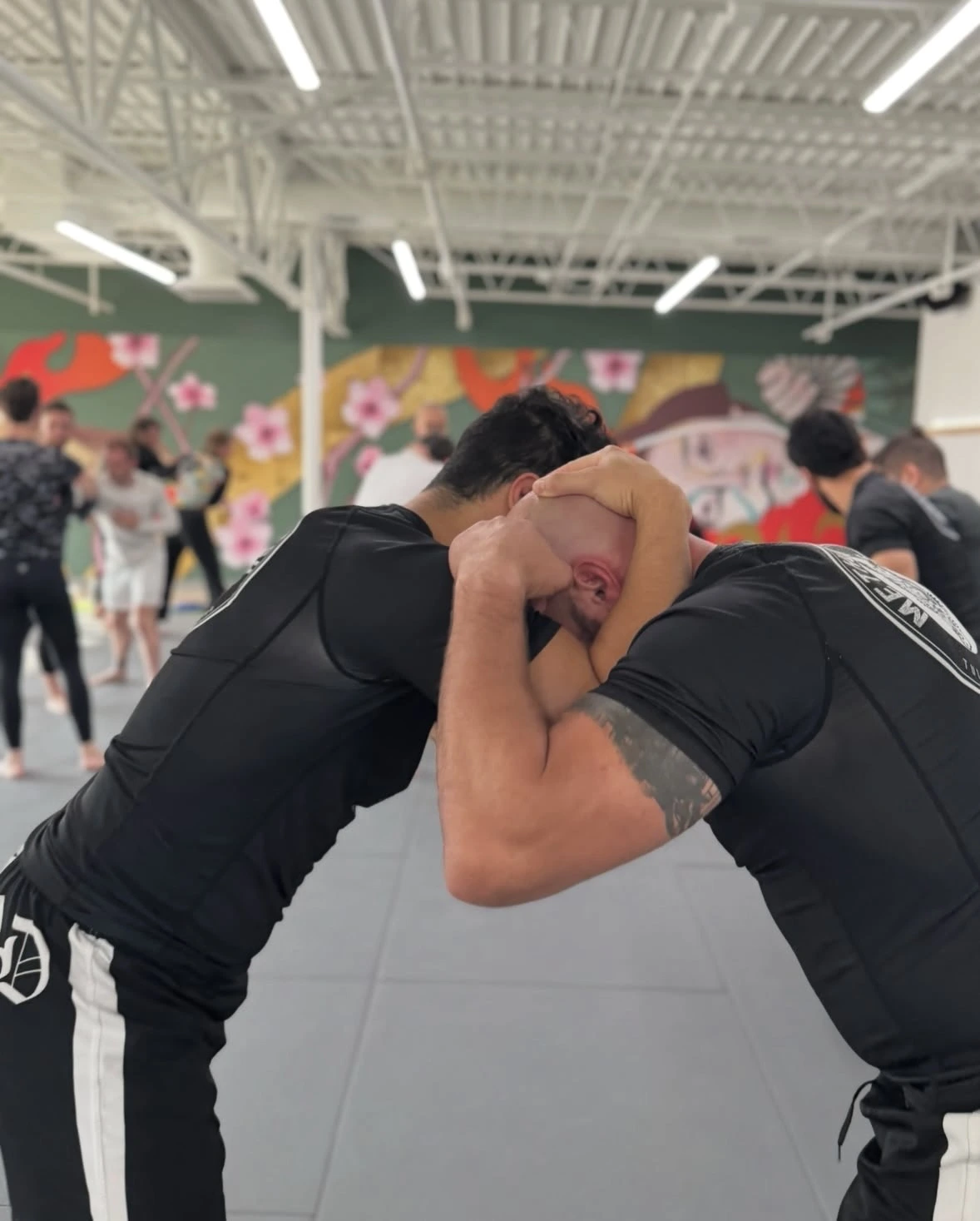
Gi BJJ uses a traditional uniform (kimono) that allows gripping the fabric for control and submissions, while no-gi uses rash guards and shorts with no fabric grips available. Gi training develops precision and patience; no-gi rewards speed and athletic grappling. Most serious practitioners train both.
WHAT IS THE GI?
The gi — also called a kimono — is the traditional uniform of Brazilian Jiu-Jitsu. It consists of a heavy-weave jacket, pants, and a belt that indicates rank. The fabric is thick enough to be grabbed, pulled, and used as a mechanical lever. This single detail changes everything about how the sport is played.
When you grab a sleeve or collar, you create a grip point that is extremely difficult to break. Those grips slow the pace of exchanges, demand technical precision in posture, and open up submission attacks that only exist because of fabric — collar chokes, sleeve-based triangles, spider guard, lapel guards, and dozens of other techniques that disappear entirely the moment the jacket comes off.
The gi has been the foundation of BJJ since the art arrived in Brazil from Japan in the early 20th century. Explore our dedicated gi jiu-jitsu program to see how we teach these fundamentals at Method. Every foundational technique — the armbar, the triangle choke, the kimura, the scissor sweep — was developed and refined in the gi before being adapted for other contexts.
WHAT IS NO-GI?
No-gi BJJ is grappling without the traditional kimono. Practitioners wear rash guards (form-fitting compression tops) and board shorts or spats. Because there is no fabric to grip, the entire game changes: you control your opponent using their body directly — wrist grips, underhooks, overhooks, body locks, and head position.
No-gi training became its own major competitive format largely through the influence of submission wrestling, MMA, and organizations like the ADCC (Abu Dhabi Combat Club). Today, some of the most celebrated grapplers in the world compete primarily or exclusively in no-gi. The absence of fabric grips removes a significant source of friction from the game, which means transitions happen faster, positions are harder to hold, and athleticism plays a greater role alongside technique.
No-gi also introduces leg lock systems — heel hooks, kneebars, and calf slicers — that are legal at most no-gi competitions but restricted in many gi rulesets. This adds an entirely different dimension of danger and technical depth that is unique to the no-gi format.
KEY DIFFERENCES SIDE BY SIDE
| Category | Gi | No-Gi |
|---|---|---|
| Uniform | Kimono jacket, pants, belt | Rash guard, shorts or spats |
| Grip style | Fabric grips (collar, sleeve, lapel) | Body grips (wrists, underhooks, necks) |
| Pace | Slower, more methodical | Faster, more athletic |
| Leg locks | Limited (straight ankle locks at most levels) | Full leg lock system commonly allowed |
| Unique techniques | Collar chokes, spider guard, lapel guard | Heel hooks, kneebars, body-lock takedowns |
| Competition orgs | IBJJF, local gi events | ADCC, EBI, Polaris, IBJJF No-Gi |
GRIP DIFFERENCES — THE CORE OF IT ALL
The single most impactful difference between gi and no-gi is gripping. In the gi, your options multiply enormously. You can grip the collar to break posture. You can grip the sleeve to steer an arm into a submission. You can use the lapel to build elaborate guard systems that tie up your opponent's entire upper body.
In no-gi, none of that exists. Every control point must be achieved through direct contact with skin: a collar tie, a wrist control, an underhook, a body lock. This forces grapplers to become stronger and more athletic, and it demands that every technique be mechanically sound — it has to work through leverage and position, not fabric assistance.
This grip difference explains why the same submission can feel completely different in each format. A triangle choke from guard is deeply familiar in the gi. In no-gi, without sleeve control to maintain the arm position you need, setting up that same triangle requires a different entry, different timing, and often a different angle entirely.
SPEED AND ATHLETICISM
No-gi is generally faster. The reduced friction means positions change quicker, escapes happen more easily, and transitions require sharper timing. A practitioner who relies heavily on grip-based control will notice that no-gi demands more explosive movement and better wrestling fundamentals.
This is not a flaw — it is a feature. Training no-gi builds real athleticism that transfers back into the gi and into any grappling context. Many elite gi competitors credit no-gi training for improving their speed, sensitivity, and takedown game. The gi, by contrast, builds patience. Because fabric grips slow everything down, there is more time to feel a positional shift, identify a threat, and respond precisely.
WHICH IS BETTER FOR BEGINNERS?
Most experienced coaches recommend starting in the gi. The gi provides a more controlled learning environment. Techniques are more visible because the pace is slower. The closed guard — the most beginner-friendly offensive position — is richer and more practical in the gi. And the gi's rank system tracked by belt and stripes gives beginners a clear progress framework that no-gi typically lacks.
That said, if your primary goal is MMA competition or real-world self-defense, starting no-gi is completely valid. No-gi develops wrestling habits and body mechanics that translate directly to those contexts. The best approach, once you have a few months of fundamentals, is to train both.
WHICH IS BETTER FOR SELF-DEFENSE?
No-gi is generally considered more directly applicable to street self-defense scenarios because most altercations happen in everyday clothing, not a kimono. The body-control skills you develop in no-gi — clinch work, takedowns, positional control without fabric — transfer naturally to real-world scenarios.
However, gi training should not be dismissed. Most street clothing has enough fabric to grab: a collar, a t-shirt, a jacket. Practitioners with gi experience instinctively understand leverage through clothing. More importantly, gi training builds exceptional submission depth. The collar chokes, armbars, and triangles refined through gi repetitions are precise, powerful, and highly effective regardless of what either person is wearing. The most self-defense-capable grapplers train both formats.
WHY MOST GYMS TRAIN BOTH
The modern BJJ academy does not force a choice between gi and no-gi. The two formats are complementary. The precision of gi training improves your no-gi technique. The athleticism of no-gi training makes your gi game more dynamic. Practitioners who train both consistently tend to develop faster and build more well-rounded games than those who specialize exclusively in one format.
Competition also drives cross-training. Many of the world's best competitors have been dominant in both formats at the highest levels. If you are just starting out, do not overthink which format to begin in — just get on the mat.
BOTH FORMATS, ONE ACADEMY
At Method Jiu-Jitsu in Tulsa, we run a full schedule of both gi and no-gi classes. Gi classes run Monday, Wednesday, and Saturday. No-gi classes run Tuesday, Thursday, and Friday. Students who train three or more days per week naturally develop in both formats simultaneously.
Our curriculum is designed so that each format reinforces the other. Techniques introduced in the gi are revisited in no-gi with appropriate modifications, so students understand not just how a technique works but why — and what it depends on. This builds a deeper, more adaptable game from day one.
Check out our dedicated no-gi program page for class details and what you'll learn.
Try a Free ClassFREQUENTLY ASKED QUESTIONS
Neither is objectively harder, but they challenge you in different ways. Gi BJJ demands more technical precision because grips slow everything down, exposing positional mistakes. No-gi BJJ is more physically demanding — without fabric friction, you must generate all your control through body mechanics and pressure, and the faster pace raises the cardio requirement significantly.
No-gi is generally considered more applicable to real-world self-defense because most confrontations happen in street clothes, not a kimono. However, gi training builds exceptional control and submission depth that transfers directly. Most self-defense experts recommend training primarily no-gi for real-world scenarios while using gi training to sharpen technique.
Yes — and most serious practitioners do. Training both accelerates your overall development because each format exposes weaknesses in the other. Gi training tightens up your technique; no-gi builds the athleticism and body mechanics to make that technique work under pressure. At Method, our weekly schedule makes it easy to train both.
For gi BJJ you wear a traditional kimono (gi) with a belt indicating your rank. For no-gi you wear a rash guard and board shorts or grappling spats. Board shorts should have no pockets, belt loops, or exposed metal. Many gyms, including Method, can lend a gi to beginners trying their first class — just come in workout clothes and we'll take care of the rest.
Most coaches recommend beginners start with gi BJJ. The slower pace makes techniques easier to see and feel, and closed guard — the most beginner-friendly offensive position — is richer in the gi. However, if your main goal is MMA or self-defense, starting no-gi is also a valid choice. At Method, new students are welcome in both gi and no-gi classes from day one.