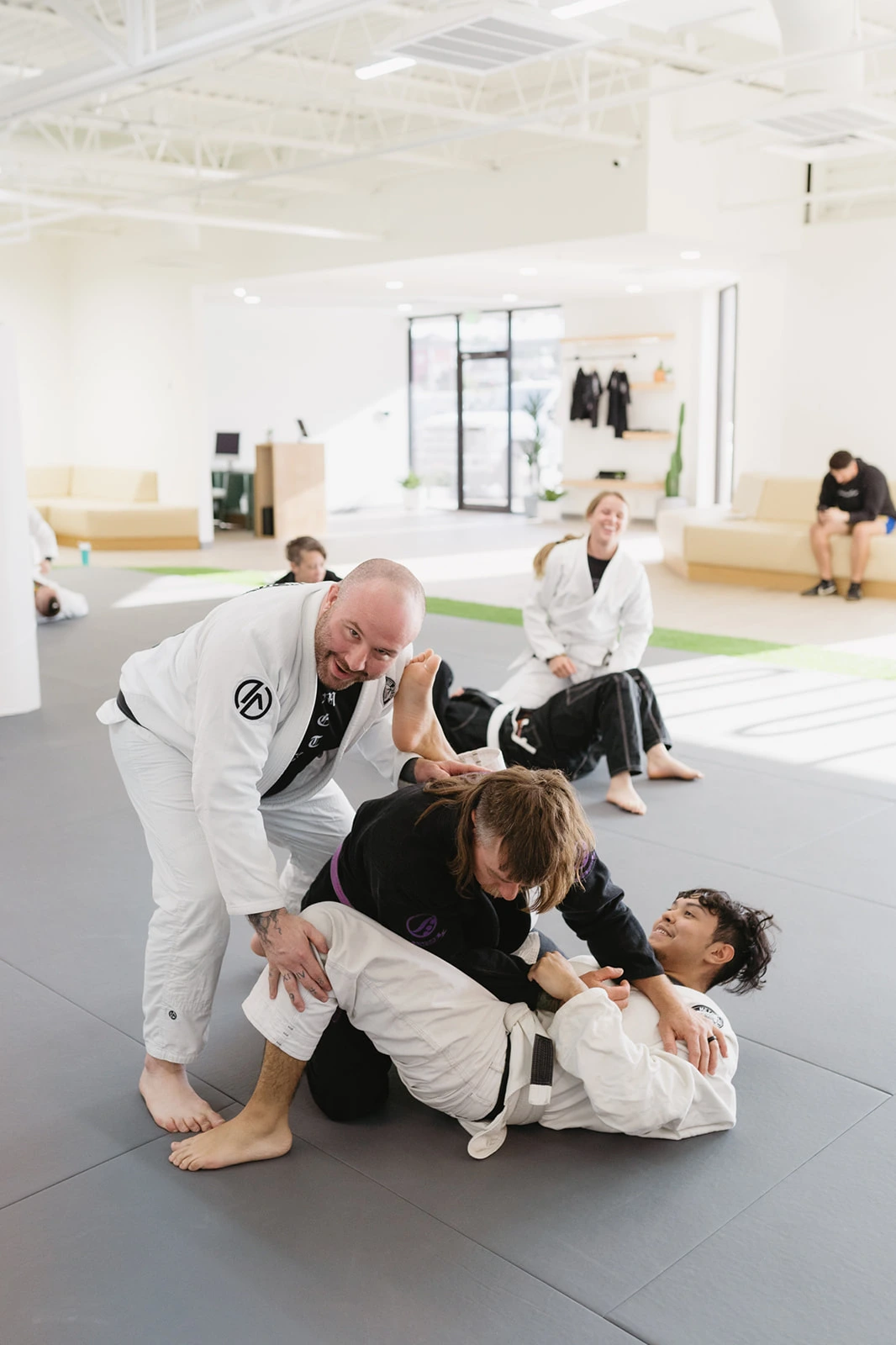
Side control is a dominant ground position in BJJ where you pin your opponent on their back while positioned perpendicular to them, chest-to-chest. It is a strong control position and a gateway to mount, north-south, and submissions including the kimura, americana, and arm triangle choke.
WHAT SIDE CONTROL IS AND WHY IT MATTERS
After passing your opponent's guard, the first position you typically land in is side control. You are beside your opponent — perpendicular to their body — with your chest on their chest and your weight pinning their upper body to the mat. Your legs are free to move, giving you mobility to transition to other positions or adjust your control.
Side control is not the highest-value position on the ground — that distinction belongs to mount and back control — but it is arguably the most important transitional position in BJJ. Nearly every path to mount, back control, and north-south passes through side control. A practitioner who is comfortable controlling side control and advancing from it is dangerous from anywhere on the ground.
For the bottom player, side control is deeply uncomfortable. Your hips are limited, you cannot use your legs to create frames the way you can in guard, and the weight of your opponent on your chest makes breathing and movement difficult. Learning to survive and escape side control is one of the core survival skills in Brazilian Jiu-Jitsu.
In competition, the guard pass that takes you to side control scores 3 points in IBJJF rules. Advancing from side control to mount adds another 4 points — creating a potential 7-point swing from a single positional sequence. Understanding this scoring logic helps practitioners set clear goals for their top game.
SIDE CONTROL VARIATIONS
Standard Side Control
The fundamental version. You are perpendicular to your opponent with your near arm under their head and your far arm blocking their near hip. Your chest is on theirs, and your hips are low to the mat for stability. Crossface pressure — driving your shoulder or forearm into the side of their face — is a key control element that limits their ability to turn into you and begin an escape.
The near arm under the head serves a dual purpose: it blocks their ability to insert an underhook, and it keeps their head turned away, which limits their ability to bridge effectively. Controlling the head in side control is as important as controlling the hips in guard — it is the primary anchor of the position.
Kesa Gatame (Scarf Hold)
A variation borrowed from Judo. Instead of your near arm under the head, you are seated beside your opponent with their head trapped under your armpit and one of their arms isolated and controlled across your chest. Kesa gatame applies significant pressure to the neck and shoulder and is difficult to escape for opponents who are not familiar with its specific counter.
The trade-off is that kesa gatame is more positionally stable than standard side control but limits your attack options somewhat. It is particularly effective as a resting position to conserve energy while maintaining control.
Reverse Kesa Gatame
You face your opponent's legs rather than their head, still beside them but with your weight on their upper body and your hips blocking their lower body. Reverse kesa creates different attack angles — particularly effective for kimura attacks on the far arm and transitions toward the legs.
North-South
Technically a distinct position from side control, north-south has you lying on top of your opponent facing their feet — chest to chest but in opposite directions. North-south is typically reached by rotating from standard side control around the head. It creates excellent kimura opportunities and is a stable resting position that limits most escape attempts. The transition from side control to north-south and back is a key movement pattern in developing a complete top game.
ATTACKS FROM SIDE CONTROL
Side control is a rich submission platform. The attacks available depend on how your opponent is framing and defending:
Kimura
When your opponent pushes against you with their near arm, you have an opportunity to trap that arm in a figure-four grip — one hand on their wrist, the other hand on your own wrist, forming a loop around their elbow. The kimura is a shoulder lock that externally rotates and extends the arm simultaneously. From side control, the kimura can be used not only as a submission but as a controlling grip to sweep, take the back, or transition to north-south.
The side control kimura is one of the most important single techniques in all of BJJ because it functions as both a submission and a positional control tool. Understanding the "kimura trap" system — using the kimura grip to control your opponent through multiple transitions — is a significant development milestone for intermediate practitioners.
Americana (Keylock)
Similar mechanics to the kimura but attacking in the opposite rotational direction. You isolate your opponent's near arm with their elbow bent, pin their wrist to the mat, and then lift their elbow — internally rotating the shoulder until they tap. The americana from side control works best when your opponent's elbow drifts away from their body.
Arm Triangle Choke (Kata Gatame)
One of the highest-percentage submissions from side control. You use your body and your arm to create a triangle around your opponent's neck and one of their shoulders — compressing both carotid arteries simultaneously. The arm triangle is set up when your opponent defends with their near arm by pushing against your shoulder, allowing you to trap that arm against their own neck and then slide your head to their far side to tighten the choke.
The arm triangle requires specific body positioning to finish cleanly, but once properly set, it is extremely tight and difficult to escape. Many practitioners consider it the premier side control submission because the setup naturally emerges from common defensive reactions.
Paper Cutter Choke (Gi)
A gi-specific choke that uses the near-side collar. You feed one hand deep into the collar, then slide it across the throat while your other arm posts on the mat. The paper cutter is a surprise weapon because it sets up quickly from a standard side control position and the choking angle makes it very tight. It is particularly effective against opponents who have a strong frame with their near arm — the same arm that is defending gives you the collar access you need.
ESCAPING SIDE CONTROL
Side control escape is one of the most important and frequently practiced skills in BJJ. The bottom player's goal is to recover guard — whether half guard, full guard, or any variation — which immediately changes the dynamic of the match.
Framing and Guard Recovery
The foundation of all side control escapes is creating space using frames. Your near forearm should be pressed against your opponent's hip to prevent them from fully settling their weight. Your far hand can post on their shoulder or neck to create additional space. Once you have a frame, you shrimp your hips away and insert your inside knee between you and your opponent, recovering to half guard first and then working to full guard.
The critical principle here is that frames must be active — pushing against the appropriate structure at the right moment. Passive frames are smothered by a skilled top player. The shrimp (lateral hip escape) is the fundamental movement that makes guard recovery possible, and drilling it from side control is one of the most valuable habits a beginner can develop.
Underhook and Back Take
When you achieve an underhook — inserting your near arm under your opponent's near arm and wrapping around their back — you have both an escape option and a back take opportunity. A strong underhook allows you to roll to your knees and take your opponent's back, turning a defensive situation into a dominant one. This escape is more aggressive than framing and guard recovery and carries more risk, but the reward — achieving back control — is significant.
Experienced practitioners use the threat of the underhook back take to open up the framing escape: if your opponent tightens their body to prevent the underhook, they often create the space you need to shrimp and recover guard.
SIDE CONTROL RETENTION — COMMON MISTAKES
For the top player, several habits will cause you to lose side control more often than necessary:
- Hips too high — raises your center of gravity and makes you easier to roll or hip-bump
- Losing crossface pressure — allowing your opponent to turn toward you is the beginning of most escapes
- Forgetting the far hip — your far arm or knee must block your opponent's far hip; otherwise they can bridge into you
- Not transitioning — staying static in one side control configuration gives your opponent time to build a systematic escape
- Attacking too soon — attempting submissions before your control is established allows your opponent to escape during the positional change
SIDE CONTROL AS A SYSTEM
At Method Jiu-Jitsu in Tulsa, we teach side control as a connected system rather than a collection of isolated techniques. Students learn the fundamental control position, the key transition to mount, the arm triangle and kimura as primary submissions, and the two escape frameworks — all in context with each other. Understanding how the attacks and escapes relate creates practitioners who can read situations rather than just react to them.
Our curriculum introduces side control and its escapes in the first months of training, giving beginners the tools to survive, escape, and eventually control this position from both sides. Black belt instruction, structured drilling, and supervised rolling combine to build real competency faster than most programs.
Try a Free ClassFREQUENTLY ASKED QUESTIONS
Side control is a dominant ground position in BJJ where you pin your opponent on their back while positioned perpendicular to them, chest-to-chest. You are beside them rather than on top, controlling their upper body with your weight and grips while your legs are free to move. It is a strong control position and a common gateway to mount, north-south, and submissions.
Side control itself does not score points in IBJJF competition — however, the guard pass that takes you to side control scores 3 points. Holding side control and transitioning to mount then scores 4 additional points. Understanding this scoring structure helps practitioners see positional advancement as a sequence rather than a single moment.
In side control, you are beside your opponent and perpendicular to their body with your weight on their chest. In mount, you are sitting on top of their torso with your knees on either side of their hips. Mount is generally more dominant because it limits escapes further and offers more submission angles. Side control is typically easier to achieve and maintain, and it provides an excellent platform to advance to mount.
The primary side control escapes are framing and guard recovery, and the underhook back take. Framing involves creating distance with active forearm frames against your opponent's hip and neck, then shrimping to recover half guard or full guard. The underhook escape involves fighting for a deep underhook on the near side and using it to roll to your knees or take your opponent's back — a higher-risk, higher-reward option that turns a defensive situation into an offensive one.