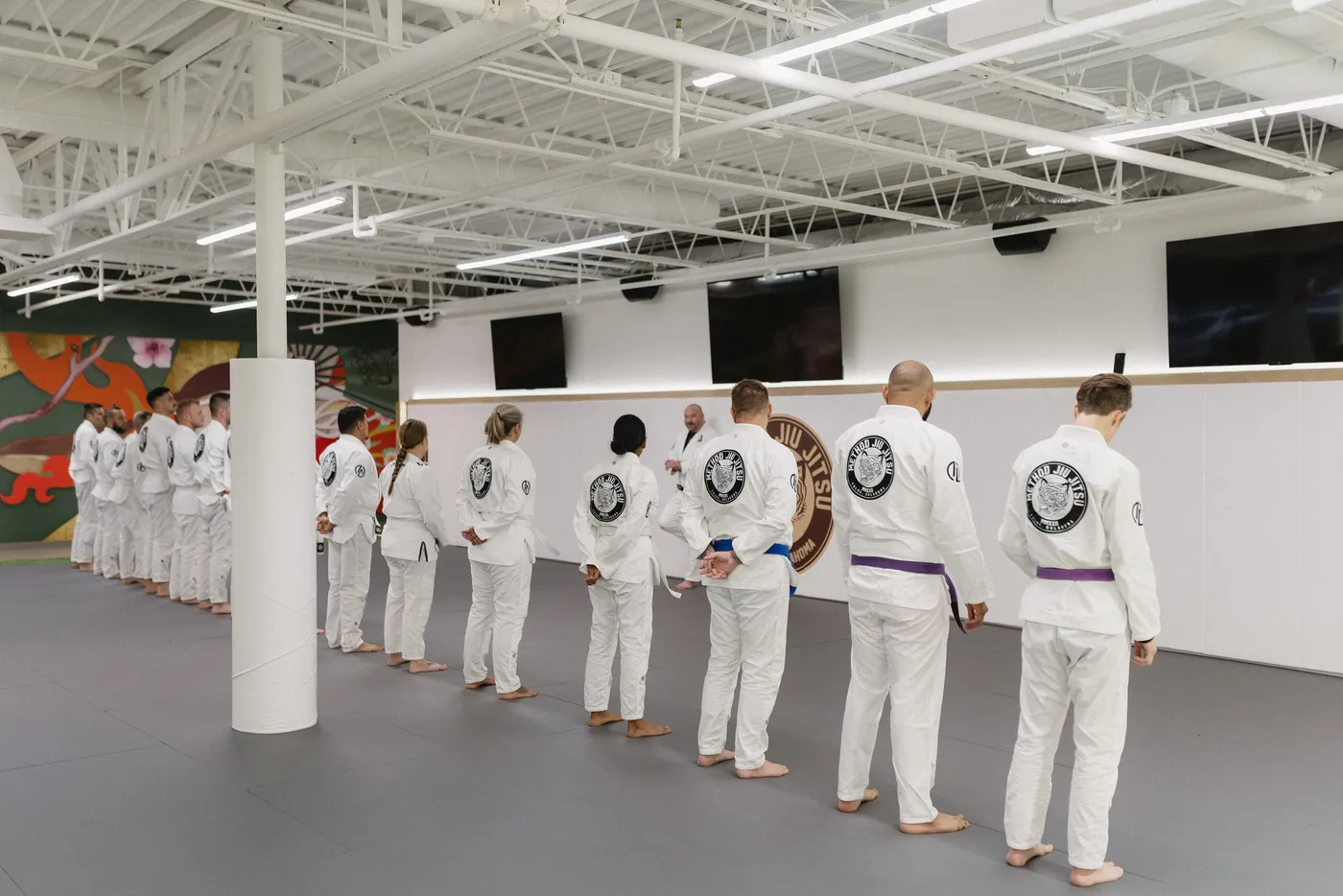

WHAT YOU'LL LEARN IN GI CLASS
Gi training opens up a version of jiu-jitsu that doesn't exist without fabric to grip. The techniques below are the backbone of what you'll drill, refine, and eventually own as you move through the belts.

COLLAR CHOKES, CROSS CHOKES, AND LOOP CHOKES
The collar of your opponent's gi is one of the most dangerous handles in jiu-jitsu. You'll learn how to finish cross collar chokes from guard and mount, set up loop chokes off a failed pass, and understand why the collar is often the first grip worth fighting for in any exchange.
GRIP-BASED GUARD SYSTEMS
Spider guard, lasso guard, and lapel guard don't exist in no-gi — they're built entirely around the friction and structure that fabric grips provide. You'll learn how to use sleeve and pant grips to control distance, off-balance your opponent, and create the angles you need to sweep or attack.
SWEEPS THAT USE THE GI AS LEVERAGE
Every grip you take is also a lever. We'll teach you how collar, sleeve, and pant grips turn ordinary sweeps into high-percentage ones, giving you the mechanical advantage to off-balance opponents who are stronger or heavier than you.
TAKEDOWNS ADAPTED FOR GI GRIPS
Standing exchanges look different with a jacket to grab. You'll learn gi-specific trips, grip fighting for takedowns, and how to use the collar and sleeve to control your opponent's posture before you ever touch the mat.
THE DISCIPLINE OF BELT PROGRESSION
The belt system in gi jiu-jitsu isn't just a ranking system — it's a roadmap. Each stripe and promotion marks real, verified growth in your technique, and that structure gives you a way to measure progress in an art that can otherwise feel endless. We take belt progression seriously because it's one of the most honest measures of your development.