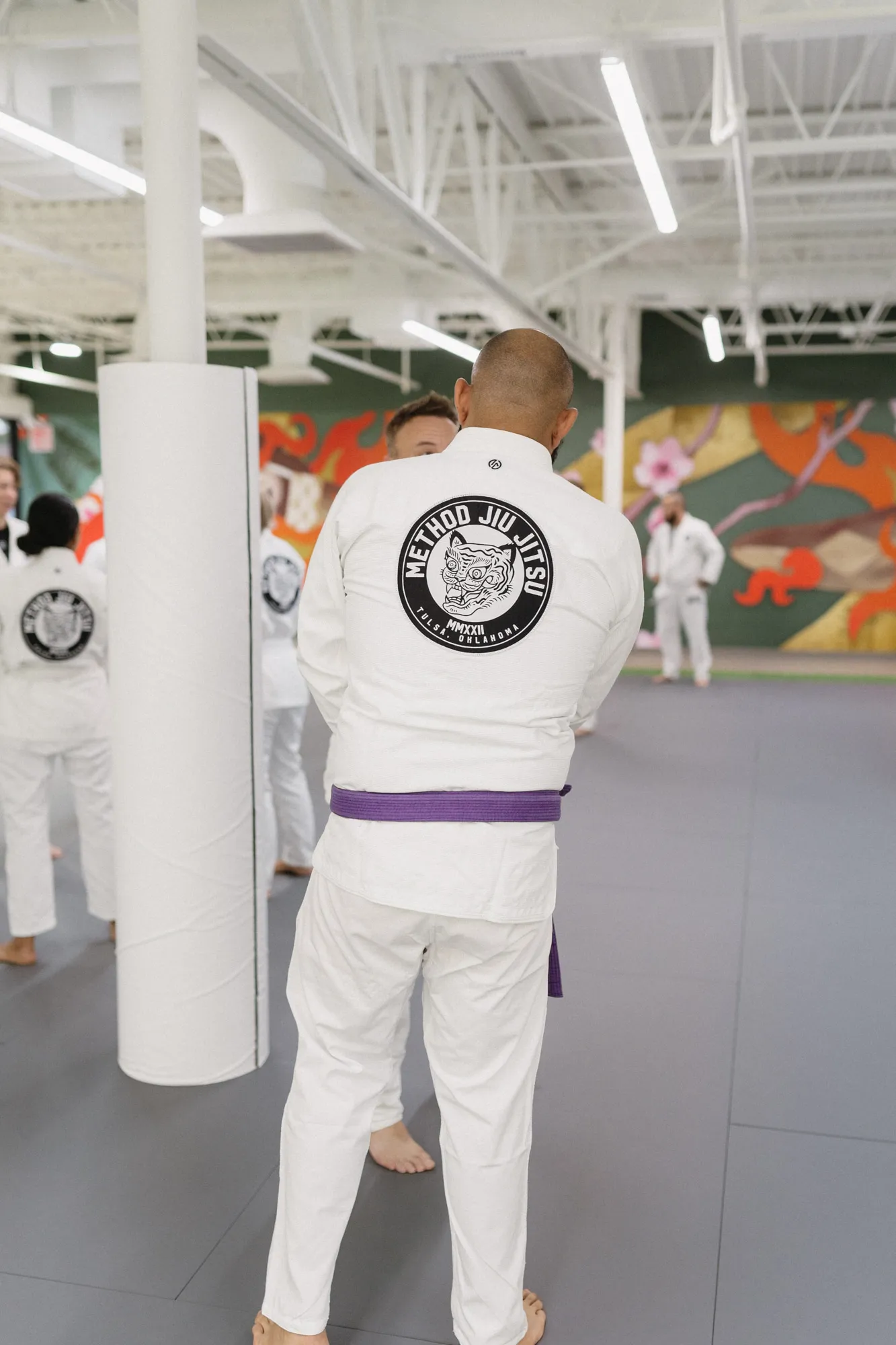
Walk into Method Jiu-Jitsu on any given evening and you will notice something that stands out from a typical Tulsa gym: parents and kids on the same mats, working the same techniques, wearing the same white gis. Family jiu-jitsu has quietly become one of the fastest-growing reasons Tulsa households walk through the door, and it is easy to see why once you understand what training together actually looks like.
Why Families Are Choosing BJJ Together
For a lot of parents, the search for family jiu-jitsu in Tulsa starts the same way. A kid gets signed up for a kids class, comes home talking about the technique they learned, and within a few weeks a parent is curious enough to try a class themselves. From there, it becomes something the whole family does together rather than a solo activity for one member of the household.
That shared interest matters more than it might seem. Most extracurricular activities pull a family in different directions — different practice schedules, different gyms, different sidelines to sit on. Jiu-jitsu is one of the few activities where a parent and child can train in the same building, sometimes the same session, and talk about the same techniques on the car ride home. It gives a family a common language and a common goal, which is part of why family martial arts programs in Tulsa have grown so much over the past few years.
There is also a practical piece. Tulsa families are busy, and finding an activity that fits into an already packed week is not easy. When kids classes and adult classes run back-to-back at the same facility, a parent can drop a child off for their class, train in the adult class that follows, and head home together. No separate drives across town, no juggling two different gyms with two different schedules.
What Family Jiu-Jitsu Classes Actually Look Like
Family jiu-jitsu does not mean parents and toddlers rolling around together in one chaotic session. At Method Jiu-Jitsu, the structure is built around age-appropriate classes that still let a family train under one roof. Younger kids have their own kids jiu-jitsu program, where instruction is paced for shorter attention spans, built around games and drills that teach real technique without feeling like a lecture. Teens and adults train in classes suited to their strength and experience level, where the pace, contact, and complexity look very different from a kids class.
The overlap comes in scheduling and in the shared experience. A parent might watch part of their child's class from the lobby, then step onto the mats themselves twenty minutes later. Siblings training at different levels still come home and talk about the same moves. And for families who want to train literally side by side, Method Jiu-Jitsu's family jiu-jitsu program is built specifically around that goal, with class structures designed so parents and kids can drill together safely.
For a parent who has never set foot on a mat, the idea of starting alongside their child can feel intimidating. It should not. Adult beginners walk in with zero experience all the time, and the onboarding process is the same regardless of whether you are 8 or 48. Understanding what to expect in your first class tends to erase most of the pre-class nerves — no one is thrown into live rolling on day one, and every new student, parent or otherwise, starts with the fundamentals.
Benefits Beyond Fitness
Ask most parents why they stuck with family jiu-jitsu past the first month, and fitness is rarely the first thing they mention. What comes up more often is the shift they see at home.
Discipline is usually at the top of the list. Jiu-jitsu has a built-in structure — bowing onto the mat, listening when an instructor is talking, working through frustration when a technique is not clicking. Kids who train consistently tend to carry that structure into other parts of their life, from homework habits to how they handle disagreements with siblings. Parents notice it too. There is something clarifying about tapping out to your own kid, or watching your kid execute a sweep on you cleanly. It resets the usual power dynamic in a way that builds mutual respect rather than eroding it.
Confidence shows up just as often. A quieter kid who struggles to speak up in a classroom setting may find that earning a stripe on their belt, or successfully defending a position against a bigger training partner, translates into a different kind of self-assurance elsewhere. Parents report the same thing about themselves — there is a particular kind of confidence that comes from knowing you can handle yourself physically, and it tends to show up in posture, in how people carry themselves at work, in how they handle stress.
Then there is the screen-free time, which more Tulsa parents mention than you might expect. An hour on the mats is an hour where nobody is looking at a phone. For families trying to carve out real connection time in a world of competing screens, training together checks a box that is otherwise hard to check.
This is also part of why so many parents look at jiu-jitsu instead of a traditional team sport. Families researching why parents choose jiu-jitsu over team sports tend to land on similar reasons: individualized pacing instead of bench time, a focus on personal improvement rather than a scoreboard, and a training environment where a kid's growth is not dependent on how the rest of the team performs that season.
Safety Is Usually the First Question
Almost every parent asks about safety before their kid steps on the mat, and it is a fair question to ask before committing to any contact sport. The honest answer is that jiu-jitsu, taught correctly, is one of the safer options among youth activities that involve physical contact. Technique and control are emphasized well before live sparring, and instructors regulate intensity based on a student's size, experience, and age. Parents who want the full picture on safety in jiu-jitsu can see exactly how injury risk in BJJ compares to more traditional contact sports, and why so many parents feel more comfortable with jiu-jitsu than with youth football or wrestling.
How Method Jiu-Jitsu Accommodates Families
None of this works without a schedule that actually fits a family's life, which is why class times at Method Jiu-Jitsu are built with that in mind. Kids classes run at times that make sense around a school schedule, adult classes are scheduled around them so a parent is not stuck waiting in the car for an hour, and the overall calendar is designed so a household with more than one member training does not need to make two separate trips across Tulsa in a single evening.
There is also flexibility for families who are not sure everyone is ready to commit at once. Some households start with just the kids, add a parent a few months later once they have watched enough classes to feel comfortable, and eventually have the whole family training on a regular schedule. Others start together from day one. Both paths are common, and neither one is the "right" way to do it.
For parents wondering whether jiu-jitsu is worth it purely as exercise, the fitness benefits of BJJ are real and well documented, but for most families that ends up being a secondary benefit rather than the main draw. The mat time, the shared language, and the time together tend to be what keeps a family coming back week after week.
Getting Started as a Family
The easiest way to find out if family jiu-jitsu is a fit is to see a class in person. There is no need to sign up for anything long-term before knowing what the atmosphere feels like, how the instructors interact with kids versus adults, and whether the schedule realistically works for your household.
Parents who are considering training themselves alongside their kids often find it helpful to first look into getting started as an adult, since starting jiu-jitsu later in life comes with its own questions that are different from what a kid experiences on day one. Between the kids program, the adult program, and the dedicated family structure, most Tulsa households can find a schedule that works without much trial and error.
The best next step is simple: come see it firsthand. Families can book a free class and watch a session, meet the instructors, and get a direct answer to whether Method Jiu-Jitsu is the right fit before making any commitment at all.