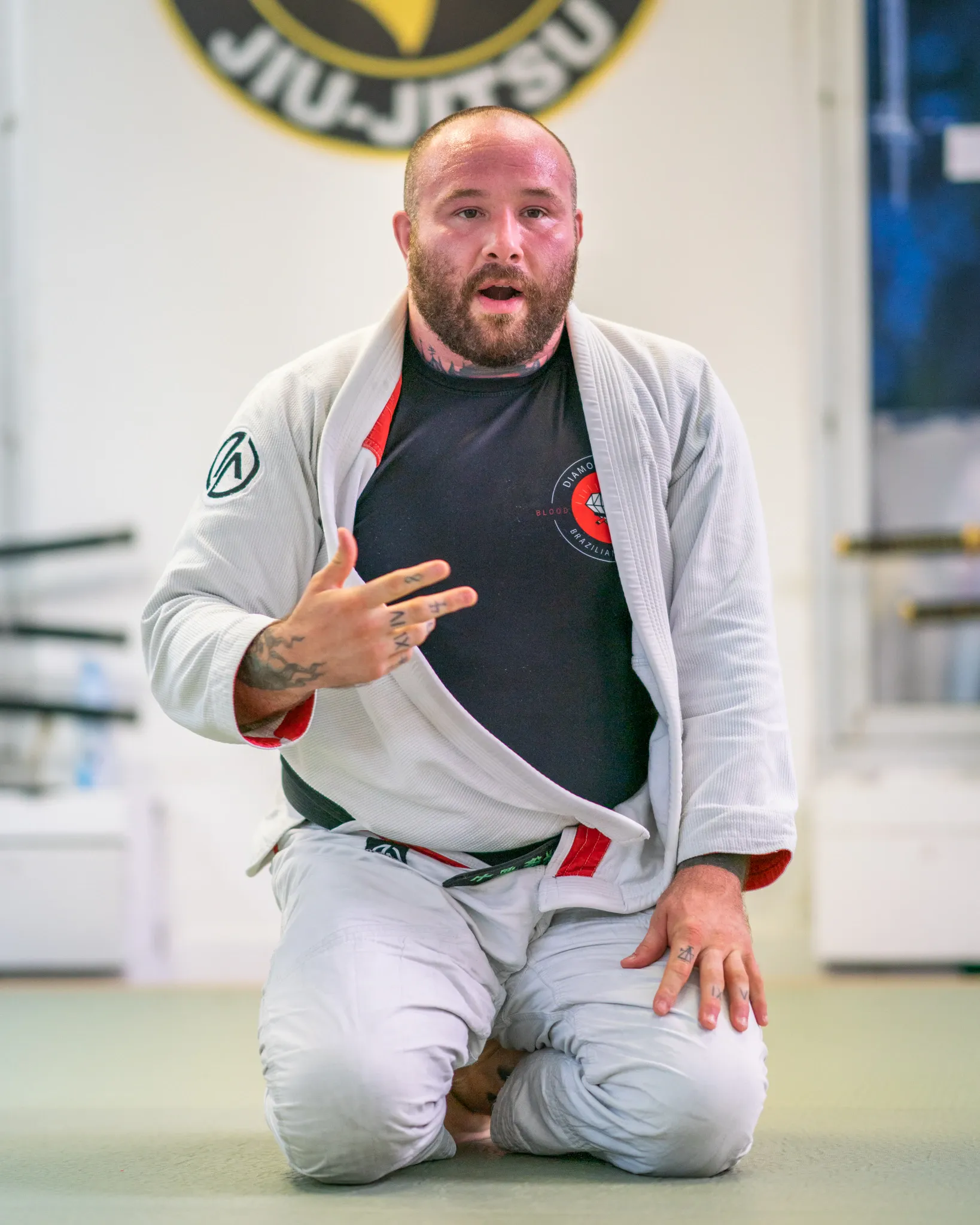
BJJ is generally safe when practiced at a reputable gym with proper coaching. Injury rates in BJJ are lower than in many contact sports like football and rugby. The "tap" mechanism lets you surrender before injury occurs, and most training is done at controlled intensity.
INJURY STATISTICS — HOW BJJ COMPARES
Prospective BJJ students often assume that a grappling-based martial art involving chokes and joint locks must carry high injury risk. The research tells a different story. Published studies on BJJ injury rates report approximately 9 to 46 injuries per 1,000 training hours depending on the study population, training context, and how injury is defined.
To put that in context, American football reports injury rates of 35–80 per 1,000 athlete exposures. Rugby union reports 81 injuries per 1,000 player hours in match play. Even recreational soccer carries significant injury risk from collisions and overuse. BJJ, trained in a controlled gym environment with cooperative training partners and a submission mechanism designed to prevent injury, compares favorably against all of these.
The majority of BJJ injuries in research studies are classified as minor — strains, sprains, and contusions that resolve without surgery or significant downtime. Severe injuries requiring surgical intervention are uncommon and typically occur in competition rather than training. Everyday class training is considerably safer than what the research captures from competition contexts.
THE TAP — BJJ'S BUILT-IN SAFETY MECHANISM
The most important safety feature in BJJ is the tap. When a submission is applied and you cannot escape, you tap — either on your partner's body, on the mat, or verbally ("tap"). Your training partner releases immediately. The exchange ends. No injury occurs.
This mechanism is what separates BJJ from purely theoretical martial arts. Because you can train with full intensity and then signal the end of an engagement before injury, you can push genuinely hard in training without the stakes of other combat sports. In boxing, for example, you absorb strikes until the referee stops the fight. In BJJ, you tap before the joint is damaged or the choke renders you unconscious.
The tap creates a training environment where intensity and safety coexist. You can go as hard as you want right up until you are caught — and then signal safety immediately. This is why BJJ has been able to establish a sparring-first training culture without an unacceptably high injury rate.
The tap works because both partners respect it as an absolute agreement. In a culture that honors the tap, injuries from submissions are rare. The risk increases dramatically in environments where the tap is not fully respected — which is one of the key red flags to watch for when evaluating a gym.
MOST COMMON BJJ INJURIES
Understanding which injuries occur most often helps you train intelligently to prevent them:
KNEE INJURIES
The most frequently reported injury site in BJJ. Ligament strains (particularly MCL) from twisting movements and scrambles. Most are minor; ACL injuries are less common but do occur.
SHOULDER INJURIES
Rotator cuff strains and AC joint injuries from collar and sleeve grips, takedowns, and resisting armbars past the point of safety. Tap before pain — not during it.
FINGER INJURIES
The most common minor injury in Gi BJJ. Sprains and "jammed" fingers from grip fighting and material catches. Usually minor but can become chronic without proper recovery.
NECK SORENESS
Common early on as your neck muscles adapt to the demands of grappling. Rarely serious. Proper warm-up and controlled sparring with beginners significantly reduces this.
HOW TO PREVENT INJURIES IN BJJ
The vast majority of BJJ training injuries are preventable with the right approach. Here are the most important prevention strategies:
Tap Early — Before Pain, Not During It
The most common cause of training injury is holding on too long in a submission. The joint or airway gives a signal before damage occurs — and that signal is when you tap. Tapping quickly is not weakness; it is intelligent training. You lose the round, reset, and continue learning. You do not miss six weeks with a torn ligament.
Warm Up Properly
Cold muscles and connective tissue are significantly more vulnerable to strain and tear. A proper warm-up that includes dynamic movement, specific drills, and gradual heart rate elevation before sparring is not optional — it is essential. Structured class formats that include warm-up before sparring dramatically reduce injury rates compared to informal open mats with no structured lead-in.
Communicate with Training Partners
Tell your training partners about pre-existing injuries before rolling. Most experienced BJJ practitioners will accommodate joint issues and will avoid certain positions or techniques upon request. This is standard gym culture at reputable gyms, not an exception.
Do Not Ego Roll
"Ego rolling" — training with more intensity than skill justifies, refusing to tap to less experienced partners, or going harder than the situation calls for — is the most culturally driven cause of injury in BJJ. The best practitioners train at the intensity appropriate to the learning objective, not the intensity their ego demands. Every experienced practitioner learns this eventually; learning it early saves a great deal of pain.
Sleep and Recover
Overuse injuries are common in practitioners who train too frequently without adequate recovery. Your tendons and ligaments adapt more slowly than your cardiovascular system and muscles. Finger joint soreness, elbow tendinitis, and knee irritation that builds session after session is a signal to back off volume temporarily. Three to four sessions per week with full recovery between them is safer than five to six sessions with inadequate sleep.
RED FLAGS IN A BJJ GYM — WHAT TO AVOID
Not all gyms are equal from a safety standpoint. These are warning signs that a training environment may not prioritize your long-term wellbeing:
- A culture that shames tapping — any environment where tapping is seen as weakness is one where injuries will accumulate
- New students sparring immediately without instruction — beginners need technique and an orientation before live rolling
- No warmup before sparring — rushing straight to live rolling is both a cultural and a physiological red flag
- Instructors who do not intervene in mismatched rolls — coaches should monitor intensity and step in when necessary
- Dirty or poorly maintained mats — mat hygiene is a direct indicator of how seriously the gym takes member health
- Poor lighting or crowded training space — physical safety of the training environment matters as much as culture
THE ROLE OF THE INSTRUCTOR IN SAFETY
A good BJJ instructor does far more than teach technique. They actively manage the training environment. This means pairing beginners with experienced, cooperative partners rather than throwing them into the deep end. It means intervening when sparring intensity becomes inappropriate for the context. It means establishing and enforcing cultural norms around the tap and around respect for training partners.
The quality and character of your instructor is the single largest factor in determining whether your gym is a safe place to train. Technical expertise matters, but so does the instructor's genuine concern for every student's long-term development. These are not mutually exclusive — the best instructors are both technically excellent and deeply invested in the wellbeing of the people on their mat.
TRAINING SMART AS YOU AGE
BJJ is genuinely lifelong — there are practitioners in their 60s and 70s who train regularly and safely. But training intelligently changes as you get older. Recovery takes longer. Connective tissue is less forgiving. The ego battles that twenty-year-olds survive more easily become genuinely risky for practitioners over 40.
The adaptations are straightforward: increase warm-up time, reduce sparring volume in favor of drilling, choose training partners who match your intensity level, and prioritize sleep and nutrition as part of your training regimen rather than as afterthoughts. None of this requires compromising the quality or authenticity of your training — it requires applying the same intelligence to your body that you apply to your technique.
SAFETY IS OUR STANDARD, NOT OUR EXCEPTION
At Method Jiu-Jitsu in Tulsa, every new student receives a first-day orientation covering the tap mechanism, how to communicate with training partners, and what to expect during their first weeks on the mat. Beginners are paired with experienced, cooperative training partners — people who know how to push appropriately and how to keep a new student safe while still providing genuine resistance.
Our coaches actively monitor sparring rounds and intervene when intensity is mismatched or a new student needs guidance. Our mats are cleaned daily. We foster a culture where tapping is respected immediately and without comment — because that respect is what makes hard, honest training possible for the long term. Safety is not a limitation on what we do. It is what makes the best training possible.
Try a Free ClassFREQUENTLY ASKED QUESTIONS
Research puts BJJ injury rates at approximately 9–46 injuries per 1,000 training hours depending on the study and training context. This is lower than football, rugby, and many other contact sports. The most common injuries affect the knee, shoulder, and fingers, and most are minor strains or sprains rather than severe injuries requiring surgery. Training with experienced, cooperative partners significantly lowers your personal risk.
Yes. Kids BJJ classes are specifically structured for age-appropriate intensity and technique. Children are paired with similarly-sized partners, certain joint locks are prohibited or taught with extreme care, and chokes are typically introduced only for older children in supervised contexts. Youth BJJ programs at reputable gyms have excellent safety records and also build physical confidence, emotional regulation, and anti-bullying awareness.
Many people with knee issues train BJJ successfully with appropriate modifications. Inform your instructor of any pre-existing conditions before your first class. Some positions and techniques place more stress on the knees than others, and a good instructor will help you identify what to avoid. Always consult your physician or physical therapist before starting any new physical activity with a pre-existing condition.
Any training partner who does not release a submission immediately upon tapping is exhibiting dangerous behavior that should not be tolerated. Report it to your instructor immediately. Reputable gyms treat this with zero tolerance — it is a fundamental violation of the training agreement. The tap is a sacred contract in BJJ. A gym's culture around tapping is one of the clearest indicators of whether it is a healthy environment to train in.
New students at Method receive a first-day orientation covering the tap mechanism, mat etiquette, and how to communicate with training partners. Beginners are paired with experienced, cooperative partners during their first weeks. Our coaches actively monitor sparring intensity and intervene when needed. Clean mats, good lighting, and a culture that respects the tap without exception are non-negotiable standards at our gym.