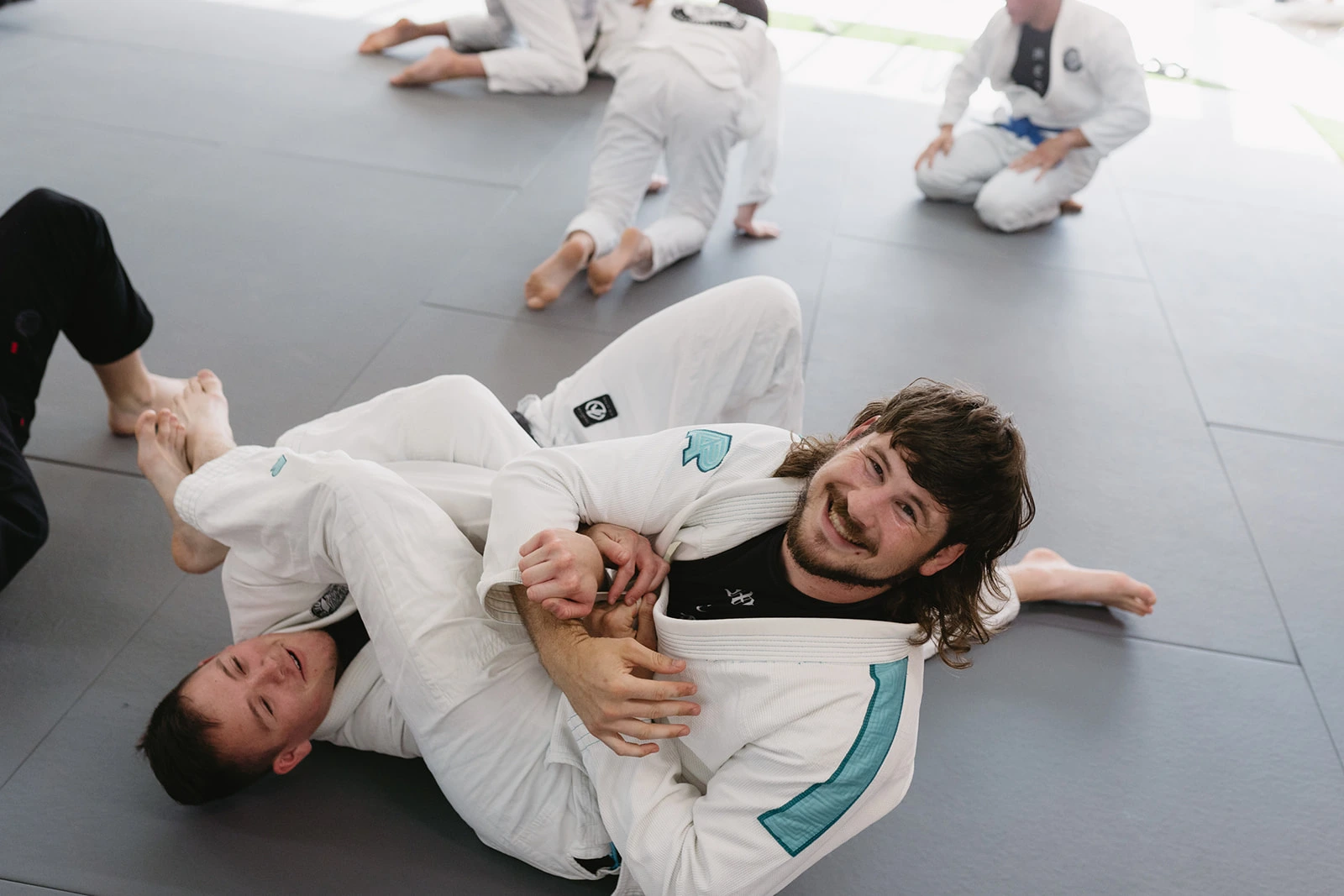
BJJ is a full-body workout that burns 500–1,000 calories per hour, builds functional strength, improves cardiovascular endurance, and increases flexibility. Unlike gym workouts, the mental engagement of BJJ makes exercise feel like play, dramatically improving consistency.
WHY BJJ IS ONE OF THE BEST FITNESS ACTIVITIES AVAILABLE
Most people who struggle with fitness do not struggle because they lack information. They struggle because they cannot stay consistent. Gyms are boring. Running is monotonous. The motivation that carried you through January evaporates by March. Brazilian Jiu-Jitsu solves the consistency problem in a way that no treadmill ever will.
When you are trying to survive a choke or execute a sweep, you are not thinking about how many calories you have burned. You are completely absorbed in the problem in front of you. That absorption is the secret weapon of BJJ as a fitness tool. Time disappears. Two hours feels like twenty minutes. And when you are done, you are drenched in sweat and genuinely satisfied — not just relieved that you survived another workout.
Beyond the psychological advantage, the physical demands of BJJ are legitimately elite. A single sparring round taxes your cardiovascular system, your muscular endurance, your flexibility, and your coordination simultaneously. There is no isolation machine in the gym that can replicate what one hard round of grappling does for your body.
HOW MANY CALORIES DOES BJJ BURN?
Calorie burn in BJJ varies based on body weight, training intensity, and the ratio of drilling to sparring in a given class. Here is how it compares to other popular fitness activities for a 180-pound person training at moderate to high intensity:
| Activity | Calories / Hour | Full Body? |
|---|---|---|
| BJJ (drilling + sparring) | 600–1,000 | Yes |
| Running (6 mph) | 550–700 | Partial |
| CrossFit (high intensity) | 500–800 | Yes |
| Weight training | 300–450 | Partial |
| Cycling (moderate) | 400–600 | Lower body |
| Yoga (vinyasa) | 250–400 | Yes |
The upper end of BJJ's calorie burn — during hard sparring rounds — rivals competitive sports like basketball and soccer. The critical difference is that BJJ training is highly structured, meaning you can maintain that output session after session without the organizational overhead of team sports.
CARDIOVASCULAR BENEFITS
BJJ develops two distinct cardiovascular capacities that most single-sport athletes lack. The first is aerobic base — the long, slow burn that comes from extended drilling, positional training, and moderate-intensity rolling. The second is anaerobic conditioning — short, explosive bursts as you explode into a takedown, bridge out of a bad position, or scramble to your feet.
Most gym cardio programs develop one or the other. BJJ develops both simultaneously because the demands of grappling are unpredictable. You cannot settle into a steady state. Your heart rate spikes and recovers continuously throughout a session — exactly the training stimulus that produces the most dramatic cardiovascular improvements over time.
After 3–6 months of consistent training, most practitioners notice that activities which previously winded them — climbing stairs, recreational sports, keeping up with their kids — feel effortless. That carry-over effect is a direct result of the cardiovascular stress BJJ places on your system every class.
FUNCTIONAL STRENGTH
The strength you build in BJJ is not the kind that shows up in isolation exercises. It is grip strength, core stability, hip power, and full-body tension — the kind of strength that transfers directly to real-world physical demands. Holding a dominant position against a resisting opponent is one of the most demanding full-body strength tests that exists.
Your core is engaged in virtually every position in BJJ. Whether you are maintaining guard, driving a hip escape, or controlling your opponent's posture from mount, your trunk is working. Over months of training, this produces a level of core stability that no amount of planks or crunches can replicate, because BJJ demands isometric strength under dynamic, unpredictable loads.
Grip and forearm strength are among the first things beginners notice improving. Gi training in particular places enormous demands on your hands and wrists. After a few months, tasks that used to tire your grip — carrying groceries, opening jars, doing pull-ups — become effortless.
FLEXIBILITY AND MOBILITY
BJJ demands movement through ranges of motion that most adults have not accessed since childhood. Hip mobility is particularly critical — guard positions, shrimping, and bridging all require fluid hip movement. Over time, consistent training restores and expands mobility that desk work and sedentary habits have stripped away.
Unlike static stretching, BJJ develops mobility under load — while your muscles are actively working, not relaxed. This functional flexibility transfers directly to injury prevention in daily life. People who train BJJ regularly tend to have significantly better hip, shoulder, and thoracic spine mobility than age-matched non-practitioners.
COORDINATION AND BODY AWARENESS
Proprioception — your body's sense of where it is in space — is one of the most underrated components of physical fitness. BJJ demands extraordinary body awareness. You must know exactly where your hips are relative to your opponent, which way your knees are pointing, and how to explode in a specific direction without telegraphing your intention.
This training effect carries over powerfully to other sports and activities. BJJ practitioners often notice improvements in their performance in tennis, skiing, recreational basketball, and other athletic pursuits as a direct result of the coordination demands of grappling.
WHY BJJ BUILDS BETTER FITNESS HABITS THAN THE GYM
The most important fitness variable is not which workout you do — it is whether you actually show up. BJJ has several built-in mechanisms that drive consistency in ways commercial gyms cannot replicate.
Accountability Through Community
When you train at a BJJ gym, you develop real relationships with your training partners. People notice when you are absent. Your partners want to see you improve because your improvement makes them better. This social accountability is one of the most powerful behavioral forces in habit science — and it is built into BJJ by default.
This is especially true for women who train BJJ in Tulsa — many describe the training community as one of the most meaningful parts of their fitness journey.
Skill-Based Motivation
The gym offers no clear progression. You can add five pounds to a lift, but the incremental nature of that progress is abstract. In BJJ, progress is tangible and intrinsically motivating. The first time you successfully execute a sweep, or hold a dominant position for longer than you ever have, provides a reward signal that no personal record in a squat rack can match.
The Engagement Factor
Boredom is the enemy of consistency. BJJ is cognitively demanding in a way that prevents boredom entirely. Every round presents new problems — a different body type, a new technique, an unfamiliar situation. Your brain is as engaged as your body, which means training feels like problem-solving, not punishment.
BODY COMPOSITION CHANGES
Most people who train BJJ consistently for 3–6 months report meaningful changes in body composition — reduced body fat and increased lean muscle — without actively dieting. The combination of high caloric expenditure, total-body muscle recruitment, and improved metabolic conditioning creates an environment where body recomposition happens as a natural byproduct of skill development.
The rate and degree of change depend heavily on training frequency, nutrition, sleep quality, and starting point. But the evidence from tens of thousands of practitioners worldwide is consistent: BJJ changes how your body looks and feels, often in ways that years of gym membership failed to achieve.
RECOVERY AND TRAINING FREQUENCY
Most beginners should target three sessions per week. This provides enough stimulus for both fitness and skill development while leaving adequate recovery time. Your muscles, connective tissue, and nervous system all need time to adapt — especially in the first months when your body is learning entirely new movement patterns.
As your conditioning improves and your technique becomes more efficient (less energy wasted through tension and poor positioning), you can increase to four or five sessions per week. Many intermediate practitioners train five days per week without overtraining, because technical efficiency reduces the physical cost of each session.
Listen to your body. Soreness in unfamiliar muscle groups is normal early on. Sharp joint pain is not. Train hard, recover fully, and let your body tell you when it is ready for more.
STRUCTURED FOR CONDITIONING
Every class at Method Jiu-Jitsu is designed to deliver a complete physical and technical workout. We open with structured warm-ups that build mobility and cardiovascular readiness, move into technical drilling that develops skill under controlled conditions, and close with timed sparring rounds that push your conditioning and test what you have learned.
New students are introduced to training partners who understand how to work cooperatively — challenging enough to build real conditioning, controlled enough to keep you safe and learning. Our coaches monitor intensity and make sure you are pushing appropriately for your experience level. The goal is sustainable progress, not one-session burnout.
Try a Free ClassFREQUENTLY ASKED QUESTIONS
BJJ typically burns between 500 and 1,000 calories per hour depending on your body weight, training intensity, and how much time you spend sparring versus drilling. A 180-pound person sparring at moderate intensity burns approximately 700–800 calories per session — comparable to a vigorous run but with far more total-body engagement and skill development.
Yes. Most people see noticeable improvements in cardiovascular endurance, functional strength, flexibility, and body composition within the first 2–3 months of consistent training at 3–4 sessions per week. BJJ is one of the few activities that delivers a full-body workout while remaining engaging enough that most people actually stick with it long term.
Both deliver excellent fitness results. CrossFit focuses on measurable athletic performance metrics, while BJJ builds fitness as a byproduct of learning a martial art. Many people find BJJ more sustainable long term because the competitive, problem-solving nature makes it easier to stay consistent. The best choice is whichever one you will actually show up to consistently — and BJJ has a strong track record for long-term retention.
No. BJJ is self-pacing — you control the intensity of your training, especially as a beginner. Most gyms pair new students with cooperative partners during their first weeks. Your fitness will improve naturally through training. Starting in poor shape is completely normal and expected. Everyone starts somewhere, and BJJ meets you where you are.
Three sessions per week is the sweet spot for most beginners — enough frequency to see fitness and skill improvements while allowing adequate recovery. As your conditioning improves, many practitioners move to 4–5 sessions per week. Quality of training matters more than volume, especially early on. Consistency over months beats intensity over days.