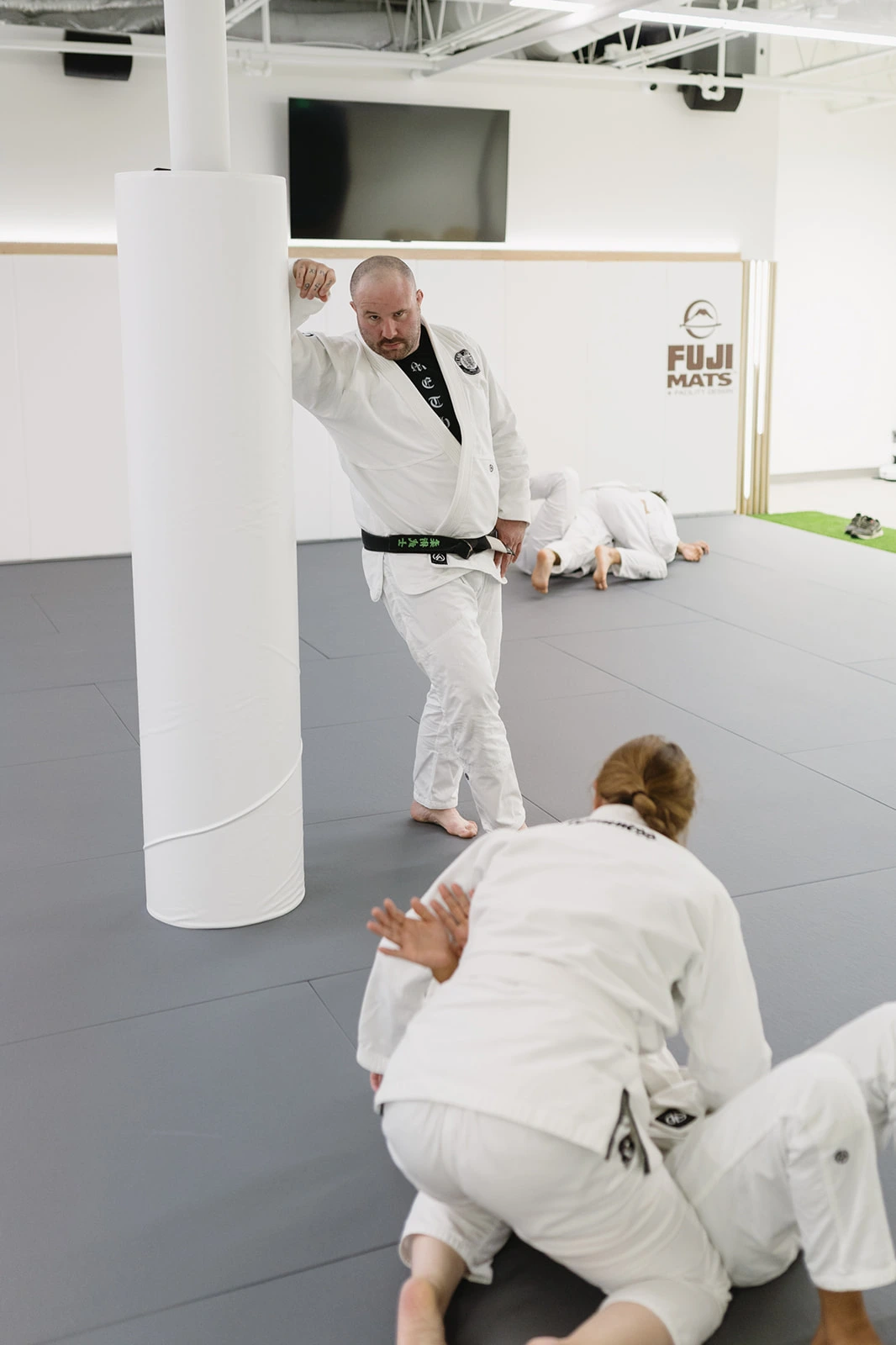
Most people earn their BJJ blue belt in 1–2 years of consistent training (3–4 sessions per week). The timeline depends on training frequency, natural athleticism, learning ability, and your gym's promotion standards.
THE HONEST TIMELINE
The white belt question everyone asks but few instructors answer directly: how long will it take? The honest answer is 1–2 years for most people training consistently at 3–4 sessions per week. Some practitioners promote in as few as 8–10 months. Others take 3 years. Both outcomes are completely normal and valid.
The most important thing to understand is that BJJ promotions are based on demonstrated skill, not time served. A person who trains five days per week with full focus and intensity for 10 months may be more ready for blue belt than someone who trained twice per week halfheartedly for three years. Promotions reflect your instructor's genuine assessment of your capability — not a tenure award.
This means the timeline question ultimately reduces to two variables: how often you train, and how well you train when you are there.
FACTORS THAT AFFECT PROMOTION SPEED
Training Frequency
This is the single largest variable. A student training five days per week accumulates skill roughly 2.5 times faster than someone training twice per week. More repetitions, more sparring rounds, more situations — the feedback loop is simply faster. If you want to earn your blue belt on the shorter end of the timeline, show up consistently.
Prior Grappling Background
Wrestlers and Judokas often move through white belt faster because many foundational movement patterns — base, pressure, hip control — are already internalized. A collegiate wrestler who starts BJJ often earns blue belt in 8–12 months. This is not the norm, but it is common enough that instructors account for it in their evaluation.
Physical Attributes
Athletic ability, body awareness, and natural coordination do affect how quickly you absorb technique. Younger, more physically coordinated people typically pick up movements faster early on. However, this advantage diminishes significantly at higher belt levels, where technical depth matters far more than athleticism.
Mental Engagement
Students who study the art outside of class — watching instructional videos, reviewing competition footage, asking questions after class — tend to develop faster. BJJ rewards active learning. The more cognitive attention you bring to the art, the faster patterns click into place during live training.
Quality of Training Partners
Training at a gym with skilled higher belts accelerates your development significantly. Rolling against better training partners reveals weaknesses in your game that same-rank rolling cannot expose. A gym with experienced purple, brown, and black belts is a major accelerant for white belt development.
WHAT A BLUE BELT SHOULD KNOW
Blue belt standards vary between instructors and gyms, but a reasonable baseline looks like this:
- Closed guard control — reliable posture breaking, grip fighting, and at least two functional submissions
- Basic guard passing — at least one reliable pass concept and the ability to pressure or move around resistance
- Escape from mount — bridge-and-roll and elbow-knee escape executed under live pressure
- Escape from side control — frame, shrimp, and recover guard or create space consistently
- Back defense — understanding of how to prevent the choke and work to escape
- Hip escape mechanics — the foundational BJJ movement pattern, executed correctly across all situations
- Survival against higher belts — not getting submitted immediately, showing genuine positional understanding
You do not need to submit everyone. Blue belt is not about finishing — it is about demonstrating that you understand the language of BJJ and can apply it in real time against resistance.
THE WHITE BELT JOURNEY — PHASE BY PHASE
MONTHS 1–3: SURVIVAL MODE
Everything is confusing. Your body does not know how to move yet. You get submitted constantly. This is completely normal. The goal in this phase is simply to show up consistently and start building foundational movement vocabulary.
MONTHS 3–6: PATTERN RECOGNITION
Techniques begin to connect. You can feel when something is working and when it is not. Survival improves. You start developing a sense of preferred positions — the earliest stage of a personal game taking shape.
MONTHS 6–12: BUILDING A GAME
Techniques become functional under pressure. You have positions you are comfortable in and positions still in development. Your defense has solidified and you can occasionally execute techniques on more experienced training partners.
MONTHS 12–24: BLUE BELT TERRITORY
Most dedicated practitioners are in the blue belt readiness range somewhere in this window. Your game has identifiable shape, your execution under pressure is consistent, and your instructor is seeing what they need to see. The promotion happens when the time is right.
COMMON MISTAKES WHITE BELTS MAKE
Obsessing Over the Belt
This is the most counterproductive mindset in BJJ. Students fixated on promotion often tense up in sparring, avoid situations that might expose their weaknesses, and train to look good rather than to learn. Instructors see through this immediately. The best way to earn your blue belt is to stop caring about the blue belt and focus entirely on getting better at jiu-jitsu.
Training Only with White Belts
White belt development requires exposure to higher belts. Rolling exclusively with same-rank training partners limits your understanding of what BJJ looks like when executed correctly. Seek out rounds with blue, purple, and brown belts. You will lose constantly. You will also learn exponentially faster.
Avoiding Uncomfortable Positions
Many white belts develop a strong top game because they quietly avoid the bottom. They pull guard to avoid takedowns, or restart from standing when things get difficult. This creates a one-sided game that instructors notice. Embrace uncomfortable positions deliberately — they are where the most learning happens.
Skipping the Fundamentals
Modern BJJ has a dizzying array of advanced techniques available on video. White belts are tempted to chase leg locks, berimbolo, and other advanced concepts before they can reliably execute a hip escape. Fundamentals first, always. A reliable hip escape and solid closed guard will carry you further toward blue belt than any advanced system.
THE "BLUE BELT BLUES" PHENOMENON
A well-documented pattern in BJJ is the "blue belt blues" — a period of frustration and reduced motivation that hits many students around the 6–12 month mark of white belt training. The initial excitement has worn off, improvement feels slow, and advanced practitioners seem impossibly far ahead.
This is normal. Almost every practitioner who reaches blue belt went through a version of this period. The solution is simply to keep showing up. The plateau feeling is often a sign that your body is integrating a large volume of information below the surface — and a breakthrough in capability frequently follows soon after. The students who push through this period are the ones who get promoted.
CURRICULUM, NOT GUESSWORK
At Method Jiu-Jitsu in Tulsa, white belts follow a structured fundamentals curriculum with clear milestones at each stage. You are never left wondering what to work on or what the next step looks like. Our coaches track your development and give you direct feedback on where you are and what you need to focus on next.
We do not charge belt testing fees. Promotions at Method are based entirely on demonstrated skill and character — the two things that actually matter. When your instructor promotes you, you will have earned it in the truest sense. No timelines to game, no politics, no ambiguity about what comes next.
Start Your JourneyFREQUENTLY ASKED QUESTIONS
Most people earn their BJJ blue belt in 1–2 years of consistent training at 3–4 sessions per week. The timeline varies based on training frequency, prior grappling experience, natural athleticism, and the promotion standards of your specific gym. Some promote in 8 months; others take 3 years. Both are completely normal outcomes.
The most reliable accelerators are training frequency, focused drilling, studying technique through video, asking good questions in and after class, and competing in tournaments. What does not work is obsessing over the belt itself — instructors promote based on demonstrated skill and character, not attitude about promotion. Stop chasing the belt and chase knowledge instead.
Blue belt standards vary by gym, but generally include: reliable closed guard with submission attacks, basic guard passing, escapes from mount and side control, back defense fundamentals, and solid hip escape mechanics. You need to demonstrate consistent execution under real resistance in live sparring — not just in drilling. You do not need to finish everyone; you need to show genuine understanding of core BJJ concepts.
No. At Method Jiu-Jitsu, promotions are based entirely on our coaches' ongoing observation of your skill and character in class and sparring — no formal test, no testing fees. We watch you train every session. When you are ready, you will know. Gyms that charge for belt tests are widely considered a red flag in the BJJ community.
Stripes are incremental recognition marks placed on your belt between formal promotions. Most BJJ systems award up to four stripes on each belt before promoting to the next level. They acknowledge consistent progress and give instructors a way to recognize development without a full belt promotion. Stripe usage varies by gym — some award them regularly, others use them more sparingly.