Before You Arrive
What to Wear
For your first class, you don't need a gi (the traditional BJJ uniform) or any special gear. Keep it simple:
- Athletic shorts with no pockets or exposed zippers — metal hardware can scratch your training partner
- A rash guard or a fitted t-shirt — loose shirts tend to get grabbed and ridden up during drilling
- Flip-flops or sandals to walk from the lobby to the mat — shoes are never worn on the mat itself
That's it. You don't need to buy a gi, a rash guard, or any gear before your trial. Come as you are and we'll take care of the rest.
What to Bring
- A full water bottle — you'll use it
- A small towel if you run warm
- An open mind and a willingness to make mistakes
A Few Prep Notes
Remove all jewelry before you step on the mat — rings, earrings, necklaces, and bracelets. Trim your fingernails and toenails the night before so you're not inadvertently scratching anyone. These are basic mat etiquette habits every BJJ student develops quickly.
Arrive 10–15 minutes early. This gives you time to meet the coach, get a quick tour of the facility, and settle in before class starts. Walking in right as the warm-up begins adds unnecessary pressure to an already unfamiliar situation.
One more thing worth saying directly: you don't need to be in shape to start. BJJ is what gets you in shape. Students who were never athletic before have gone on to earn their black belts. The training builds your fitness for you, over time, without you having to be ready for it in advance.
The Warm-Up (10–15 Minutes)
Every class at Method begins with a group warm-up. Unlike a generic gym warm-up, the movements here are specific to Brazilian Jiu-Jitsu. You'll learn things like:
- Hip escapes (shrimping) — a foundational movement for escaping bad positions
- Bridging — using your hips to create leverage from your back
- Technical stand-ups — getting up safely when someone is in front of you
- Forward and backward rolls — basic tumbling that shows up constantly in BJJ
These movements will feel strange at first. That's completely normal — nobody walks in doing them correctly. What matters is that you try. The warm-up serves double duty: it raises your heart rate and teaches you the vocabulary of BJJ movement at the same time.
The Technique Lesson (20–25 Minutes)
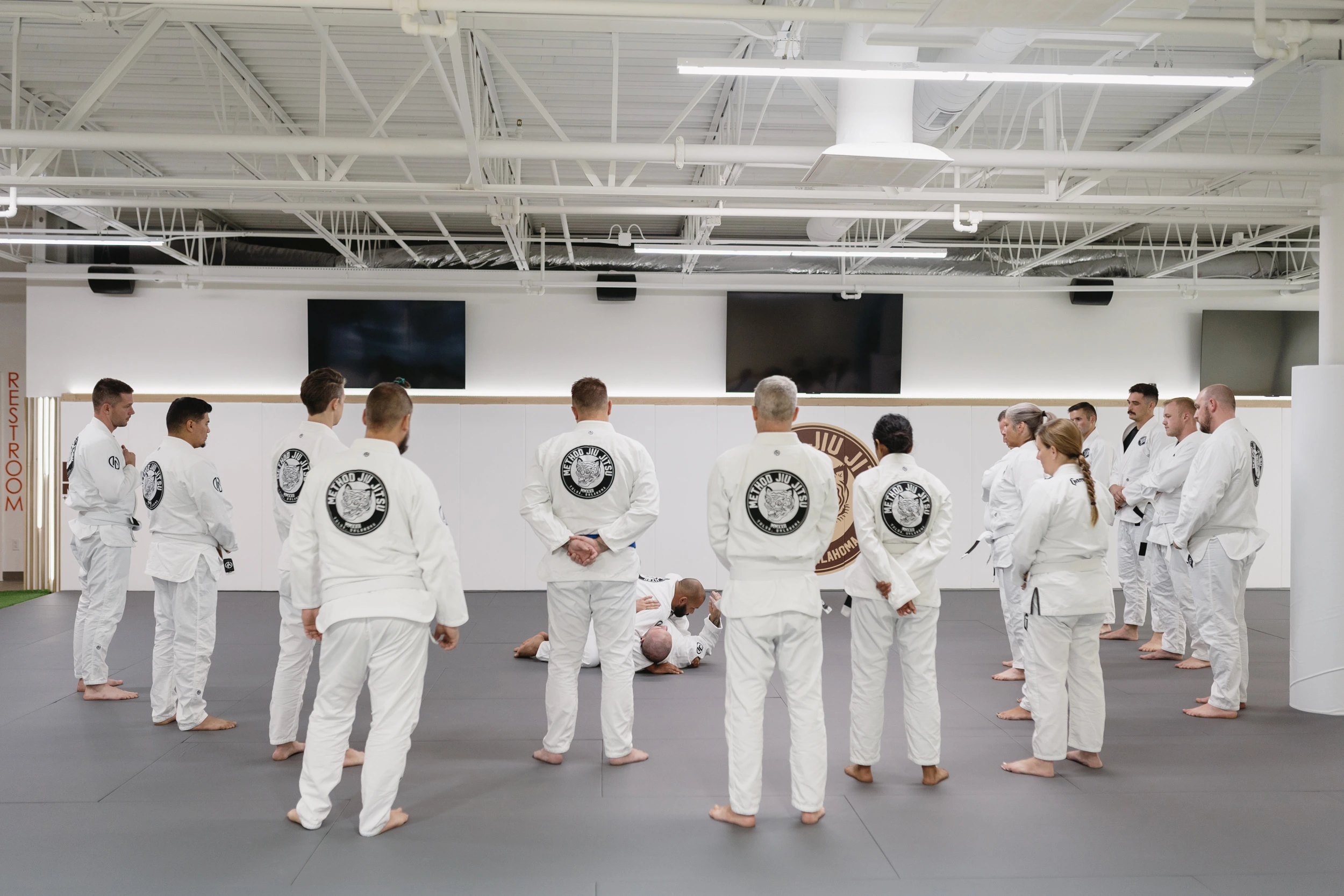
After the warm-up, the coach will demonstrate 2–3 techniques. This is the core of the class. The approach looks like this:
-
01Coach demonstrates the technique The coach shows the move at full speed first, then breaks it down step by step with a training partner. Watch closely — details matter in BJJ.
-
02You pair up with a partner Newer students are often paired with more experienced training partners who know how to go easy and give helpful feedback. Your partner wants you to learn.
-
03Drill, drill, drill Repetition is how BJJ is learned. You won't master the technique in one class, and that's fine. Each repetition builds a small piece of the larger pattern.
-
04Ask questions freely The coach walks the mat during drilling. If something isn't clicking, flag them down. No question is too basic — coaches genuinely enjoy fixing the details.
The technique taught on any given day will fit into a broader theme the class is working through over several weeks. As a new student you won't always have that context, and that's fine. Focus on the movement itself.
In BJJ, you're always training with another person. This means learning to communicate. If a training partner applies a technique too hard or moves into a position that causes pain, it's always okay to say so. Good training partners and good coaches prioritize safety above everything else.
Live Sparring / "Rolling" (15–20 Minutes)
After the technique portion, most classes end with live sparring — called rolling in BJJ. This is where two training partners move freely, each trying to apply what they've learned while their partner resists.
On your first day, you'll almost certainly watch from the sideline during this part — and that's completely appropriate. Watching is genuinely useful. You'll start to see the concepts from the technique lesson appear in real-time, and you'll develop an instinct for what rolling actually looks like before you're in it.
If a coach decides you're ready and pairs you up for a round, the experience will be nothing like what you might imagine. Rolling in BJJ is often described as physical chess. The goal isn't to overpower anyone — it's to maneuver, create angles, and apply technique. An experienced partner will move slowly with a beginner, explain what's happening as it happens, and make it a learning experience rather than a competition.
About Tapping Out
In BJJ, when you find yourself in a joint lock or a choke that you can't escape, you "tap" — either patting your partner twice or saying "tap" clearly. Your partner immediately releases. Tapping is not losing. It's a fundamental safety mechanism and a core part of BJJ culture. Everyone taps, including black belts. Tapping often and early is how you train for years without injury.
After Class
When the timer goes off, both training partners slap hands — a show of mutual respect that happens at the beginning and end of every round in BJJ. The post-class environment at Method is casual and friendly. People stretch, talk, laugh about something that happened during rolling, and help each other with questions.
You'll probably feel tired in a way that's different from a regular gym workout — BJJ uses muscles you didn't know you had and demands mental focus at the same time. Most people also feel a strong sense of accomplishment after their first class, even when nothing went particularly well technically.
The coach will check in with you before you leave. This is a good time to ask any questions that came up during class, get a recommendation for which class to try next, or just have a conversation about what you're looking to get out of training.
What We Tell Every Beginner at Method
There are a few things the coaches at Method say to every new student, because they're genuinely true:
- Everyone started where you are. Every black belt, every competition winner, every long-time member had a first day. They were confused, got put in bad positions, and had no idea what they were doing. That shared history creates real empathy in the room.
- You don't need any prerequisites. Not athleticism, not flexibility, not strength, not prior martial arts experience. None of it is required. BJJ is remarkably egalitarian in that way — smaller, older, or less physically gifted students regularly submit larger, younger ones through technique alone.
- The hardest part is walking through the door. Most people who sign up for a free trial have been thinking about it for weeks or months. After the first class, the decision of whether to keep training becomes much easier — because now it's based on actual experience rather than imagination.
If you'd like to read more about the coaching approach at Method, visit the instructor page to learn about Dallas Niles and the team that teaches on the mat every day.