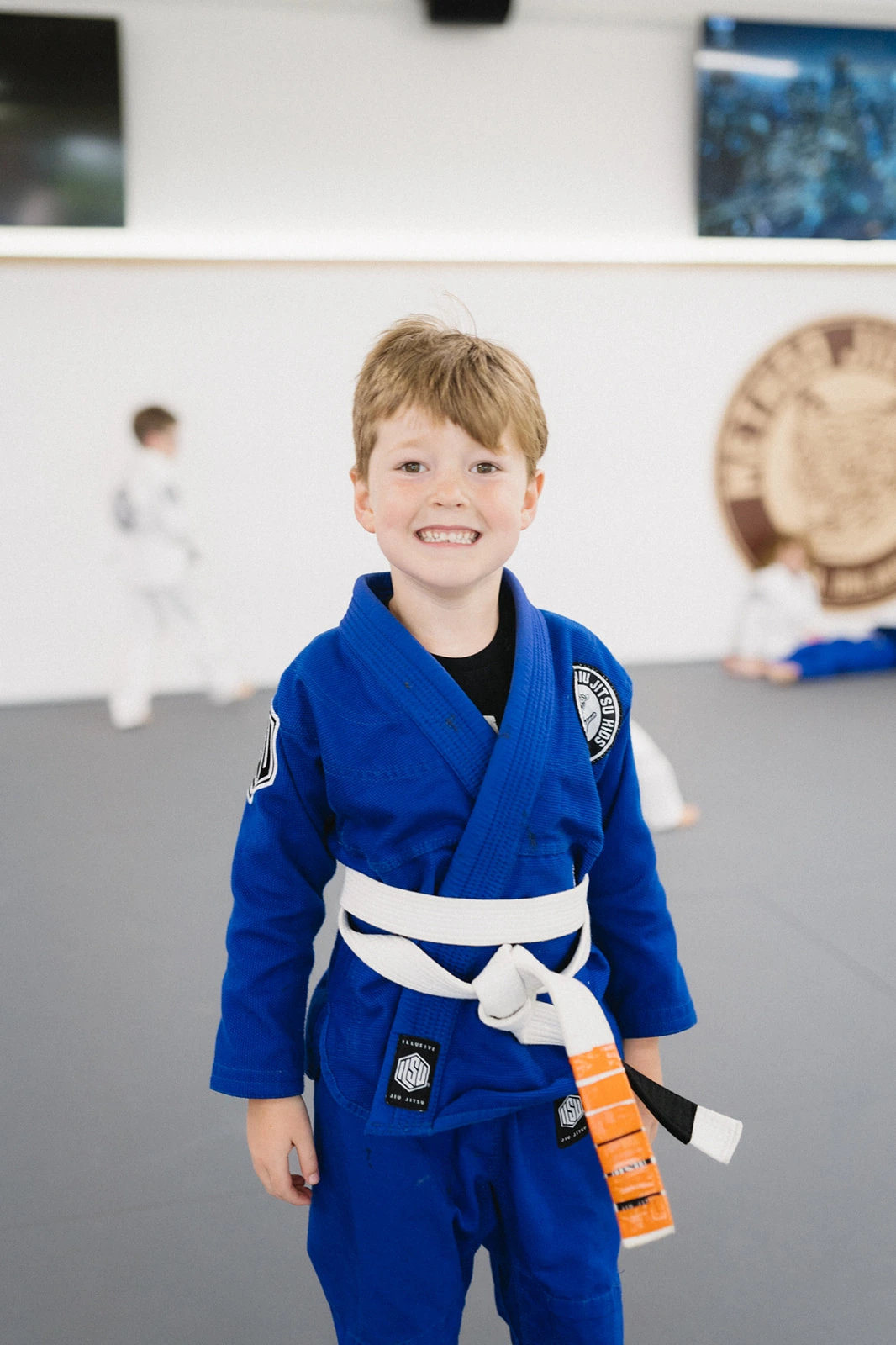
BJJ focuses on ground fighting, submissions, and positional control, making it unique among martial arts. While striking arts like boxing and Muay Thai excel standing up, BJJ dominates on the ground — where most real fights end up.
WHAT MAKES BJJ DIFFERENT FROM OTHER MARTIAL ARTS
Most martial arts are built around the assumption that combat happens standing up. You punch, kick, block, and move. Brazilian Jiu-Jitsu rejects that assumption entirely. BJJ's central thesis is that the vast majority of real-world physical confrontations — whether in a street altercation, a competition, or an MMA cage — go to the ground at some point. BJJ practitioners are uniquely prepared for that reality.
The other thing that sets BJJ apart is how it is trained. In most traditional martial arts, techniques are practiced through kata (forms) or drills with a cooperative partner. In BJJ, the primary training method is live sparring — called "rolling" — in which two practitioners compete against each other in real time, with full resistance. This pressure-testing against genuine resistance is what makes BJJ reliably effective in ways that more theoretical systems often are not.
BJJ VS KARATE
Karate is a striking-based art rooted in punches, kicks, and blocks, with many styles emphasizing kata practice. Traditional Karate training rarely involves full-contact sparring, which means the techniques are rarely tested against realistic resistance.
In terms of self-defense effectiveness, BJJ has a significant advantage in any scenario that goes to the ground — which, statistically, most real altercations do. A trained Karateka who is taken down or trips has virtually no tools for that environment. A BJJ practitioner is fully at home on the ground and can end the altercation from there.
This is not to dismiss Karate entirely. Many Kyokushin and sport Karate practitioners are excellent strikers. But the lack of ground defense is a critical gap that BJJ closes. Many Karate practitioners who add BJJ to their training describe it as transformative for their overall capability.
BJJ VS JUDO
Judo and BJJ share a common ancestor in Japanese Jujitsu and are closely related arts. Judo focuses primarily on throwing and takedowns — achieving positional dominance by bringing the opponent to the ground, scoring in competition with a clean throw. BJJ picks up where Judo leaves off, specializing in what happens after the throw: ground control and submissions.
Modern competition Judo has significantly reduced the ground game through rule changes that limit time spent in ground fighting (ne-waza). As a result, many Judokas have limited submission defense and limited experience in the kind of protracted ground battles that BJJ practitioners navigate daily.
However, Judokas often have exceptional takedown skills that translate well to both self-defense and MMA. The two arts complement each other naturally — Judo for stand-up, BJJ for the ground. Many elite BJJ practitioners also train Judo specifically for this reason.
BJJ VS WRESTLING
Wrestling and BJJ are perhaps the most closely aligned of all pairings. Both are grappling arts, both are trained with full resistance, and both produce athletes with exceptional physical conditioning and spatial awareness on the ground. The primary difference is intent.
Wrestling is scored on takedowns and controlling the opponent from top position. The goal is to pin the opponent to the mat. Submissions are not part of wrestling. BJJ shares the emphasis on takedowns (to a lesser degree) and top control, but adds a full library of submissions — chokes, joint locks, and leg attacks — that wrestlers typically have no training in.
Wrestlers who add BJJ often have a significant advantage: their takedowns and top control are already elite, and they simply add submission finishing tools and submission defense. Many of the most successful BJJ and MMA competitors began as wrestlers. The crossover is high.
BJJ VS MUAY THAI
Muay Thai — the striking art of Thailand — uses punches, kicks, elbows, and knees, and is widely considered the most complete striking system in the world. In a pure stand-up exchange, an experienced Muay Thai fighter has a substantial advantage over a BJJ practitioner who lacks striking training.
The dynamic shifts the moment the fight goes to the ground. A Muay Thai fighter with no grappling experience is immediately at a disadvantage once grabbed or taken down. They have no positional awareness, no submission defense, and no tools to control or escape from an experienced grappler.
This is why modern MMA almost universally combines BJJ with a striking art. The most complete fighters in the world train BJJ for the ground and Muay Thai (or boxing) for the stand-up. Neither alone is sufficient for the full spectrum of combat.
BJJ VS KRAV MAGA
Krav Maga is a self-defense system developed for the Israeli military, focused on real-world threat neutralization. It incorporates strikes, weapon defenses, and situational awareness. In principle, Krav Maga sounds comprehensive. In practice, the critical variable is how it is trained.
Most civilian Krav Maga training involves cooperative partner drills rather than fully resisted sparring. Techniques are tested against partners who know the attack is coming and cooperate with the defense. This is fundamentally different from BJJ's rolling-based training, where nothing is pre-arranged and the opponent offers genuine resistance.
The result is that while BJJ techniques are battle-tested in competition against fully resisting opponents, many Krav Maga techniques remain largely theoretical in their effectiveness against someone who actually fights back hard. This is not a knock on the concept of Krav Maga — it is simply an observation about training methodology and what it produces.
BJJ IN MMA — WHY EVERY FIGHTER TRAINS IT
The strongest argument for BJJ's effectiveness is the empirical evidence from mixed martial arts competition. When the UFC was founded in 1993, one of its original purposes was to determine which martial art was most effective. Royce Gracie won the first three tournaments using BJJ, defeating opponents from boxing, wrestling, Karate, and Savate.
Today, virtually every top MMA competitor in the world has a strong BJJ foundation. It is not the only art they train — the sport has evolved to reward well-rounded athletes. But BJJ remains indispensable. A fighter without BJJ can be submitted and controlled on the ground with no recourse. A fighter with strong BJJ can neutralize takedowns, submit opponents, and get back to their feet at will.
WHICH MARTIAL ART IS BEST FOR SELF-DEFENSE?
For most people in most real-world scenarios, BJJ offers the most reliable self-defense foundation for these reasons:
- It is trained with full resistance, meaning techniques are tested against genuinely resistant opponents
- It works on the ground, where the majority of physical altercations end up
- It allows a smaller person to control and neutralize a larger, stronger attacker using leverage
- It provides tools to escape bad positions without needing to inflict maximum damage
- The tap mechanism means you can train hard without injuring your partners or yourself
This does not mean BJJ is perfect for every situation. Awareness, de-escalation, and situational judgment are more important than any technique. And adding basic striking knowledge substantially improves your overall self-defense capability. But as a single foundational art, BJJ is the most practically validated option available to civilian practitioners.
CAN YOU TRAIN MULTIPLE MARTIAL ARTS?
Absolutely, and many practitioners do. BJJ pairs exceptionally well with boxing, Muay Thai, Judo, and wrestling. The common pattern is to develop a solid BJJ foundation first — usually to blue belt — then add complementary arts. This sequence works because BJJ provides the most complete and technically demanding ground game, which takes the most time to develop. Stand-up skills can be layered on top more quickly once your body and movement vocabulary are established through grappling.
ALL BACKGROUNDS WELCOME
At Method Jiu-Jitsu in Tulsa, we have trained practitioners from virtually every martial arts background — wrestlers, Judokas, Muay Thai fighters, MMA competitors, and complete beginners with no prior experience. Our curriculum is designed to meet each student where they are, building on existing strengths while filling the gaps.
If you come from a wrestling background, we will accelerate your takedown game and add submission finishing tools. If you come from a striking background, we will help you understand the ground in a completely new way. And if you have no background at all, we will build your game from the ground up with a structured, proven curriculum. Everyone starts at the same place: curious and willing to learn.
Try a Free ClassFREQUENTLY ASKED QUESTIONS
No single martial art is universally the best — effectiveness depends on context. BJJ is widely considered the most effective system for one-on-one ground fighting and is extensively pressure-tested in competition and MMA. For self-defense, it consistently ranks among the top choices because it works against larger opponents and has been validated against fully resistant opponents over decades.
Yes, and many practitioners do. BJJ and boxing or Muay Thai complement each other perfectly — BJJ handles the ground, striking covers the stand-up range. This combination is the foundation of modern MMA. Many BJJ gyms are familiar with students who split time between disciplines and will structure your training accordingly.
BJJ is essential for MMA. Virtually every successful MMA fighter has a strong BJJ foundation. It provides submission offense and defense needed to survive and win on the ground, where a large percentage of fights are decided. It also teaches takedown defense and the ability to get back to your feet — critical skills in any mixed-rules competition.
Both are highly effective. Wrestling provides superior takedown ability and top control, while BJJ adds submission finishing tools that wrestling does not emphasize. For self-defense, BJJ has a slight edge because it includes techniques to end a fight from the bottom — useful if you are taken down or tripped. Many serious grapplers train both arts for complete coverage.
No. BJJ is completely accessible without any prior martial arts experience. Most beginners start with no background whatsoever. A striking background can help with stand-up awareness, but it provides no advantage on the ground — which is where BJJ training primarily takes place. You will learn everything you need from the start.