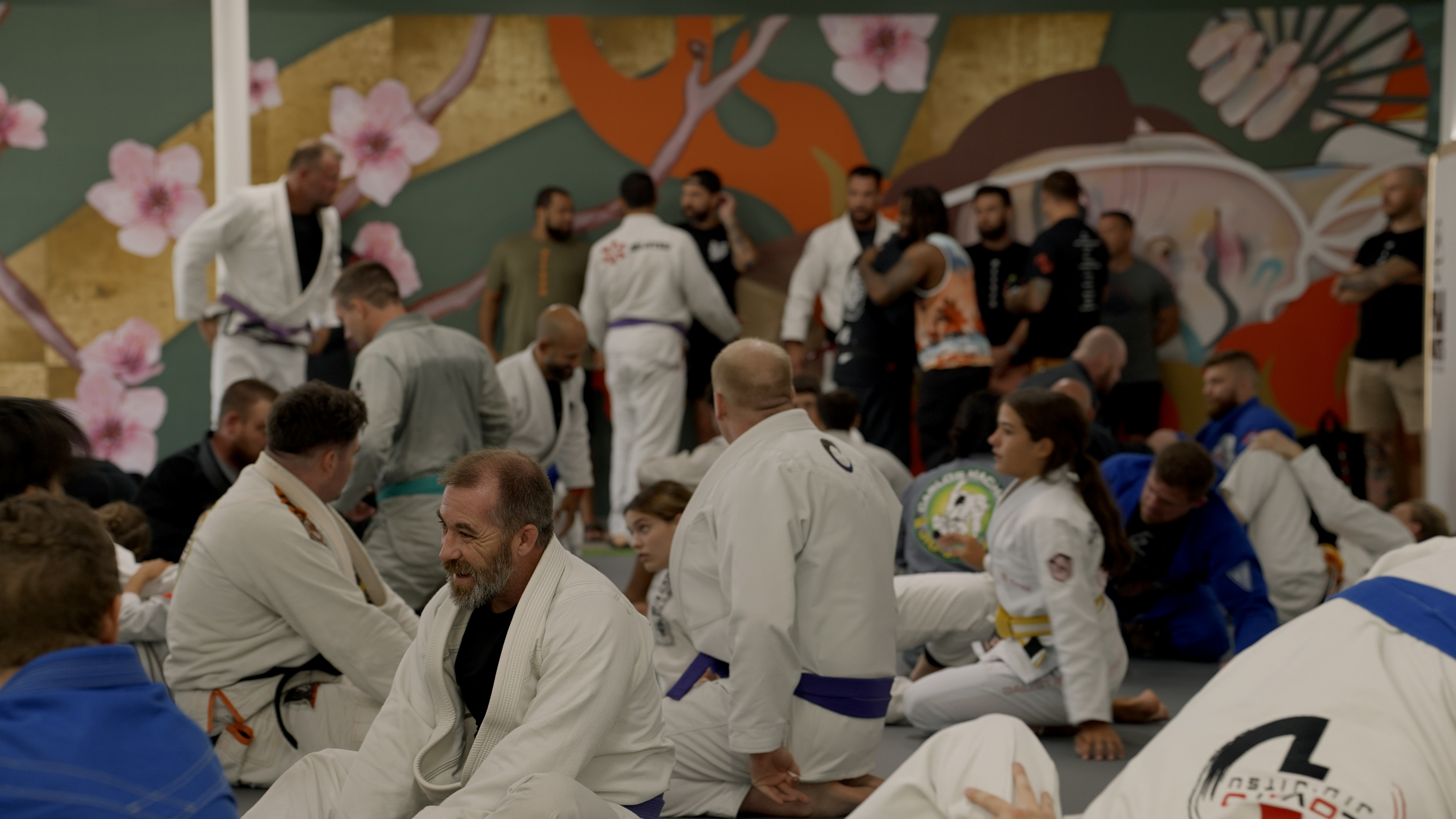
The photo above shows a packed class at Method Jiu-Jitsu. It captures something a technique video cannot: the people who help make a technique yours. You can watch an escape a hundred times, but you need a partner to feel where the weight goes, ask what changed, and try it again. If you are looking for a jiu jitsu community in Tulsa, the quality of the people you train with deserves as much attention as the moves on the syllabus.
At Method, training is individual progress built through shared work. The people next to you on the mats become the reason you learn to adapt, return after a frustrating day, and eventually help the next beginner find their footing. Here is what to look for in BJJ training partners in Tulsa and why that culture matters.
BJJ Is an Individual Skill You Cannot Build Alone
A heavy bag does not change its defense. A training partner does. In gi jiu-jitsu, the person across from you changes grips, posture, and pressure in response to your decisions. In no-gi jiu-jitsu, a small adjustment in head position or wrist control can change an entire exchange. You learn to notice those details by working with another person, not just memorizing steps.
Good partners give honest resistance without treating every drill as a tournament final. They let a beginner learn the motion, then gradually add the problem the technique is meant to solve. If you are new, our guide to what happens in your first class explains why that progression is more useful than being thrown into the deep end.
Different Body Types Reveal Different Answers
A move that works easily against a partner your size may feel completely different against someone taller, shorter, stronger, or more mobile. A long-limbed partner forces you to close space before passing; a compact partner may make you refine your angles. Neither person is a better or worse training partner. Each shows you a question you might miss if you always roll with the same build.
This is one reason a varied mat room is valuable. The aim is not to "beat" every body type. It is to understand which mechanics stay reliable and which habits only worked because one familiar partner reacted predictably. The gi versus no-gi guide adds another layer: changing grips and friction can expose gaps even with the same partner.
Mixed Experience Levels Speed Up Learning
A newer student can practice a clean movement with another beginner and learn to explain it aloud. An intermediate student can add controlled resistance and show where a setup breaks down. An advanced partner can make the same drill feel precise without overpowering anyone. That mix creates more chances to improve than a room where everyone trains the same way.
Experienced students benefit too. Teaching a newer partner to protect their neck or frame before escaping sharpens the teacher's understanding. The beginner gets a safer, clearer round. Professor Dallas Niles's approach to instruction helps set the tone, but daily partners make the lesson stick.
A Packed Mat Is a Clue, Not a Guarantee
The packed class pictured here signals that people are willing to come together and work. More students can mean more choices of partners and styles, which helps everyone avoid the rut of always solving the same puzzle. A strong BJJ community gym in Tulsa should make that variety useful through coaching, organized space, and respectful pairing.
Crowding alone is not proof of culture. Look at the room: Are students making space for one another? Does the instructor notice when a first-timer needs help? Do partners let go immediately when someone taps? A healthy gym feels busy but not chaotic. Our broader guide to choosing a BJJ gym in Tulsa covers the other questions worth asking on a visit.
How Do You Find Good Training Partners?
Start by showing up regularly enough to recognize faces. Tell the coach your experience level and whether you want a technical, slower round. Ask a prospective partner, "Want to work on position or roll?" and agree on an intensity before you begin. Communicating clearly is a skill, not a sign that you do not belong.
Then notice how people respond. Good jiu-jitsu training partners respect a tap, adapt to the drill, control submissions, and help both people leave ready to train again. You are free to decline a pairing that does not feel right. The BJJ etiquette guide gives new students a useful vocabulary for these conversations.
A Good Round Is Not Always a Hard Round
If every exchange becomes a strength contest, you may survive class without learning much. A positional round can be more productive: one partner starts in side control, the other practices frames and escapes, then both reset. Choose a specific problem, keep the pace appropriate, and ask what worked afterward.
This is especially important when someone is returning from time away or trying a new position. The mount fundamentals and half guard basics make more sense when a partner gives calibrated resistance. A useful round challenges your decisions while protecting the possibility of training tomorrow.
Trust, Taps, and Mutual Respect Come First
BJJ involves close contact and temporary control of another person's movement. Trust is therefore practical, not merely a slogan. A tap means stop immediately. A partner who checks before increasing intensity, releases a submission promptly, and never surprises a beginner with a dangerous move makes the entire room better.
Respect also extends beyond safety. People have different goals, fitness levels, and comfort with sparring. Some are preparing to compete; others are learning practical self-defense or looking for a sustainable hobby. A good martial arts community in Tulsa has room for each goal without demanding that everyone train identically. See how BJJ safety works for more on controlled practice.
Consistency Grows Faster With Accountability
Progress is seldom linear. You may spend weeks getting stuck in the same position before one detail finally clicks. A familiar partner who remembers what you are working on can test that detail, encourage you, and ask where you have been when life gets busy. That small social nudge is often enough to keep a good habit alive.
Two or three sessions a week can be a realistic start; some people work up to three or four as recovery and schedule permit. The important thing is a rhythm you can sustain. Check the current class schedule, then choose times you can actually make. For adults who wonder whether it is too late to begin, starting BJJ as an adult offers perspective.
Friendships Are Built Between Rounds
People arrive at a gym from different jobs, neighborhoods, and stages of life. During drills, they share a concrete problem. Between rounds, names become familiar, questions turn into conversations, and a teammate's small improvement becomes something to celebrate. A friendship does not have to be promised by a gym to become possible there.
This social side does not replace instruction. It supports it. When you feel comfortable asking someone to repeat a movement or explain why your guard retention failed, you can learn more from each class. A welcoming culture makes curiosity normal rather than embarrassing.
Is Jiu-Jitsu Intimidating for Beginners?
It can be. Walking into a room full of people in uniforms, watching a fast round, and hearing unfamiliar words can make anyone pause. Beginners should not have to pretend otherwise. A good first visit gives you a chance to meet a coach, ask about expectations, and work at an appropriate pace with a suitable partner.
You do not need to know how to roll before arriving. Learn the basic positions, practice tapping, and ask questions. Our beginner program and first-class guide explain the starting point. In Method's gi training, a premium Method gi is included with membership, so you do not have to figure out a uniform purchase on your own.
Gi and No-Gi Introduce You to Different Partners
Training across formats lets you meet more teammates and solve different versions of the same grappling problem. The gi's grips and friction can reward patience and control. No-gi's pace and limited fabric grips demand attention to body position and transitions. Neither is a test of whether you are a "real" practitioner.
Explore the gi program and no-gi program, or read the submission grappling starter guide. The no-gi techniques overview and no-gi drilling article show how partners turn movements into usable reactions.
Kids Learn Community Through Practice, Too
Children do not need a lecture on teamwork to experience it. In an age-appropriate class, they can take turns drilling, listen to a partner's boundaries, and learn that both students improve when each person works safely. Parents can ask how coaches pair children by age, size, and experience rather than assuming all kids will train together in the same way.
Method's kids BJJ program is for ages 4 to 13. Families exploring classes together can read about family jiu-jitsu in Tulsa, confidence and self-defense for kids, and BJJ compared with team sports. The shared values are learning, patience, and respect, whether a parent trains too or simply cheers from the sideline.
Instruction Gives Community Its Direction
Friendly partners are essential, but they cannot replace knowledgeable coaching. Someone has to set the curriculum, explain why a movement works, manage intensity, and make sure the room supports beginners as well as experienced grapplers. At Method Jiu-Jitsu, Dallas Niles provides that instructional foundation, with connections to world champion Xande Ribeiro that have helped shape the gym's technical culture.
Read more about Dallas Niles and the Xande Ribeiro connection. For a closer look at how technique and teaching intersect, see the Dallas Niles BJJ Fanatics conversation. Credentials matter, but the real test is whether a coach translates them into better learning for everybody in the room.
What Should You Look for on a Gym Visit?
Watch one class from beginning to end. Notice whether newer students know where to go, whether partners change when a drill calls for it, and whether the instructor corrects details without making anyone feel small. Ask if you can observe or try a class, and talk with someone about your goals. The best gym is one where the teaching and culture fit the life you actually have.
Our gym selection guide and article on what classes at a BJJ gym look like offer more questions. If you live in South Tulsa, Broken Arrow, Jenks, or Bixby, also factor in the drive and class times: a community only helps you grow when you can show up consistently.
Find Your Place on the Mats in Tulsa
The image at the top is not a promise that every class will look identical or that every partner will be your ideal match. It is a reminder that every person in a healthy room adds a different opportunity to practice, learn, and belong. Good training partners turn hard rounds into useful lessons and ordinary Tuesdays into a reason to return.
Method Jiu-Jitsu is at 8011 S Sheridan Rd, Suite B, Tulsa, OK 74133, convenient to South Tulsa and nearby Broken Arrow, Jenks, and Bixby. Call (918) 995-4692 with questions, view the schedule, or book a visit to meet the coaches and see the community firsthand.
Frequently Asked Questions About BJJ Community
How do I find good jiu jitsu training partners in Tulsa?
Visit a gym and try a class. Choose partners who communicate, respect taps, and help you learn, then train consistently enough to build rapport. Tell the coach what you want to work on; they can suggest an appropriate pairing.
Is jiu jitsu intimidating for beginners?
A first class can feel unfamiliar. Supportive coaching and a considerate partner make it manageable: you can ask questions, learn the tap, and progress at a pace that suits you. No prior grappling experience is required to start.
What makes a BJJ gym community good?
Look for varied experience levels, instruction that welcomes questions, partners who keep each other safe, and respect that carries beyond the round. A busy mat is encouraging, but how people treat newcomers matters more.
How often should I train jiu jitsu to improve?
Consistency matters more than a perfect number. Two or three weekly classes can be a sustainable start; some train three or four when time and recovery allow. Keep asking partners and coaches for useful feedback.
Does Method Jiu Jitsu offer classes for all skill levels?
Method offers gi classes, no-gi classes, and kids classes for ages 4 to 13. Check the schedule and ask the coaches which class and partner pairing fits your experience.