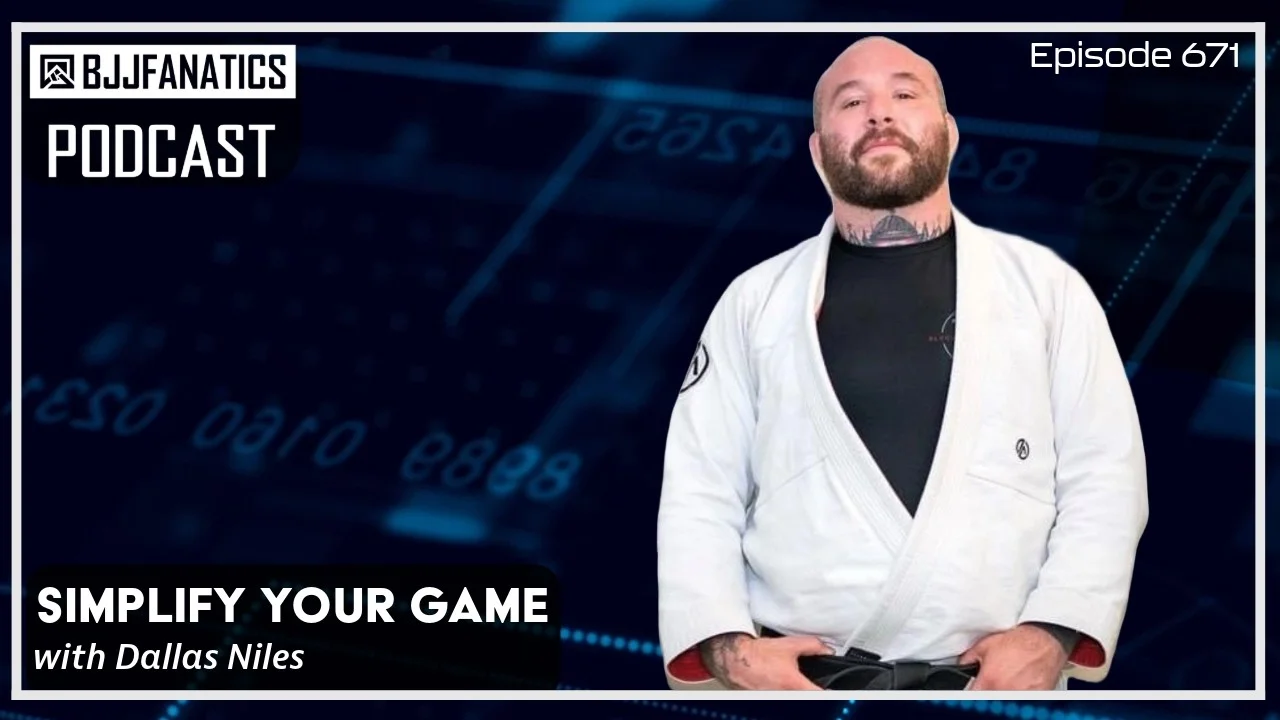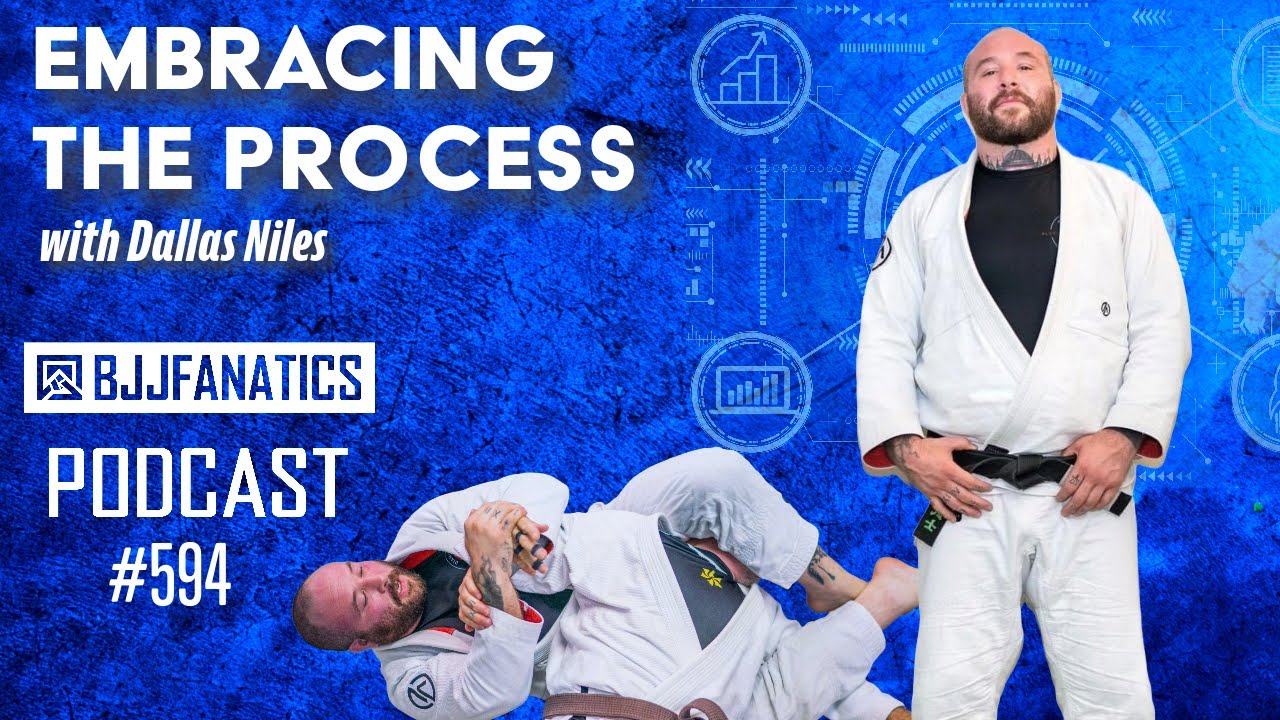
Dallas Niles sat down with Ryan Ford on the BJJ Fanatics Podcast for a nearly two-hour conversation about jiu-jitsu in Tulsa, what it took to earn a black belt under Rafael Lovato Jr., and why he left a 13-year coaching career in Oklahoma City to build Method Jiu-Jitsu from the ground up. The conversation covers his training philosophy, the techniques he has built his competitive career around, and something most martial arts podcasts never touch: the role of anxiety, depression, and daily discipline in a lifelong practice.
If you train in Tulsa or are thinking about starting, this episode is worth your time. If you just want the key takeaways, keep reading.
Watch the Full BJJ Fanatics Podcast Episode
Who Is Dallas Niles? From Touring Metal Musician to BJJ Black Belt
Before there was a black belt, before there was a gym, there was a guitarist playing in a nationally touring metal band called Destroyer Destroyer, reviewed 10/10 by Decibel Magazine. Dallas grew up skateboarding and playing music. His father is a professional musician who plays guitar using a hook prosthetic. Performing was in his blood, but at 22, working at Starbucks with bad knees from years of skating, Dallas walked into a jiu-jitsu academy and found something he was not expecting to find: a discipline that felt like music theory applied to the human body.
In the podcast, Dallas draws a direct line between learning music theory and learning BJJ principles. In music, once you understand the underlying harmonic structure, you can improvise freely in any key, in any tempo, with any group of musicians. Jiu-jitsu works the same way. Once you understand the principles behind positions and transitions, you stop relying on memorized sequences and start responding to what is actually happening in front of you.
He thought he would last six months. He lasted seventeen years and counting.
17 Years on the Mats: Training Under Rafael Lovato Jr. in OKC
Dallas earned his black belt under Rafael Lovato Jr. at Lovato's School of Brazilian Jiu-Jitsu in Oklahoma City. For 13 of those 17 years, he served as a head instructor and primary training partner to Lovato, one of the most accomplished American competitors in the history of the sport.
During that time, Dallas built a competition resume that includes a Pan-American Championship at blue belt, an American National Championship, and medals at both the No-Gi World Championships and the European Championships. He also became one of the most published instructional authors on BJJ Fanatics, with detailed courses on the crucifix system and deep half guard.
The Lovato lineage runs deep in Oklahoma martial arts. Training beside a competitor of that caliber for over a decade shaped how Dallas teaches, how he structures classes, and what he expects from students at every belt level. You can read more about his full background on the instructor page.
Why Dallas Founded Method Jiu-Jitsu in Tulsa
After 13 years building someone else's program, Dallas made the decision to build his own. Method Jiu-Jitsu opened in Tulsa with a founding class of about 20 adult students and a clear vision: strip away everything that does not make you better on the mats.
That meant eliminating the mindless calisthenics that eat up class time at many academies. No jumping jacks, no aimless jogging. At Method, that time goes to targeted movement drills, positional sparring, and focused technique work. Dallas describes his ideal training split as roughly 20 percent open rolling, with the majority of mat time dedicated to situational drilling and positional work.
He also renamed the beginner curriculum. Rather than calling it "fundamentals," which students tend to devalue and rush through, Dallas calls it "Essential Jiu-Jitsu." The name reflects the reality: these are not basic techniques to move past. They are the techniques that work at the highest levels, drilled until they become reflexive.
Method Jiu-Jitsu is located at 8011 S Sheridan Rd, Suite B, Tulsa, OK 74133. Drop-ins are welcome. Dallas extends an open invitation in the podcast to anyone traveling through Tulsa to come train.
Inside the Conversation: Crucifix, Deep Half, and "Essential Jiu-Jitsu"
The technical depth in this podcast sets it apart from most BJJ interviews. Dallas walks through the concepts behind several of his signature positions.
The Crucifix: Dallas has built an entire competitive and instructional career around the crucifix position. In the podcast, he explains why this position is underutilized: the IBJJF does not award positional points for the crucifix the way it does for traditional back mount with hooks, so competitors overlook it despite its equal or superior control. He discusses entries beyond the traditional turtle roll-through, including double-over and bodylock entries, front headlock setups, and even flying variations. His BJJ Fanatics instructional, "Total Crucifix Back Attacks," covers the full system.
Deep Half Guard: Another cornerstone of Dallas's game, deep half is a sweeping and retention system he plays equally well in gi and no-gi. The position allows a smaller or older grappler to neutralize size and pressure advantages from bottom.
Cross-Choke from Mount: Dallas makes a case for what he calls the most disrespected technique in the sport. A clean cross-choke from mount, finished against a training partner who is actively defending, is one of the hardest things to accomplish in jiu-jitsu. He connects this to the same principle behind his mounted armbar approach: control the position, remove the defensive tools systematically, then finish.
Action-Reaction: Dallas's Training Philosophy
One of the most practical segments of the podcast covers what Dallas calls the action-reaction principle, which he compares to the way judoka set up throws. Every attack should have a paired response for when the opponent resists in the opposite direction.
Dallas gives the example of a scissor sweep. If your opponent sits back on their heels to base against the sweep, that reaction itself creates an opportunity to attack them going backward, which triggers their forward resistance, which feeds right back into the original sweep. The pattern repeats across every position and every technique.
He extends this to a broader training philosophy: "Defense liberates offense." Using Garry Tonon as an example, Dallas explains that when a grappler trusts their escapes and defensive positioning completely, they can attack with full commitment. There is no hesitation, no hedge, because even if the attack fails, they know they can recover. That mindset changes everything about how you train no-gi grappling and how you approach live rounds.
BJJ and Mental Health: Managing Anxiety and Depression Through Training
The conversation takes a turn that most martial arts content avoids entirely. Dallas talks openly about living with anxiety and depression since age 16. He does not frame jiu-jitsu as a cure. He frames it as a daily anchor, a routine that forces you to be present, to breathe, to problem-solve under pressure, and to interact with a community of people who show up every day for the same reasons.
This matters for anyone in Tulsa considering martial arts as part of a broader health strategy. The physical benefits of jiu-jitsu are well documented. The mental health dimension is harder to quantify but, for many practitioners, it is the reason they stay. Dallas is honest about the fact that training transforms more than your fitness. It restructures your relationship with stress, failure, and incremental progress.
For adults thinking about starting, that honesty matters. Knowing that the person teaching your class has navigated the same struggles and found something that helps is a different kind of credential than a medal count. It is the kind of thing that makes you trust the process when the learning curve feels steep. If that resonates with you, read more about why adults are starting jiu-jitsu in Tulsa.
From Music Theory to Jiu-Jitsu: Why Improvisation Matters on the Mats
Dallas returns several times to the music analogy, and it is one of the clearest explanations of how jiu-jitsu learning works that you will find anywhere.
In music, beginners memorize songs. They learn chord shapes, scale patterns, and specific sequences of notes. An intermediate musician starts to understand why those shapes and patterns work. They learn the theory behind the chords. An advanced musician can improvise because they understand the underlying structure so deeply that they do not need to think about individual notes. They respond to what the other musicians in the room are doing in real time.
Jiu-jitsu follows the same arc. Beginners memorize techniques. Intermediate students start understanding the principles behind those techniques: why the hip angle matters, why the grip breaks the posture, why the weight distribution creates the sweep. Advanced practitioners improvise. They read their training partner's movement, weight shifts, and defensive reactions and respond with whatever position or submission the moment calls for.
This is the philosophy behind what Dallas teaches at Method. It is not about collecting techniques. It is about understanding the structures that make all techniques work, so you can navigate positions you have never drilled and still find answers. That approach shapes everything from the gi program to the no-gi program and is why students who train at Method develop a style that adapts rather than breaks under pressure.
Come Train With Dallas If You Are in Tulsa
Watching a two-hour podcast gives you a window into how Dallas thinks about the art. Training with him gives you the experience directly. The details that make techniques work, including the pressure angles, the timing of transitions, and the invisible adjustments that turn a good position into a finishing position, need to be felt on the mats.
If you are looking for a BJJ gym in Tulsa where the instruction is systematic, the environment is disciplined without being rigid, and the person running the room has 17 years of experience at the highest level of the sport, book a free trial class and see what training at Method feels like. Your first class is on us.
Watch the full episode on YouTube →
FAQ: Dallas Niles and Method Jiu-Jitsu in Tulsa
Who is Dallas Niles, the founder of Method Jiu-Jitsu Tulsa? Dallas Niles is a Brazilian Jiu-Jitsu black belt under Rafael Lovato Jr. with 17 years of experience. He is a Pan-American Champion, American National Champion, and medalist at the No-Gi World Championships and European Championships. After spending 13 years as a head instructor and training partner to Lovato in Oklahoma City, Dallas founded Method Jiu-Jitsu in Tulsa to build a program rooted in principle-based learning and efficient class structure.
What is the crucifix position Dallas Niles is known for? The crucifix is a back-attack position where the attacker traps both of the opponent's arms using their legs and upper body, exposing the neck for chokes and the arms for joint locks. Dallas has a BJJ Fanatics instructional called "Total Crucifix Back Attacks" and has written extensively about entries from deep half guard and double-over positions.
Can I drop in and train at Method Jiu-Jitsu if I am visiting Tulsa? Yes. Dallas extends an open invitation in this podcast episode to anyone traveling through Tulsa. Method Jiu-Jitsu is located at 8011 S Sheridan Rd, Suite B, Tulsa, OK 74133. Check the class schedule and book your visit.
How can BJJ training help with anxiety and depression? Dallas discusses this openly in the podcast. He has managed anxiety and depression since age 16 and describes jiu-jitsu as a daily anchor that forces presence, breath control, and problem-solving under pressure. The combination of physical exertion, structured learning, and community builds a routine that many practitioners find stabilizing. It is not a replacement for professional mental health care, but it can be a meaningful complement.
Did Dallas Niles really train with Rafael Lovato Jr.? Yes. Dallas spent 13 years as a head instructor and primary training partner at Lovato's School of Brazilian Jiu-Jitsu in Oklahoma City. Lovato is one of the most decorated American competitors in the sport's history, and that training partnership shaped the technical system Dallas now teaches at Method.
Where can I listen to the full BJJ Fanatics Podcast episode with Dallas Niles? The full episode is available on YouTube and on all major podcast platforms by searching "BJJ Fanatics Podcast Episode 593." The video version is embedded at the top of this page.