Most people imagine a jiu-jitsu class as two people grappling on the ground while a coach watches from the corner. That is about ten percent of what actually happens. The other ninety percent — the warm-up that builds coordination you did not know you lacked, the technique breakdown where one detail changes everything, the drilling that turns awkward movements into instinct — is where real progress lives.
If you have been searching for jiu-jitsu classes in Tulsa and wondering what you would actually walk into, this is the unfiltered version. No highlight reels, no marketing language. Just what a structured BJJ class looks like from warm-up to cool-down, how classes differ by experience level, and how to choose the right one for where you are right now.
The Structure of a Typical BJJ Class
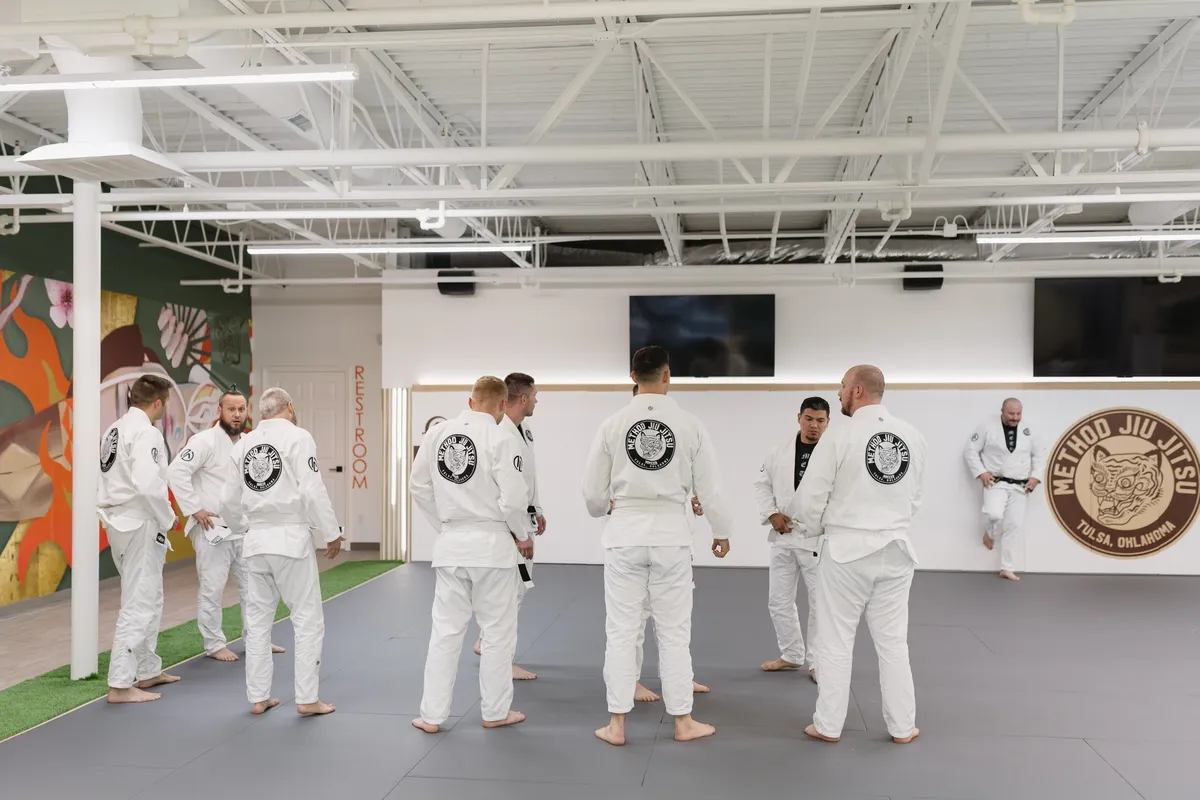
Every class at Method Jiu-Jitsu follows a consistent structure. That consistency matters more than people realize: it lets your body and mind settle into the rhythm of training so you can focus on learning instead of wondering what comes next.
Warm-Up (10–15 Minutes)
The warm-up is not jogging in circles. BJJ warm-ups are movement-specific. You will practice hip escapes, technical stand-ups, forward and backward rolls, and guard retention drills. These are not arbitrary exercises. Every movement in the warm-up connects directly to positions you will use on the mat.
For new students, the warm-up is where you start building the coordination that jiu-jitsu demands. Experienced practitioners use it to refine mechanics they have done thousands of times. Either way, by the time the warm-up ends, you are physically prepared and mentally present.
Technique Instruction (20–25 Minutes)
The coach demonstrates a technique or series of connected techniques. This is the core of the class. You watch, ask questions, then pair up with a training partner to practice what was shown.
Instruction typically follows a progression: the coach shows a position, then an attack from that position, then a follow-up option when the first attack is defended. This layered approach mirrors how jiu-jitsu works in real time — you are always reacting to what your partner does, not executing moves in isolation.
At Method, technique blocks are structured in weekly and monthly themes. Monday's lesson builds on Saturday's. This week's guard passing connects to last week's guard retention. If you attend two to three classes per week, you will see how the pieces fit together in a way that single-session drop-ins cannot replicate.
Positional and Technical Drilling (10–15 Minutes)
After learning the technique, you drill it. Repetition with a cooperative partner is how your body memorizes new movements. This phase is not about winning or losing. Your partner gives you the right amount of resistance so the movement becomes reliable under pressure.
Drilling is where most of the actual learning happens. The technique demo gives you the blueprint. Drilling builds the muscle memory to use it when everything speeds up.
Live Rounds / Sparring (15–20 Minutes)
This is what most people picture when they think of jiu-jitsu: two people grappling at full speed, using everything they know. At Method, live rounds are structured and supervised. Rounds are typically five minutes. You rotate partners between rounds, which means you train with different body types, skill levels, and styles in a single class.
New students are not expected to spar on day one. Your first several classes focus on drilling and positional sparring — starting from a specific position and working from there, rather than a full free-for-all. This controlled introduction lets you build confidence before adding intensity.
The tap — a signal that tells your partner to release a submission — is the most important rule on the mat. It is respected immediately, every time, without exception. That mutual trust is what makes live training safe and productive.
Cool-Down and Debrief (5 Minutes)
Class ends with a brief cool-down and a moment to ask the coach questions about anything that came up during training. This is a good time to clarify technique details or get advice on a position you struggled with during live rounds.
How Classes Differ by Experience Level
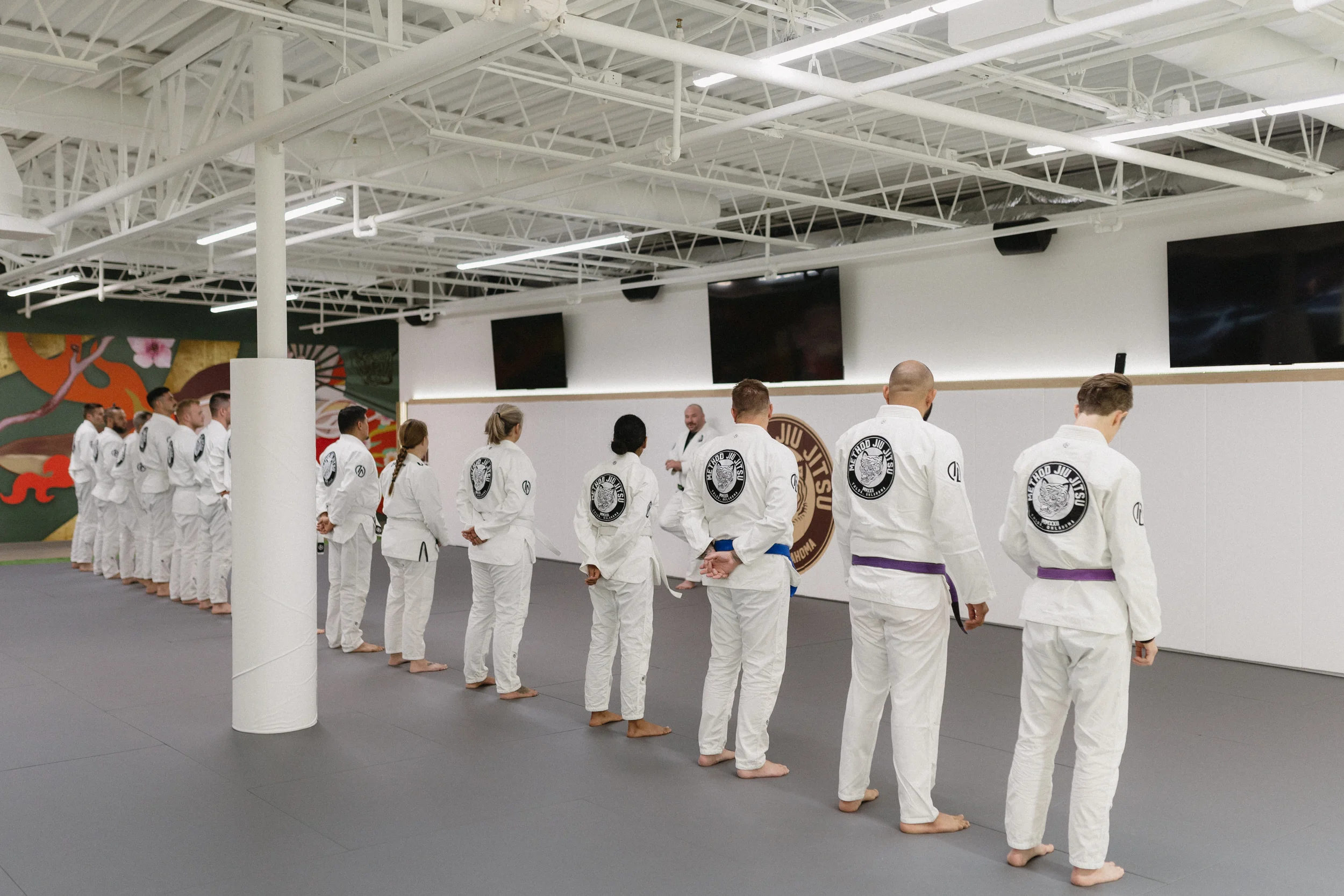
Not all jiu-jitsu classes are the same, and a good gym does not put a first-week white belt in the same training environment as a competitive purple belt without structure.
Fundamentals / Beginners
Beginner classes focus on core positions and escapes: how to survive mount, how to escape side control, how to establish and maintain guard. The pace is slower, the instruction is more detailed, and the live training is positional rather than open sparring.
If you are starting as an adult with no martial arts background, this is where you begin. The goal is not to learn everything. It is to build a foundation of defensive awareness and movement quality that everything else will stack on top of.
All-Levels
All-levels classes are the core of most BJJ training schedules. Technique instruction scales naturally: the same guard pass taught to a white belt has layers of detail that a blue or purple belt is still refining. Training partners are mixed, which gives newer students exposure to higher-level movement and gives experienced students the chance to sharpen their teaching instincts.
Competition / Advanced
For students who compete or train at a higher intensity, competition classes focus on chain attacks, advanced transitions, game-planning, and hard sparring. These classes assume a working knowledge of all fundamental positions and a comfort level with sustained live training.
Gi and No-Gi: Two Formats, One Art
If you have seen jiu-jitsu online, you have probably noticed two versions: one where people wear traditional uniforms (the gi) and one where they train in shorts and rash guards (no-gi).
Gi training uses the fabric of the uniform as part of the technique. You grip the collar, the sleeves, the pants. This slows the pace and rewards precision. No-gi training removes those grips, which makes everything faster and more reliant on body positioning, underhooks, and wrist control.
Most BJJ practitioners train both, and the differences between gi and no-gi complement each other. Gi makes your defense tighter. No-gi makes your transitions faster. At Method, we offer both formats throughout the week so you can develop a well-rounded game.
Classes for Specific Populations
One of the things that distinguishes a serious BJJ gym from a general martial arts studio is the depth of its programming. A single "martial arts class" cannot serve a seven-year-old and a forty-five-year-old professional with the same structure.
Kids and teens. Youth BJJ classes at Method are age-appropriate and structured around skill development, discipline, and controlled physical engagement. Kids learn the same fundamental positions as adults but in an environment calibrated for their attention spans and physical development. Teen programs bridge the gap between youth and adult training.
Women. Our women's BJJ community continues to grow because the training environment is built to be welcoming without being watered down. Women train alongside men in most classes and have the option to work with female training partners. The technique is the same. The culture is intentional.
Over 40. Jiu-jitsu is not a young person's sport. Some of the most technically skilled practitioners in any gym are the ones who started later and have been training for years. BJJ over 40 is less about intensity and more about efficiency — using technique to compensate for the advantages that younger, more athletic training partners have.
Families. Family training is one of the most underrated benefits of joining a BJJ gym. Parents and kids share a common language, a common activity, and a common respect for the difficulty of learning something hard together.
How to Choose the Right Class for Your Goals
The right class depends on what you are trying to accomplish.
If you want practical self-defense skills, start with fundamentals. The core positions and escapes taught in beginner classes are exactly what you need to protect yourself in a real situation. Jiu-jitsu is the most effective martial art for close-quarters self-defense, and the fundamentals class is where those skills are built.
If you want fitness and stress relief, any class will deliver a full-body workout. But BJJ for fitness is most effective when you attend consistently — two to three times per week. The physical benefits compound over time as your movement quality improves and your rounds become more active.
If you want to compete, build your base in all-levels classes and add competition training once your coach confirms you are ready. Rushing into competition prep before your fundamentals are solid creates holes that opponents will exploit.
If you are not sure what you want, that is fine. Most people start with a general curiosity and figure out their direction after a few weeks on the mat. The first step is the same regardless: show up to a class.
What to Bring and How to Prepare
You do not need to own a gi to try your first class. What to wear is simpler than you think: athletic clothes that cover your knees and elbows work for a trial class. If you decide to continue, a gi is an early investment — and the gym can help you find the right one.
Beyond clothing, the main thing to bring is the willingness to be a beginner. Jiu-jitsu has a steep learning curve in the first month. You will feel lost. That is normal and expected. Mat etiquette is straightforward: be clean, be respectful, tap when you need to, and ask questions when you do not understand something.
Consistency Over Intensity
The students who improve fastest are not the ones who train the hardest on any given day. They are the ones who show up three times a week for six months. Jiu-jitsu rewards consistency above everything else.
The belt system reflects this. A blue belt is not awarded for a single impressive performance. It represents hundreds of hours of accumulated mat time, steady technical growth, and a demonstrated understanding of core positions. There are no shortcuts, and that is precisely what makes the achievement meaningful.
At Method Jiu-Jitsu, we see this pattern repeat with every student who stays past the first uncomfortable month. The ones who build a routine around their training — who protect their class time the way they protect a work meeting or a family commitment — are the ones who look back a year later and barely recognize the person who walked in on day one.
Try a Class for Free
If you are looking for jiu-jitsu classes in Tulsa that are structured, welcoming, and serious about development at every level, Method Jiu-Jitsu is worth one visit. We offer a free trial class with zero commitment and zero pressure. Check the full class schedule and pick a time that works for your week.
The mat is open. The only thing left is to walk through the door.
Method Jiu-Jitsu is located at 8011 S Sheridan Rd, Suite B, Tulsa, OK 74133. We offer programs for beginners, women, kids, families, competitors, and adults over 40. View our full class schedule or book a free trial class.