If you are comparing kids karate vs jiu-jitsu Tulsa options, you are already doing the most important thing: looking past a convenient after-school activity and asking what your child will actually learn. Karate and taekwondo have long, respected traditions. They can offer structure, fitness, and confidence. But for many families, Brazilian jiu-jitsu (BJJ) is the better fit because it teaches children how to solve a changing physical problem without relying on punches or kicks.
At Method Jiu-Jitsu's kids program, children learn in a welcoming, coached environment built around movement, respect, and practical skill. We serve South Tulsa families as well as Broken Arrow, Jenks, and Bixby. This is a comparison—not a dismissal of traditional striking arts—and it can help your family choose the best martial arts path.
Start with the question behind the search
A search for “kids karate” or “kids taekwondo” usually means a parent wants more than exercise. You may be hoping your child becomes more confident, handles conflict better, listens more closely, or has a healthy place to belong after school. Those are excellent goals, and children's martial arts in Tulsa can support all of them.
The difference is how the arts practice those goals. Karate and taekwondo often emphasize stance work, striking mechanics, forms, and target drills. BJJ teaches children to manage distance, balance, grips, escapes, pins, and safe transitions with a resisting partner. Before choosing, it helps to understand what Brazilian jiu-jitsu is and watch how a school teaches beginners.
Respecting karate and taekwondo while making a clear choice
Karate and taekwondo deserve respect. Excellent schools build discipline, courtesy, coordination, and a meaningful connection to tradition. A child who loves the rhythm of forms or the athletic challenge of kicking may thrive there.
Still, parents comparing a karate alternative for kids Tulsa often want live, adaptable practice rather than a program centered on rehearsed sequences. In BJJ, a technique has to work with a partner who is moving, reacting, and trying to improve their own position. That gives children immediate feedback. They do not simply memorize an answer; they learn to find one. Our broader guide to BJJ versus other martial arts provides useful context for families exploring the options.
Why jiu-jitsu is a non-striking martial art
Brazilian jiu-jitsu is primarily grappling. Children learn how to use posture, frames, grips, balance, leverage, and positioning. They do not train by punching or kicking a partner. That distinction matters to many parents looking for a constructive outlet for energy rather than an activity that practices impact.
No sport is risk-free, and every program should teach falling, body awareness, boundaries, and responsible partner behavior. But a non-striking curriculum avoids routine head contact. That is one reason families considering kids self-defense in Tulsa often choose BJJ. Students learn to control a situation, disengage, and get help—not to “win” an exchange of blows.
What the injury research says—and what it does not
Parents deserve straight talk rather than blanket promises. Injury risk varies with age, rules, coaching, protective equipment, experience, and how hard students spar. Research in the American Journal of Sports Medicine and wider sports-medicine literature has repeatedly identified head and facial injuries as important concerns in striking combat sports, while karate and taekwondo studies document concussion and head-impact mechanisms associated with kicks and punches. A useful starting point is the American Academy of Pediatrics' guidance on martial arts participation and its emphasis on qualified instruction and safety rules.
BJJ is not “safe because nothing can happen.” It is safer only when instructors create a thoughtful culture: controlled drilling, appropriate pairings, supervision, hygiene, rest, and immediate respect for a tap. At Method, children progress through skills deliberately. Parents who want a deeper safety overview can read is BJJ safe?.
Rolling teaches control, consent, and a way to stop
In jiu-jitsu, controlled sparring is called rolling. For children, it is structured, closely supervised practice—not a free-for-all. Students learn to match intensity, stop when an instructor calls time, and tap when a position is uncomfortable. Their partner releases right away. That tap-out convention makes communication and care part of the training itself.
The goal is not to hurt a classmate. It is to recognize a problem, make a decision, and reset. This environment helps children develop a calm relationship with challenge. It also gives instructors a chance to teach the humility that makes BJJ etiquette more than a list of rules.
BJJ is “human chess,” not just a collection of moves
Parents often hear jiu-jitsu called human chess. The phrase fits because every position presents choices: protect your space, improve your balance, recover a guard, escape, hold a stable position, or safely stand up. A move that works on one partner may need a different angle on another.
This is where BJJ can be especially powerful for children. They practice critical thinking, adaptability, spatial awareness, patience, and emotional regulation while their body is active. A child learns that panic wastes energy and that a small, smart adjustment can change an outcome. Exploring concepts such as the guard, mount, and side control shows how positions become problems to solve rather than scripts to recite.
From repetitive patterns to adaptable problem-solving
Forms and kata can develop attention to detail; they are not without value. Yet their sequence is known in advance. BJJ adds an important layer: the other person’s response is not known in advance. A child may drill an escape, then discover during light resistance that they need to adjust timing, posture, or direction.
That learning loop builds resilience. Instead of interpreting a failed attempt as “I am bad at this,” students are coached to ask, “What changed? What can I try next?” Our beginner BJJ program uses that same growth-minded approach for new students of every age.
Real-world self-defense favors control and escape
Many physical confrontations involve grabbing, clinching, pushing, or a loss of balance that brings people close to the ground. Exact percentages vary widely by the population and study, so responsible instructors should be cautious about claims that “nearly every fight goes to the ground.” The practical point is simpler: children need skills for close contact, not only long-range strikes.
BJJ teaches posture, distance management, standing up safely, and ways to control another person long enough to leave and find an adult. It never replaces awareness, de-escalation, or school safety procedures. It gives kids a non-striking set of options when leaving is not immediately possible. Families can explore a foundation in submission grappling and learn why takedown fundamentals matter without turning self-defense into combat thinking.
Anti-bullying skills without escalating the conflict
The best response to bullying is prevention, boundaries, reporting, and adult support. Martial arts is not a license for a child to intervene physically. But physical confidence can reduce the fear that makes a child feel cornered, and grappling teaches a useful principle: control without retaliation.
A child who can protect their balance, make space, and move away may be less likely to throw a punch in anger. They can practice saying no, keeping hands open, and seeking help. That aligns with the approach in our kids confidence and self-defense guide: real confidence is quiet, responsible, and rooted in capability.
Why leverage helps smaller children
Size and strength matter in any physical interaction. Honest coaching never pretends otherwise. BJJ’s advantage is that it gives smaller students tools based on posture, angles, timing, and leverage rather than asking them to meet force with force.
As your child learns to use their hips, frames, and base, they begin to understand that smart mechanics can improve their position. That lesson is physical and psychological. It says: “I may not control everything, but I can stay calm and make a good next choice.” Instruction in both gi jiu-jitsu and no-gi jiu-jitsu gives children a broad movement vocabulary while keeping the focus on age-appropriate fundamentals.
Confidence that is earned, not performed
Belt progression can be meaningful in karate, taekwondo, and BJJ. At its best, it gives children visible evidence that consistent effort matters. At Method Jiu-Jitsu, promotions reflect demonstrated skills, maturity, attendance, and readiness—not merely time spent in a uniform.
More important than any stripe or belt is what happens each week: a child who once avoided a drill tries it again, a student practices a hard escape patiently, or a teammate offers encouragement after a setback. Those experiences create durable confidence. The same mindset is why many parents find value in our comparison of kids jiu-jitsu and team sports.
Resilience grows one reset at a time
Every roll contains a reset. A child might lose position, pause, listen, and begin again. That is a healthy rehearsal for schoolwork, friendships, and future setbacks. BJJ teaches that losing a round is information, not an identity.
Good coaching makes the lesson feel safe. Instructors praise attention, courage, control, and effort—not only outcomes. Students also learn humility when a smaller or newer partner solves a problem unexpectedly. This mix of accountability and support is central to the Method Jiu-Jitsu community.
The full-body benefits parents notice
BJJ asks children to crawl, bridge, shrimp, balance, pull, push, turn, and coordinate with a partner. The result is an engaging full-body workout that develops body awareness, mobility, coordination, and age-appropriate conditioning. It can complement rather than replace other activities.
Because class is interactive, children often stay absorbed longer than they would in repetitive exercise. They build athletic foundations that carry into other sports and daily movement. For a look at how technical practice works, see our discussions of no-gi drilling, no-gi techniques, and the over-under throw. Advanced examples are not a kids curriculum; they show the depth of a martial art children can grow into over time.
A team culture without a military-style atmosphere
Children need expectations, but they also need belonging. Method Jiu-Jitsu aims for a respectful, family-centered culture where students work with many partners, celebrate effort, and learn that a strong teammate protects the room.
Head instructor Dallas Niles and the coaching team keep lessons structured without making them rigid. Students train with a common purpose, not against one another. Families who want to make martial arts a shared activity can explore family jiu-jitsu in Tulsa and our BJJ for families program. You can also see the high-level standards behind the academy through Xande Ribeiro’s connection with Method.
What kids classes look like at Method Jiu-Jitsu
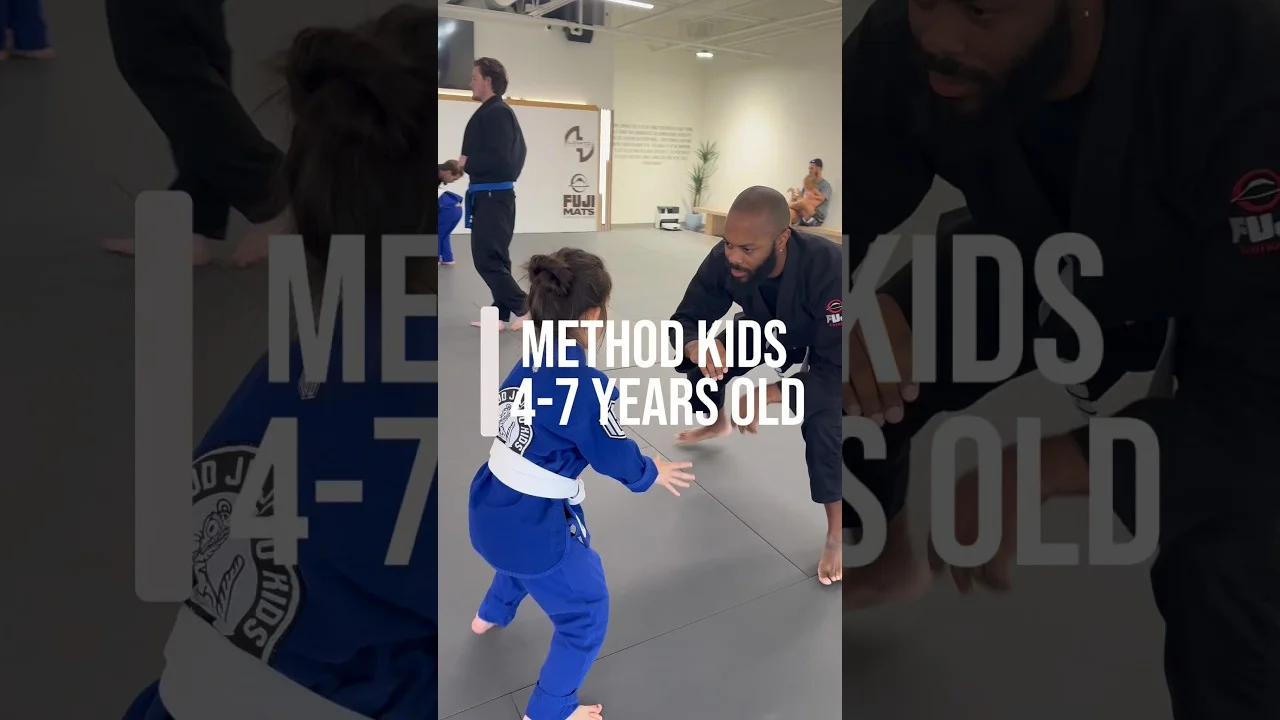
Our youngest students, ages 4 to 7, join Little Warriors on Tuesdays and Thursdays from 4:10 to 5:00 PM. Classes use movement games, listening drills, partner cooperation, and simple grappling concepts matched to their developmental stage.
Ages 8 to 13 train in Junior Grapplers on Tuesdays and Thursdays from 5:00 to 6:00 PM, with a Friday competition team option for students who want more focused training. Every membership includes a premium Method Jiu-Jitsu gi—never a temporary loaner—so your child can feel prepared and part of the team. See the current class schedule and our first-class guide before visiting.
How to compare martial arts schools in Tulsa
Whether you choose karate, taekwondo, or BJJ, tour the school. Watch a class. Are instructors attentive? Are children paired appropriately? Is the room clean? Do students look engaged and safe? Is the program clear about rules, progress, and parent communication?
Then give your child a chance to participate. A free trial reveals more than a website can: whether the coaches connect, whether the pace feels right, and whether your child leaves excited to return. Method Jiu-Jitsu is at 8011 S Sheridan Rd, Suite B, Tulsa, OK 74133. With more than 50 five-star Google reviews, we invite South Tulsa families to experience our program rather than take our word for it. Call (918) 995-4692 or start with a free kids BJJ trial.
Is jiu-jitsu safer than karate or taekwondo for kids?
Every martial art has risk, and the quality of instruction is decisive. BJJ is non-striking, so children do not practice punches or kicks to a partner’s head. Progressive drilling, appropriate supervision, and the tap-out system help keep training controlled. Ask any school how it manages contact, pairs students, and responds to discomfort.
Which is better for a child: karate, taekwondo, or jiu-jitsu?
There is no universal answer. Karate and taekwondo can be excellent for the right child. Families looking for close-range self-defense, problem-solving under light resistance, and a curriculum without striking often find BJJ is the better match. A trial class is the most honest way to decide.
Can a smaller child use jiu-jitsu for self-defense?
BJJ emphasizes leverage, positioning, balance, and control rather than trying to overpower someone. It teaches practical principles for creating space, escaping, safely standing up, and seeking help. It does not guarantee safety, but it gives smaller students useful tools and real confidence.
What ages can join kids jiu-jitsu at Method Jiu-Jitsu in Tulsa?
Little Warriors is for ages 4 to 7; Junior Grapplers is for ages 8 to 13. Both programs are scheduled after school on Tuesdays and Thursdays, and Junior Grapplers may also join the Friday competition team. Check the schedule for the latest details.
Does my child need a uniform for a free trial class?
No. Comfortable athletic clothing is perfect for a first visit. Once enrolled, every membership includes a premium Method Jiu-Jitsu gi. The only thing your child needs to bring to a trial is curiosity and a willingness to learn.
For parents comparing kids taekwondo vs jiu-jitsu, the decision comes down to what you want your child to practice every week. If you want a warm, disciplined environment where they learn to think, adapt, control, and grow, we would love to welcome your family to Method Jiu-Jitsu. Browse the Method Jiu-Jitsu blog for more parent resources, or book a free class today.