Guard passing is one of the first big puzzles in Brazilian jiu-jitsu. You reach a partner's legs, move to one side, and suddenly a knee or foot appears between you again. That is not failure; it is the guard doing its job. If you are searching for BJJ guard passing in Tulsa, the useful question is not “Which move always works?” It is “What sequence of decisions lets me advance without giving away my balance?”
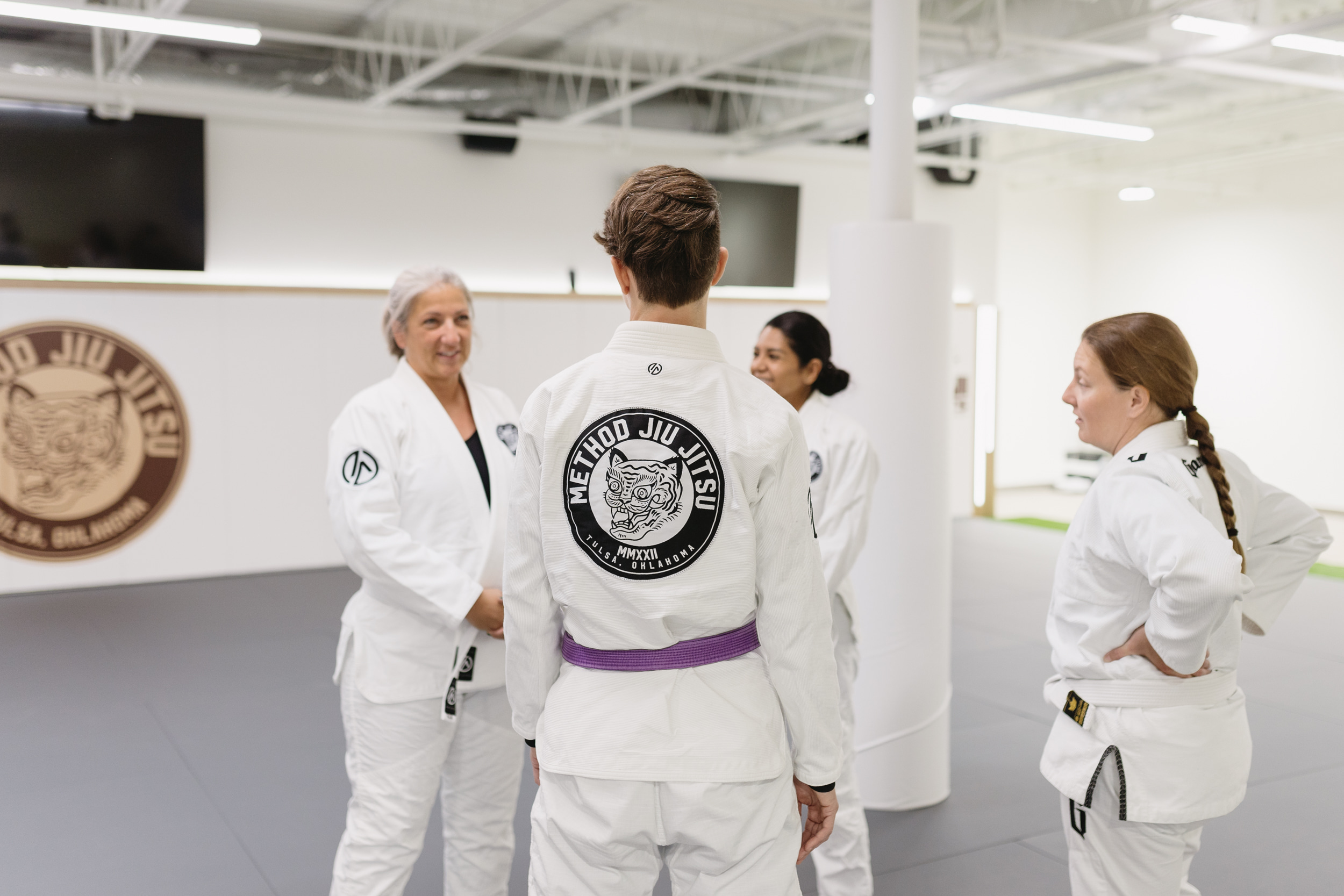
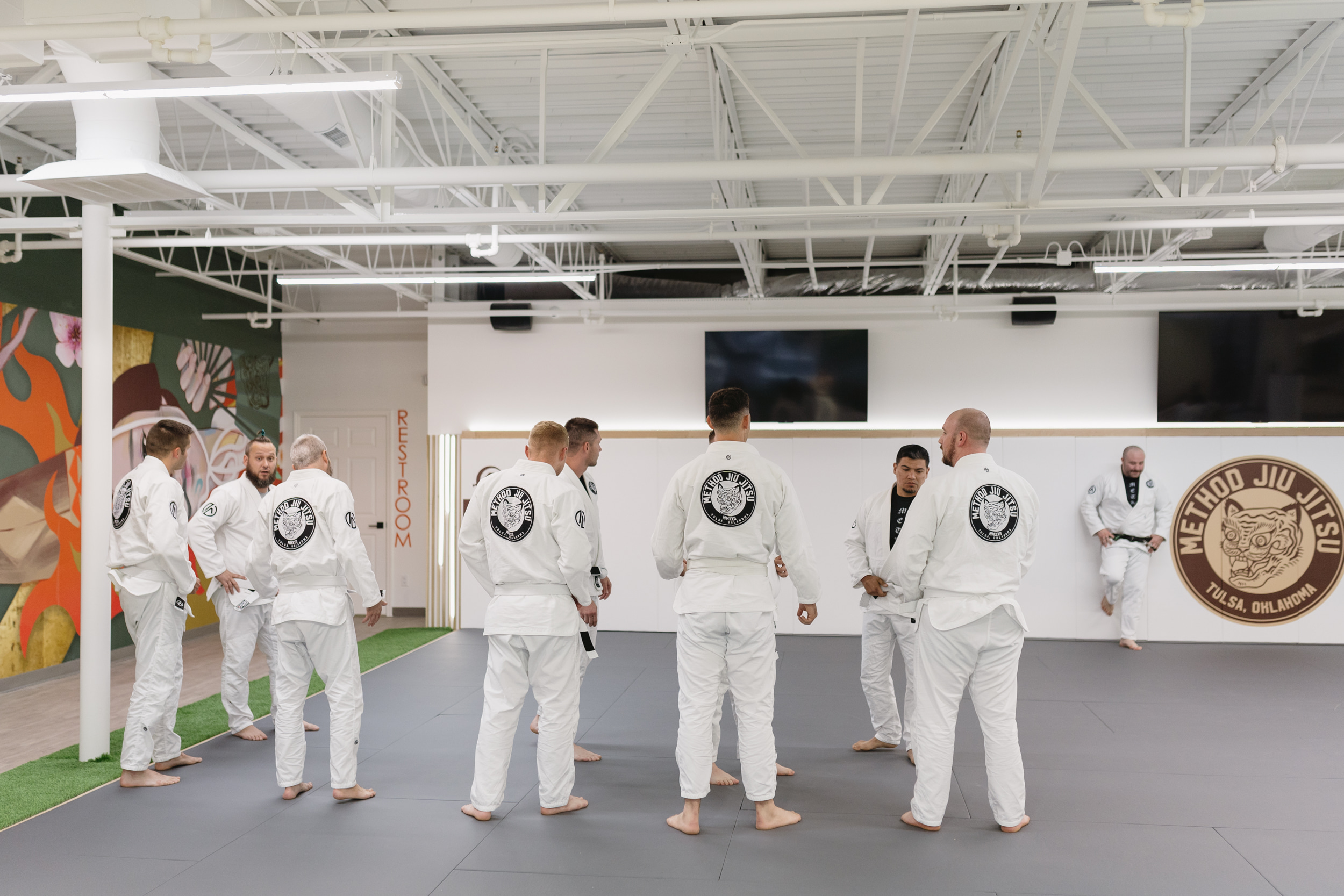
The Method Jiu-Jitsu students pictured above are gathered on the mats before technical work; the photo does not depict a specific guard pass. What follows is a practice roadmap, not a claim that one still image demonstrates the technique. For a bigger vocabulary of positions, start with what guard means in BJJ and the BJJ terminology glossary.
1. What Counts as a Completed Guard Pass?
A guard player uses their legs, hips, grips, and frames to manage distance from the bottom. A passer wants to get beyond those leg barriers and secure top control. Passing is not just stepping over a foot: if your partner immediately turns toward you and recovers their knees, you have not established control yet. Aim to clear the legs, settle your weight without crushing your partner recklessly, and hold a recognizable position such as side control or mount.
This distinction changes how you train. A fast burst around the legs may work once, but if you cannot stop guard recovery, the exchange resets. Think “position before celebration.” Your coach may score or define a pass differently for a particular ruleset; ask which standard applies in that class.
2. Build a Map Before Memorizing Moves
Beginners often collect named passes but cannot explain where the opponent's legs are. Build a simpler map: Are you outside both legs, between them, or caught by one? Is the bottom player attached to your sleeves or ankles, and is their torso square to you? Each answer suggests a different way to remove a frame or change angle.
Closed guard requires opening a locked leg configuration safely before passing; a loose open guard may require controlling distance and one or both legs. Half guard means one of your legs is trapped, so the immediate goal is freeing it without losing upper-body position. Learning those distinctions is more useful than trying the same move everywhere.
3. Posture and Base Come Before Speed
If you lean forward with straight arms, your partner can pull you off balance or redirect your shoulders. Keep a stable base appropriate to the position, bend at the knees and hips rather than folding blindly at the waist, and keep your head and hands engaged in purposeful control. There is no one stance for every guard, but a passer should be able to answer: “If my partner pulls right now, where will my weight go?”
Try a slow drill: one partner plays seated guard and changes the direction of their push or pull; the passer adjusts feet and hips while staying balanced. Do not chase a finish until you can change direction without falling into a sweep. Our beginner BJJ program is a place to ask an instructor to correct base in real time.
4. Win the Distance Battle Without Lunging
A guard is dangerous when the bottom player gets the distance they want. Some guards want your weight close; others use extended feet and grips to keep you away. The passer should approach deliberately, clear the first barrier, and prevent the hips from following every step. Do not sprint around legs while leaving your arms behind: that can expose your balance and make it easier for your partner to turn back in.
Try to name the barrier before attacking it: a foot on your hip, a knee across your center, or grips steering your sleeves. Remove or redirect that barrier before changing lanes. In the gi program, fabric grips may help control it; the no-gi program teaches the same spatial problem without sleeve or pant grips. Neither format excuses unsafe, uncontrolled pressure.
5. Make the Hips Turn Before You Chase the Head
The bottom player's hips determine where the knees can return. If the hips follow you freely, a pass that looked finished can disappear. Instead of reaching for the head while your own leg remains entangled, first change the angle or pin a hip long enough to free your path. Upper-body control becomes more useful once the leg line is cleared.
Use the “knee line” as a practical visual cue: if your opponent can put a knee back between your chest and their chest, expect a guard recovery. The exact geometry varies by position; a coach can show what hip and shoulder alignment makes your pass secure. What is mount? and what is side control? show the positions you are working toward.
6. Inside Passing: A Simple Knee-Cut Concept
A knee cut is a common way to pass from between an opponent's legs or a loose half-guard-like position. The basic idea is to control upper-body alignment, create an opening for your cutting knee, move that knee across the thigh line, and free the trailing foot before settling on top. Your coach should teach the grips and body placement that match the guard in front of you.
The error is to slide the knee while your shoulders are easily pushed away. Another is to leave the trailing foot trapped and call the pass complete. Drill the path slowly, pause when your knee clears, then practice freeing the foot and stabilizing. Against a real partner, they may frame, re-guard, or turn away. Those reactions tell you what to fix; they are not invitations to force a joint through pain.
7. Outside Passing: Go Around, Not Through
When a guard player leaves space beyond their legs, an outside pass may be simpler than driving through the middle. Redirect the feet, step to an angle, and keep your upper body close enough that the hips cannot simply rotate to face you. Going wide without controlling the legs is often just a lap around the mat.
One useful cooperative drill has the bottom player recover their knees slowly while the top player practices moving around them and settling into side control fundamentals. Then switch roles. This is a different problem from the over-under throw takedown, which concerns bringing a standing opponent to the mat; guard passing begins once a guard engagement exists.
8. Pressure Is Alignment, Not a Strength Contest
Good pressure makes the bottom player's frames less effective while preserving the passer's own balance. It can come from connected shoulder and hip position, deliberate weight distribution, and blocking the direction the hips want to turn. It does not require dropping your bodyweight suddenly onto a smaller partner or ignoring a tap. Technical control should work at a moderated pace.
Ask a partner for feedback: Can they breathe comfortably? Can they put a knee inside? Where does your weight feel unsupported? The aim of positional training is repeatable mechanics. If you need to use all your strength to hold a static position, adjust your angle and ask the coach to look at your base. The BJJ safety guide explains why communication and controlled movement belong in every round.
9. Common Mistakes That Invite Guard Recovery
Three mistakes recur in beginner passing. First, the passer focuses on the head while leaving the near knee free; the bottom player turns and rebuilds a leg barrier. Second, the passer crosses their feet or narrows the base while stepping, making a sweep easier. Third, the passer clears the legs but does not establish chest-to-chest or another stable top control before reaching for a submission.
A useful reset question is: “What did my partner use to recover?” If it was a knee, control the knee line. If it was a frame at the shoulder, address the frame. If it was a pull that toppled you, rebuild your base. Armbar from mount becomes relevant after you secure mount; chasing it from an unfinished pass is a different and riskier exchange.
10. Practice in Three Stages: Cooperative, Responsive, Live
First, rehearse the pass cooperatively so both people understand the pathway. Then ask the guard player to offer one predictable response—recover a knee, frame at the shoulder, or turn onto a side—while the passer solves that single problem. Finally, try a short positional round: begin in a defined guard, top tries to stabilize a pass, bottom tries to retain or recover, then reset. Agree on pace and switch roles.
This progression is not the same as learning every no-gi drilling method; it applies to both uniform formats. Track one detail per session: did you control the foot, free your trailing leg, or secure the endpoint? Two useful repetitions with a specific correction can beat ten rushed repetitions. Check the class schedule to make consistent technical practice possible.
11. What Should the Bottom Partner Practice?
Passing only makes sense against a guard player who acts intelligently and safely. The bottom partner can work on turning hips to face the passer, placing a knee back between bodies, and using frames to create room without locking joints or grabbing fingers. On beginner drills, offer an appropriate challenge rather than total resistance from the first repetition.
Changing roles helps the passer feel why an angle succeeds or fails. If you spend time in half guard, you learn why the trapped leg matters; if you play closed guard, you understand why opening it is a separate task. More broadly, training with good partners makes controlled feedback and safe resistance possible.
12. How Gi and No-Gi Change the Passing Details
In a gi, legal cloth grips can slow the exchange and help you redirect a leg or secure a collar-and-sleeve relationship. They can also let the bottom player hold you in place; learn grip breaking, not just grip taking. Without the gi, sweat and fewer fabric handles may make control more transient, so head, shoulder, and hip placement become especially apparent.
The goal remains the same: clear the leg line and secure top control. Read the gi versus no-gi explanation, gi training in Tulsa, and no-gi class overview for format-specific context. A premium Method gi is included with each membership; ask the team how to get fitted before your first gi class.
13. Make a Four-Week Beginner Practice Plan
Week one: learn how your gym names its main guards and practice stable posture from one starting position. Week two: choose one inside route and one outside route, and rehearse each against a cooperative partner. Week three: add one specific defensive response to each drill. Week four: run short positional rounds, noting whether the pass was stabilized or the guard recovered. This is a framework, not a promise of mastery in four weeks.
Write one sentence after class: “I lost the pass when the knee came back,” or “I rushed before clearing the foot.” Bring that observation to an instructor. Dallas Niles and the Method coaching team can adapt a technical sequence to your current level. Students interested in competitive rules can also explore the competitors program, but most beginners benefit first from reliable positioning.
14. Learn Guard Passing With Coaching in Tulsa
A written guide can organize the problem; a live instructor sees the angle you cannot feel. At Method Jiu-Jitsu, ask a coach to show you a guard-pass entry appropriate to your experience, then repeat it with a partner at a safe pace. If you are brand-new to training, what to expect in your first class covers the broader visit, while this article focuses specifically on the technical problem of passing guard.
Method Jiu-Jitsu is at 8011 S Sheridan Rd, Suite B, Tulsa, OK 74133, serving South Tulsa and students coming from Broken Arrow, Jenks, and Bixby. Explore programs, see current class times, or book a visit. For questions about class fit or equipment, call (918) 995-4692. The goal is not a magic pass; it is to learn how to solve the leg-and-hip puzzle one controlled decision at a time.
15. Frequently Asked Questions About BJJ Guard Passing
What is guard passing in Brazilian jiu-jitsu?
Guard passing means moving past an opponent's leg defenses and establishing a stable top position. Merely reaching the far side is not enough if they immediately recover guard; side control is one possible endpoint.
What guard pass should a beginner learn first?
Start with posture, distance, clearing a leg, and stabilizing. A coached knee cut or basic outside pass can teach those ideas, but the best first choice depends on the guard and the instructor's curriculum.
Can I practice guard passing without sparring hard?
Yes. Start with cooperative repetitions, add one predictable response, then try short positional rounds at an agreed intensity. Read the etiquette guide, communicate limits, and respect every tap.
Do guard passing principles work in gi and no-gi BJJ?
Yes. Posture, hip control, leg clearance, and stabilization transfer across both. Cloth grips change some gi details, while no-gi relies on controls that do not require fabric; compare the two formats.
Where can I learn BJJ guard passing in Tulsa?
Method Jiu-Jitsu teaches BJJ at 8011 S Sheridan Rd, Suite B, Tulsa, OK 74133. View the schedule and book a visit to ask which class suits your experience.