Being pinned under mount can make a first Brazilian jiu-jitsu round feel impossibly long. Your partner sits across your torso, your hips feel stuck, and pushing harder only tires your arms. If you searched how to escape mount in BJJ, the useful answer is not one magic move. It is a short decision tree: protect yourself, make the top player choose how to balance, then either roll through a blocked post or bring your knee back inside.
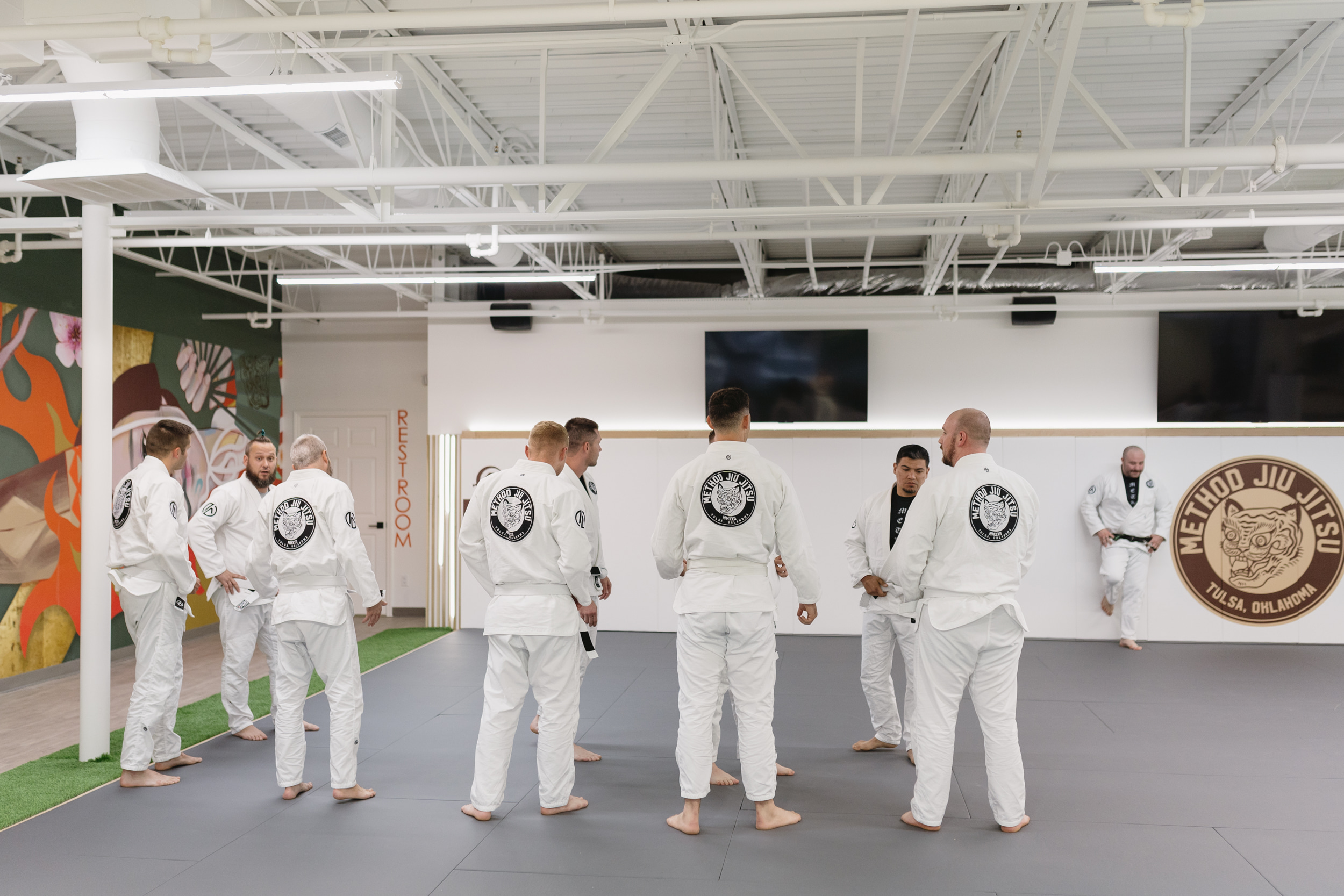
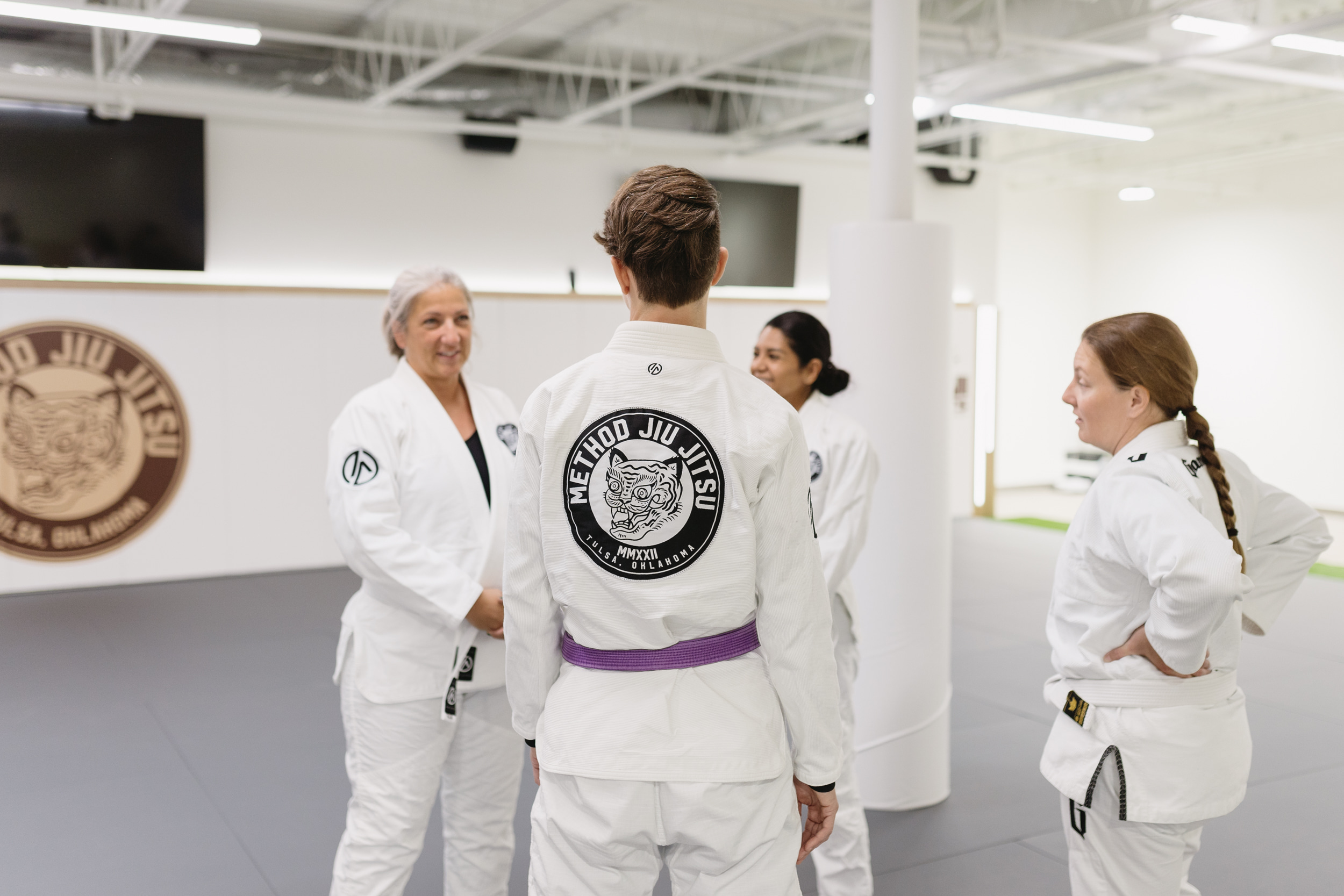
The featured photo shows Method Jiu-Jitsu practitioners together on the Tulsa mats before practice; it does not show an escape in progress. This guide explains the movements to learn with a coach, not a technique supposedly visible in the photo. If the vocabulary is new, start with what mount is and the BJJ terms guide.
1. What Does Escaping Mount Actually Mean?
In mount, the top person straddles the bottom person's torso and can control movement while looking for attacks. Escaping means improving the bottom position in a repeatable way, not merely knocking the person forward for a second. A successful trap-and-roll may reverse the position and leave you on top in their closed guard. A successful elbow-knee escape may restore half guard or full guard. Those are different endpoints, and neither automatically wins the rest of the round.
Mount is not side control: the top player's hips and knees make different barriers. This article addresses escaping mount only; our guard-passing roadmap addresses what to do when you are on top facing someone's leg defenses.
2. Before You Move, Protect Your Arms and Neck
A common first reaction is to place both palms against the top player's chest and straighten the elbows. That exposes arms to attacks and gives the top person something to isolate. Keep elbows relatively close, use your forearms as purposeful frames, and protect your neck without hiding your face or holding your breath. If your partner controls an arm, prioritize defending that threat before launching a large bridge. Tap early when caught in a submission.
Do not mistake “protect your arms” for lying flat and waiting. Make a small adjustment that brings your elbows toward your ribs and gives your hips room to move. An instructor can help you feel where a frame belongs so it creates space rather than pressing into a stronger person's whole body. Read BJJ safety basics and mat etiquette before harder positional rounds.
3. Read the Top Player's Balance
Ask: where can the top player put a hand or foot to stop a roll? If you trap one arm but leave the same-side leg free, they may still post with that foot. If you grab a foot but allow the near hand to land on the mat, the bridge may stall. Watch how their knees shift and whether their weight moves forward or back as you create pressure. A heavy chest does not mean the base is unbreakable.
Your goal is not to shove a static opponent with your arms. Make their balance a decision: posting to stop a roll can create room for a knee; tightening mount to block your knee can sometimes reduce their ability to post. The mount position explainer helps you recognize how top control changes as your partner moves.
4. Build a Bridge That Changes an Angle
Plant your feet where you can drive through the floor, generally closer to your hips than far out in front. Lift your hips with a controlled bridge and turn toward a chosen shoulder, rather than arching straight upward and dropping back in the same spot. The bridge is a way to redirect weight or make space; it is not a strength test. Keep breathing, and avoid throwing your head or neck into the mat.
Try it without a partner first: bridge, rotate slightly, return safely. Then have a partner give light, predictable pressure so you can feel which direction of movement changes their balance. A coach can adjust foot placement to your mobility and the top player's mount. This foundational hip movement also appears in beginner jiu-jitsu training, but live mount escapes require an intelligent partner's reactions.
5. Option A: Trap an Arm and Foot, Then Roll
For the classic trap-and-roll, also called an upa, control one of the top player's arms so that hand cannot post on the side you intend to roll toward. Block or trap their same-side foot so they cannot widen the base there. Bridge your hips to shift weight, then turn toward that trapped side as one connected movement. Once you reverse, stabilize and protect your posture: you may now be inside their guard rather than past it.
This is a conceptual sequence, not a guarantee against every mount. A high mount or an opponent who has already isolated your arm changes the problem. Do not crank a partner's arm or entangle a knee recklessly to force a reversal. Practice slowly, check the arm-and-foot relationship with an instructor, and compare the next phase with guard fundamentals.
6. Why the Trap-and-Roll Fails
If your partner posts a hand as soon as you bridge, you likely did not control the arm you needed. If they post a foot, you may have trapped only the arm. If they ride the motion without needing either post, the bridge may be too vertical or too early. Solve one cause at a time instead of bridging harder five times in a row.
Start a cooperative repetition with the top player maintaining a stable but not crushing mount. Tell them which post you intend to remove, then have them give a limited response. Switch roles so you feel how a base changes when the arm and foot are unavailable. If the mount is very high under your armpits, ask the coach how to first make room to lower the opponent's position. The armbar from mount article shows why extending an arm carelessly in this position carries a cost.
7. Option B: Recover a Knee With the Elbow-Knee Escape
When the top player maintains a wide, posting base, recovering guard is often the better direction. Keep the near elbow inside the line of their knee, bridge enough to lighten pressure, turn to your side, and move your hips away in small increments. Slide your near knee between your bodies; connect elbow and knee so the gap does not close before the leg enters. Rebuild half guard or closed guard if the opening permits.
The elbow is a wedge and a guide, not a tool for digging into someone's joint. Avoid pushing with straight arms. “Shrimp” is a hip movement that changes the angle between your torso and your partner; it works best after you have made a little space. Ask a coach how to handle a high mount or cross-face rather than forcing the same path from every version of the position.
8. Make the Knee Entry, Not the Shrimp, Your Goal
Students sometimes hip-escape a full body-length across the mat while the top person follows easily. Movement alone is not recovery. The meaningful checkpoint is whether your elbow and knee reconnect, and whether your knee actually arrives between the bodies. A small bridge and two short hip movements can do more than one desperate slide.
Use a two-second pause when your knee enters. Can the top player simply push it out, or have you created a stable leg barrier? The guard definition and half-guard guide explain what you are trying to restore. Recovery may begin with half guard; do not call that a failure because you did not immediately reach full guard. First establish a defensible position, then work on improving it.
9. Combine the Escapes Instead of Choosing One Forever
These options can create openings for each other. If you bridge toward a trapped side, your opponent may post and make rolling impossible; the same adjustment can momentarily lift a knee and invite guard recovery. If you turn to recover a knee, they may tighten their base in a way that reduces a posting option. Watch for that change rather than repeating the identical movement.
In a short drill, begin with a clear intention: try a controlled bridge-and-roll once. If your partner posts, switch to elbow-knee recovery. Reset when either person reaches the agreed endpoint. With experience, your instructor may teach other escapes, but two connected answers are a better beginner map than ten names memorized without context. For adjacent skills, see how beginner classes work.
10. What If the Mount Is High or Your Partner Is Heavier?
A high mount often limits access to the opponent's leg and makes a simple foot trap difficult. A heavier partner can amplify that problem, especially if you lie flat with no inside arm position. Protect your arms, keep breathing, and ask a coach for a way to recover elbow position and hip mobility before attempting the same escape. Sometimes the first task is simply to stop the top person climbing higher.
There is no honest promise that one escape always works against a larger, skilled partner. Work with appropriately matched partners and a manageable pace. The BJJ safety guide and guide to training with different partners are relevant because feedback and consent matter during pressure-based practice. If you feel unsafe or injured, stop, tap, and tell the instructor.
11. Gi and No-Gi: Same Problem, Different Handles
The bridge, angle, inside elbow, and knee-entry ideas transfer across uniform formats. In gi jiu-jitsu, fabric grips and friction can slow a turn or help a top player anchor you; learn how to address those grips safely. In no-gi jiu-jitsu, fewer cloth handles and less friction change the timing and control points. Neither format turns a bad base into a reliable escape.
Ask your instructor which version belongs in the current lesson and whether a ruleset changes legal grips or finishing details. Our gi versus no-gi guide covers broader differences. Each Method membership includes a premium Method gi; ask the team about sizing if you are preparing for a gi class.
12. A Safe Three-Stage Drill for Tulsa Beginners
First, rehearse the starting frame, bridge, and turning direction with a cooperative partner. Second, let the top player offer one predictable response: post an arm or shift a knee. The bottom player responds with the appropriate roll or knee recovery. Third, try a 30- to 60-second positional round from mount at an agreed pace, resetting when the bottom player recovers guard or reverses, or when the top player stabilizes or attacks. Your coach may use different endpoints.
Switch positions so each student learns the balance problem. Limit repetitions if a shoulder, neck, or knee feels strained. Keep one observation after a round—“I lost my knee entry because my elbow drifted out”—and ask for one correction. See the current schedule and beginner program for ways to practice consistently.
13. Common Mistakes and a Useful Self-Check
Straight-arm pushing exposes attacks; replace it with protected elbows and active frames. Holding your breath burns energy; exhale during effort. A vertical bridge without an angle returns you to the same pin; direct the weight toward a controlled side. Hip-escaping without bringing a knee in makes distance but no lasting barrier. Finally, treat guard recovery as an escape, not a disappointment because you did not reverse.
After a round, ask three questions: Which post stopped the roll? Did my elbow reconnect with my knee? What position did I reach after escaping? The answers turn a frustrating pin into a specific practice plan. If the top person transitions to side control or back control, the problem changes; ask your coach to reset the scenario instead of trying to apply a mount-only recipe everywhere.
14. Learn Mount Escapes With Coaching in Tulsa
Text can show the decision tree, but a coach can see whether your elbow is inside, your feet are positioned to bridge, and your knee has space to enter. At Method Jiu-Jitsu, ask to work on BJJ mount escapes in Tulsa during appropriate technical or positional training. Professor Dallas Niles and the coaching team can adapt a drill to your experience; do not assume every scheduled class covers mount escapes on a given day.
Method Jiu-Jitsu is at 8011 S Sheridan Rd, Suite B, Tulsa, OK 74133, convenient to South Tulsa, Broken Arrow, Jenks, and Bixby. Browse programs, check the schedule, or book a visit. Questions about class fit? Call (918) 995-4692. If you are new to the mat, read what to expect on your first day before you come in.
15. Frequently Asked Questions About BJJ Mount Escapes
What is the easiest mount escape for a BJJ beginner?
Start with two complementary skills: trap-and-roll when you can block a hand and foot on one side; elbow-knee recovery when the top player keeps enough base to prevent the roll. A coach can help choose the correct response for a given mount.
Why does my bridge-and-roll mount escape fail?
Often a free hand or foot posts to stop the reversal, or the bridge goes straight upward instead of toward the trapped side. Practice controlled entries with a partner and check your angle rather than just adding force.
Can I escape mount against someone heavier than me?
Timing, frames, and creating room can help more than pushing with straight arms, but no single escape is guaranteed. Start with moderate positional rounds and ask a coach to adjust the sequence to your partner and your mobility.
Does a mount escape work in both gi and no-gi?
Yes, the core principles transfer, though grips and friction change the details. Compare gi and no-gi training, then have an instructor show the appropriate variation.
Where can I practice BJJ mount escapes in Tulsa?
Visit Method Jiu-Jitsu at 8011 S Sheridan Rd, Suite B, Tulsa, OK 74133. Check class times and book a visit to ask about beginner-friendly technical practice.